

16 OR 24?
Big Ten stands firm on CFP expansion. Will SEC get on board?
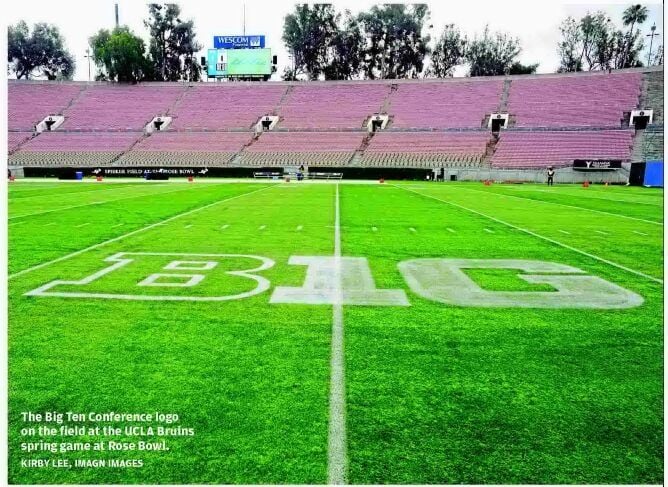
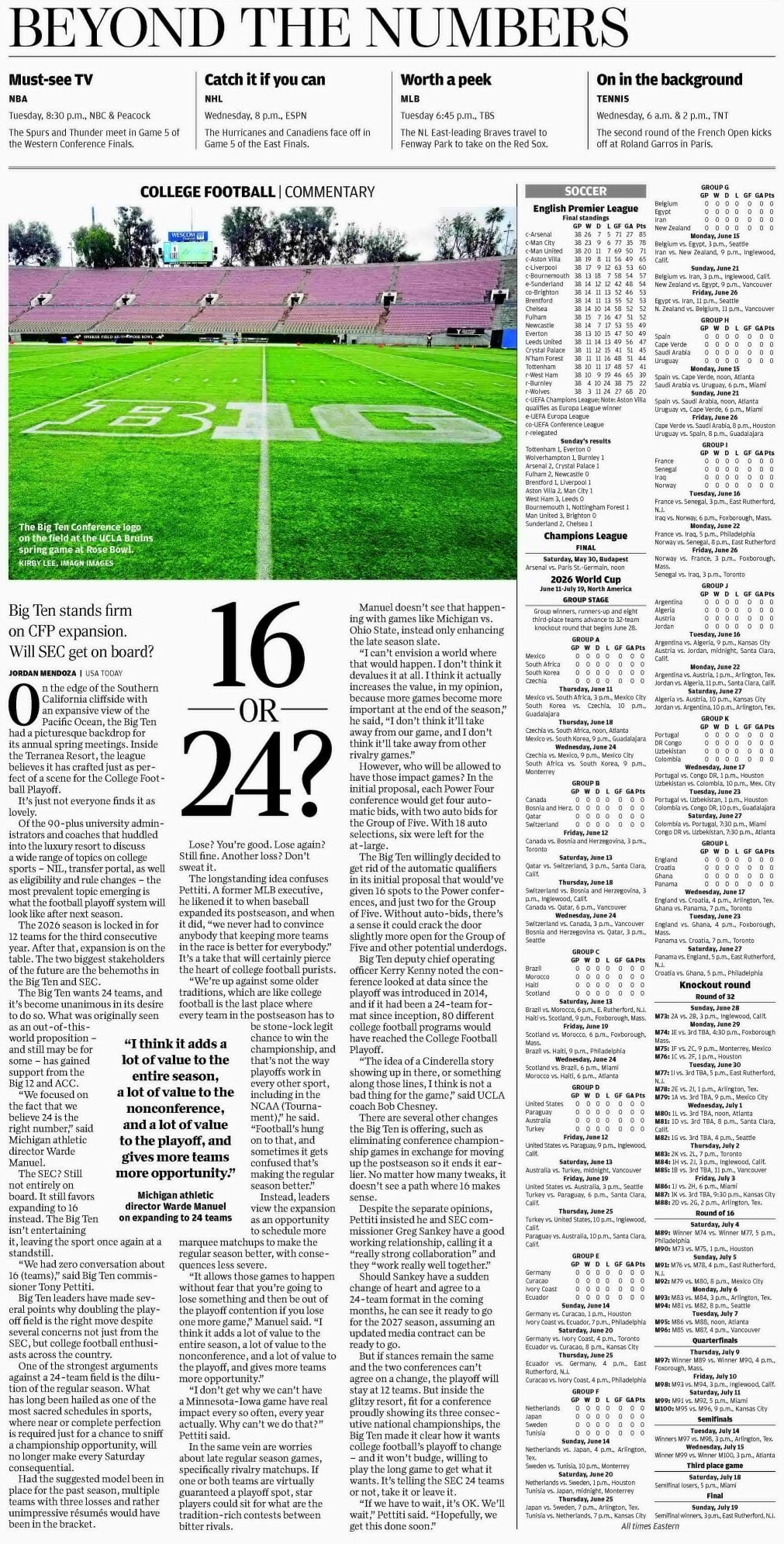
The Big Ten Conference logo on the field at the UCLA Bruins spring game at Rose Bowl.
COLLEGE FOOTBALL| COMMENTARY
On the edge of the Southern California cliffside with an expansive view of the Pacific Ocean, the Big Ten had a picturesque backdrop for its annual spring meetings. Inside the Terranea Resort, the league believes it has crafted just as perfect of a scene for the College Football Playoff.
It's just not everyone finds it as lovely.
Of the 90-plus university administrators and coaches that huddled into the luxury resort to discuss a wide range of topics on college sports – NIL, transfer portal, as well as eligibility and rule changes – the most prevalent topic emerging is what the football playoff system will look like after next season.
The 2026 season is locked in for 12 teams for the third consecutive year. After that, expansion is on the table. The two biggest stakeholders of the future are the behemoths in the Big Ten and SEC.
The Big Ten wants 24 teams, and it's become unanimous in its desire to do so. What was originally seen as an out-of-this-world proposition – and still may be for some – has gained support from the Big 12 and ACC.
"We focused on the fact that we believe 24 is the right number," said Michigan athletic director Warde Manuel.
The SEC? Still not entirely on board. It still favors expanding to 16 instead. The Big Ten isn't entertaining it, leaving the sport once again at a standstill.
"We had zero conversation about 16 (teams)," said Big Ten commissioner Tony Pettiti.
Big Ten leaders have made several points why doubling the playoff field is the right move despite several concerns not just from the SEC, but college football enthusiasts across the country.
One of the strongest arguments against a 24-team field is the dilution of the regular season. What has long been hailed as one of the most sacred schedules in sports, where near or complete perfection is required just for a chance to sniff a championship opportunity, will no longer make every Saturday consequential.
Had the suggested model been in place for the past season, multiple teams with three losses and rather unimpressive résumés would have been in the bracket.
Lose? You're good. Lose again? Still fine. Another loss? Don't sweat it.
The longstanding idea confuses Pettiti. A former MLB executive, he likened it to when baseball expanded its postseason, and when it did, "we never had to convince anybody that keeping more teams in the race is better for everybody." It's a take that will certainly pierce the heart of college football purists.
"We're up against some older traditions, which are like college football is the last place where every team in the postseason has to be stone-lock legit chance to win the championship, and that's not the way playoffs work in every other sport, including in the NCAA (Tournament)," he said. "Football's hung on to that, and sometimes it gets confused that's making the regular season better."
Instead, leaders view the expansion as an opportunity to schedule more marquee matchups to make the regular season better, with consequences less severe.
"It allows those games to happen without fear that you're going to lose something and then be out of the playoff contention if you lose one more game," Manuel said. "I think it adds a lot of value to the entire season, a lot of value to the nonconference, and a lot of value to the playoff, and gives more teams more opportunity."
"I don't get why we can't have a Minnesota-Iowa game have real impact every so often, every year actually. Why can't we do that?" Pettiti said.
In the same vein are worries about late regular season games, specifically rivalry matchups. If one or both teams are virtually guaranteed a playoff spot, star players could sit for what are the tradition-rich contests between bitter rivals.
Manuel doesn't see that happening with games like Michigan vs. Ohio State, instead only enhancing the late season slate.
"I can't envision a world where that would happen. I don't think it devalues it at all. I think it actually increases the value, in my opinion, because more games become more important at the end of the season," he said, "I don't think it'll take away from our game, and I don't think it'll take away from other rivalry games."
However, who will be allowed to have those impact games? In the initial proposal, each Power Four conference would get four automatic bids, with two auto bids for the Group of Five. With 18 auto selections, six were left for the at-large.
The Big Ten willingly decided to get rid of the automatic qualifiers in its initial proposal that would've given 16 spots to the Power conferences, and just two for the Group of Five. Without auto-bids, there's a sense it could crack the door slightly more open for the Group of Five and other potential underdogs.
Big Ten deputy chief operating officer Kerry Kenny noted the conference looked at data since the playoff was introduced in 2014, and if it had been a 24-team format since inception, 80 different college football programs would have reached the College Football Playoff.
"The idea of a Cinderella story showing up in there, or something along those lines, I think is not a bad thing for the game," said UCLA coach Bob Chesney.
There are several other changes the Big Ten is offering, such as eliminating conference championship games in exchange for moving up the postseason so it ends it earlier. No matter how many tweaks, it doesn't see a path where 16 makes sense.
Despite the separate opinions, Pettiti insisted he and SEC commissioner Greg Sankey have a good working relationship, calling it a "really strong collaboration" and they "work really well together."
Should Sankey have a sudden change of heart and agree to a 24-team format in the coming months, he can see it ready to go for the 2027 season, assuming an updated media contract can be ready to go.
But if stances remain the same and the two conferences can't agree on a change, the playoff will stay at 12 teams. But inside the glitzy resort, fit for a conference proudly showing its three consecutive national championships, the Big Ten made it clear how it wants college football's playoff to change – and it won't budge, willing to play the long game to get what it wants. It's telling the SEC 24 teams or not, take it or leave it.
"If we have to wait, it's OK. We'll wait," Pettiti said. "Hopefully, we get this done soon."
"I think it adds a lot of value to the entire season, a lot of value to the nonconference, and a lot of value to the playoff, and gives more teams more opportunity."
Michigan athletic director Warde Manuel on expanding to 24 teams