
Life on the water
Boaters find adventure, community as they sail the Great Loop route

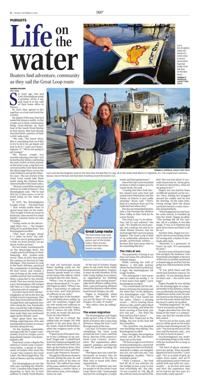
Larry Burmingham holds the America's Great Loop Cruisers' Association flag that hangs from the bow of the Red Pearl.
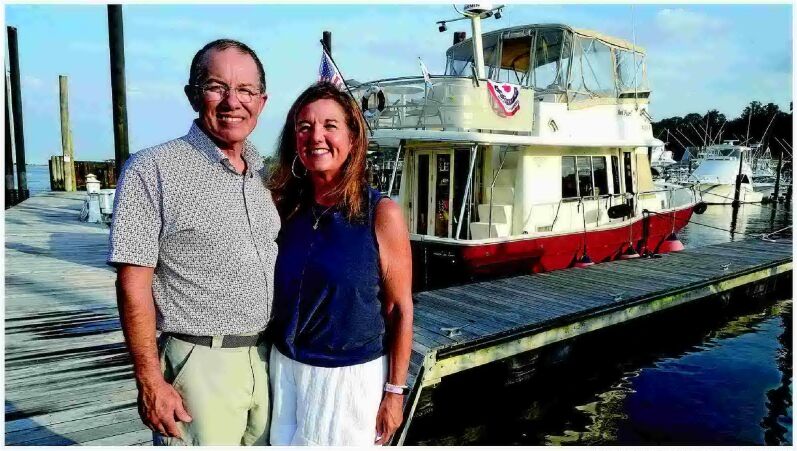
Larry and Dea Burmingham stand on the dock near the Red Pearl on Aug. 28 at the Sandy Hook Marina in Highlands, N.J. The couple from Lawrence, Kansas, live on the boat and have been traveling around the eastern U.S.

PURSUITS
Six years ago, Dea and Larry Burmingham made a promise, wrote it up, and stuck it to the wall of their home office in Kansas.
By 2025, they agreed to live together on a boat and travel the country.
By August of this year, they had made that dream a reality. As the couple sat in their combination living room-kitchen on their boat at the Sandy Hook Marina in New Jersey, they had already transited three-quarters of their 6,000-mile route.
"We said, 'You know what, this is something that we'd like to try to do if we can figure out how to do it,'" said Larry Burmingham, 55. "We're not going to get younger."
The Kansas couple was recently enjoying a few days' rest in Raritan Bay before continuing the next stretch of their journey on the Great Loop, a trip that over several months took them down the Mississippi River, across the Gulf of Mexico and up the Atlantic coast. The last stretch of the Great Loop would take them north along the Hudson River and eventually to the Great Lakes.
"We had a small little runabout ski boat on a lake in Kansas," Dea Burmingham said. "We've had that for 25 plus years, so we've loved being on the water for years."
In 2023, the Burminghams bought a boat — The Red Pearl — that would enable them to spend more time on the water. They bought it from an owner in Kentucky, then moved it to their family's summer home on Lake Michigan.
"Going north on the Mississippi River was … the hardest thing we've probably done," Dea Burmingham recalled.
"This boat averages about 8 ½ miles an hour," she said. "So when you're going against a 4 mile-an-hour current, you go about 4 miles an hour."
For two weeks, traveling north on the Mississippi River, the couple practiced living on their Mainship 400 trawler-style vessel. Then, in 2025, they spent the summer on the boat in Lake Michigan. They learned to cook in the boat's kitchen, practiced the complexities of docking the 40-foot vessel, and created a way of living on the water with satellite internet that would keep them connected to the outside world. That was crucial, because Larry Burmingham still worked full-time as a sales manager for a pharmaceutical company.
On Labor Day in 2025, the Burminghams set off on the first leg of their Great Loop journey. This time, they went south on the Mississippi River and explored river cities along the way. Eventually, they crossed the Gulf of Mexico, traveled around the Florida Keys, then made their way northward again up the Atlantic coast.
They spent their free time fishing, exploring new cities and meeting fellow boaters at various marinas along the way.
"In the boating community, and especially the 'Looper' community, if you're a looper, you're immediately friends," Dea Burmingham said.
Their boat carries a flag for the America's Great Loop Cruisers' Association, a group of thousands of boaters who travel the "Loop" that connects the Great Lakes, the Mississippi River, the Gulf of Mexico and the Atlantic coast.
The Burminghams are not the only ones traveling the Atlantic coast. Canadian John Hagen was preparing to dock his 51-foot sailboat at Sandy Hook Marina to wait out hurricane season before heading south for the winter. The retired surgeon from Toronto spends weeks at a time on his Hanse 508 sailboat, which is named after his wife, Ileana.
"When I was in practice, I'd always dream about it," 71-year-old Hagen recalled. "When I was little, I had bottles of sailboats in my room, and I had pictures of sailboats on my walls."
On rough days at the hospital, he would think about sailing, he said. On vacations, Hagen and his wife would rent sailboats in other parts of the world: Turkey, Italy or Greece, he said. When he could, he would sail and race boats on Lake Ontario.
Now that he is retired, the sailing trips are longer. His wife prefers to fly and meet him at his warm, tropical destinations, when the roughest parts of the trip are over.
"I spent most of the (past) winter in the Caribbean on my sailboat," Hagen said. "I sailed it back from the Dominican Republic last May and sailed to New York City, then up the Hudson River, then through the Erie Canal, and then across Lake Ontario to Toronto."
Though he still returns home to Toronto during the year, he said he spends most of his time on the boat. The sailboat has many of the same comforts of home: air conditioning, a washer-dryer, a dish washer, oven, stove and generator, he said.
At the end of October, Hagen plans to sail south from Sandy Hook toward Hampton, Virginia, to meet up with members of the Salty Dawg Sailing Association, an organization for building friendships and sharing knowledge about offshore sailing. From there, some in the group will head toward the Bahamas while others head toward Antigua, he said.
Hagen is frequently asked questions like: "Why don't you just fly there? It's way, way cheaper. It's safer. It's faster."
"But sailors, they go sailing," he said.
The ocean migration
The Burminghams and Hagen make up just a few of the hundreds of boaters who cruise long distances along the East Coast through much of the year.
Last year, 272 boaters reported completing the Great Loop around the East Coast, said Kim Russo, director of the America's Great Loop Cruisers' Association. The organization offers support, guidance and meetup events for people traveling the Loop.
That figure does not count the thousands of boaters who do smaller portions of the trip on their own or travel with other organizations.
"It's still a relatively rare feat for people to do the entire Great Loop," Russo said. "Some people may just be cruising for a couple weeks and then going home."
One of the trip's most beautiful sections is when Loopers pass by Sandy Hook, she said.
"Coming into New York Harbor aboard your own boat and seeing lower Manhattan and the Statue of Liberty is just really amazing," Russo said. "That's kind of a moment that can't be replicated anywhere else."
She also recommended boaters take a trip through the Hudson River Valley in New York for its scenic beauty.
The Great Loop "is an adventure, but it's not arduous," she said. "It's doable for most people. You could go out and try to climb Mount Everest, but for most people that's not ever gonna happen. The Great Loop is kind of an achievable adventure for people, particularly retirees … because they have more time to do something like this."
The risks at sea
The popularity of living at sea does not mean the adventure is without danger.
While crossing the Gulf of Mexico, a 180-mile journey where the Red Pearl traveled just 8 mph, the Burminghams hit rough weather.
"We anticipated 1-foot waves and we ended up having 3to 4-foot waves that night," Larry Burmingham recalled.
"You could barely tell the difference between the horizon and the water line" in the darkness, Dea Burmingham said. "Then you hear the Coast Guard (on the radio). There's a missing vessel. … We're hearing those distress calls, and it's pitch black and we're rocking, and when the boat's moving at that level, you just stay put. … You drive the boat and you don't move."
While they stayed put in the bridge, the rest of the boat fell into shambles.
"The furniture was knocked over and things were falling," Dea Burmingham recalled.
Then, the lights, the navigation system and all the electronics went out on the boat.
"We have an app on our iPad so we have redundancies, and we hit such a big wave that our iPad fell. And all of a sudden, our autopilot was out, our radio was out," Dea Burmingham recalled. "We're starting to panic."
"Then I realized … the iPad had hit all of our switches (in the bridge) in just a way to just turn everything off," she said. "It was a matter of, 'OK, flip all the switches back on and we'll be fine.' But you had about 15 seconds of pure fear of, 'oh my gosh, we have no electronics, what are we going to do?'"
Hagen, too, has had his share of difficult moments on his vessel. Once, fishing net wrapped around his rudder and he lost his steering. At the same time, strong swings blew the Ileana eastward toward a rocky shoreline along Barbuda.
"What happened was the boat, for some reason, it rounded up into the wind," Hagen recalled. "The netting fell off the rudder. All of a sudden, it was like magic, it was as if Neptune had gone down there and taken it off for us."
Another time, Hagen was trying to outrun an incoming storm by turning into a harbor in Bermuda after dark.
"Bermuda is a graveyard of boats," he said. "It's surrounded by reefs."
He had a team of friends to help him navigate the darkness. One friend held a flashlight at the bow of the boat as another monitored a channel app on an iPad, but the going was still treacherous in the dark.
"It was pitch black and the storm had started to come in," he recalled. "It was blowing about 26 knots and … the waves were huge."
Hagen thought he was aiming for the flashing light of a channel marker in the darkness, but he was accidentally steering toward a lighthouse on the rocks, he said. His friend on the iPad was able to see the way more clearly and steer the boat to safety, he recalled.
"Nothing happened," he said, "but it was pretty exciting."
Hagen described his love for being on the water as a compulsion, one that lies outside of his full control.
"You're out on the ocean, and you're a little speck on the water and the wind's blowing nicely," he said. "You look up and you see the stars and the heavens, and … you just feel so much at peace."
Dea Burmingham, too, wants to continuing living on the water with her husband for as long as possible.
"We kind of pinch ourselves every day and go, 'Wow, we really figured out how to do this,'" Larry said. "For us to kind of pick up stakes from home, and we've still maintained contact with our (adult) kids and with our community … to do that and work and have the experience that we've had for the last year, it's been really, really special."