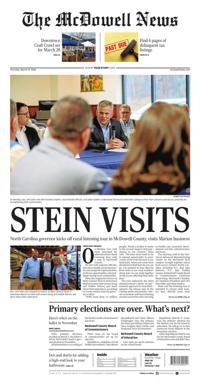

STEIN VISITS
North Carolina governor kicks off rural listening tour in McDowell County, visits Marion business

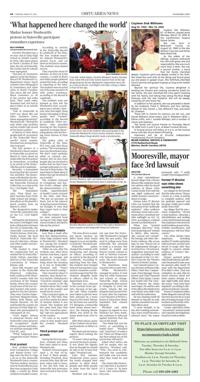
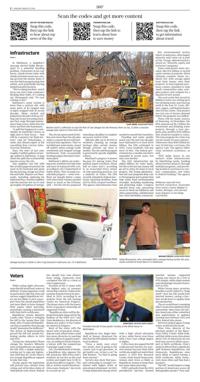
Monday, Gov. Josh Stein met with business leaders, local elected officials, and other leaders at McDowell Technical Community College to hear their concerns and discuss priorities for engthening their communities.
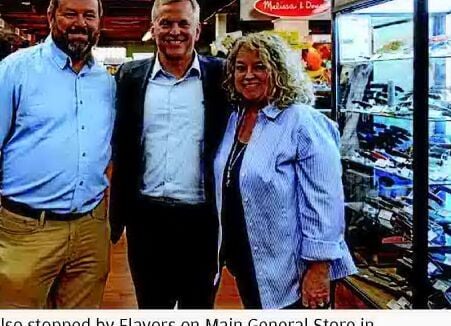
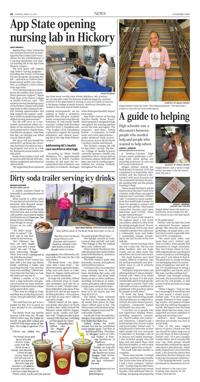
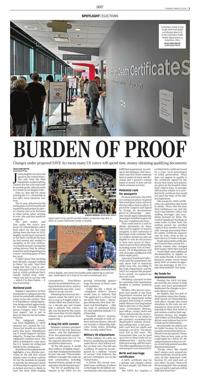
Gov. Josh Stein also stopped by Flavors on Main General Store in downtown Marion to meet with owners Doug and Debbie Watson and learn about their experience.
On Monday, Gov. Josh Stein launched his administration's Rural Listening Tour with a stop in McDowell County.
He met with regional officials, educators, health care professionals and nonprofit representatives to discuss opportunities and challenges facing rural communities.
Stein also stopped by Flavors on Main General Store in downtown Marion to meet with owners Doug and Debbie Watson and learn about their experience, according to a news release from the governor's office.
"With more than 3.5 million people, North Carolina is home to the second-largest rural population in the country," Stein said. "We have more work to do to expand opportunity to every corner of the state because if you work hard, where you come from should never limit how far you can go. I'm grateful to hear directly from some of our rural residents about how we can work together on the issues affecting their daily lives."
The tour represents the Stein administration's whole-of-government approach to rural development, the release said. In the coming weeks and months, cabinet secretaries will host listening sessions across the state, focusing on health care, economic development and jobs, infrastructure, and more.
The meeting, held at the Universal Advanced Manufacturing Center on the McDowell Tech campus, brought together voices from across western North Carolina, including N.C. Rep. Jake Johnson, N.C. Rep. Dudley Greene, Rutherford County Board of Commissioners Chairman Bryan King, McDowell Chamber of Commerce President and CEO Kim Effler and other leaders.
Stein said the listening tour is intended to ensure state leaders hear directly from rural communities about the issues shaping their future. His office coordinated all invitations to the event.
"We want to have a conversation with rural residents and rural leaders to hear how we're doing when it comes to economic development, job growth, health care, education and public safety," Stein said.
The McDowell County meeting was the first of approximately a dozen listening sessions planned across North Carolina, according to a news release.
Workforce development and economic growth
Workforce development emerged as a central theme throughout the discussion, with many emphasizing the importance of strong partnerships among community colleges, K-12 schools, local businesses and industry leaders.
While acknowledging that he is always looking for ways to improve, Stein noted that North Carolina's workforce training system has a well-deserved reputation as a leader in workforce development.
"Site Selection magazine ranked North Carolina No. 1 in the country for workforce development," he said.
Several comments highlighted the importance of programs that allow students to earn industry-recognized credentials and wages while completing their education, and Stein pointed to examples across the state where students are gaining technical skills and credentials, even at the high school level.
"They are learning and doing academic classes so they get their high school degree, but they're also learning technical skills," Stein said. "And they're getting paid while they're doing it."
Local economic development advocates also emphasized the need to support companies already invested in the region.
"It's just as important to take care of the people that are here as it is to attract new industry," said J.W. Kelley, president at McDowell Tech, while discussing the investments several major manufacturers have made to remain in McDowell County following Hurricane Helene.
Housing availability was also raised as an emerging workforce issue, particularly for younger workers and new employees relocating to the area.
Infrastructure needs
Infrastructure challenges were repeatedly cited as major barriers to rural economic growth.
Officials and regional planners pointed to the importance of water and sewer systems, broadband connectivity, electrical capacity and transportation improvements to support both existing employers and new business recruitment.
Stein concurred with those assessments, emphasizing the importance of foundational infrastructure investments.
"Water is life," he said. "If you don't have water, ain't nothing going to grow."
Reliable infrastructure, attendees noted, is critical not only for business expansion but also for housing development and long-term community growth, according to the news release.
Health care and mental health
Health care providers and public health officials described increasing strain on rural health care systems, particularly due to an aging population and workforce shortages.
Dr. Amy Russell, chief medical and population health officer at Mountain Area Health Education Center in Asheville, referred to the demographic trend affecting rural communities as a "silver tsunami," describing the growing number of seniors who require care, especially among residents moving to western North Carolina from other states.
Behavioral health services were also highlighted as an urgent need.
Community advocate the Rev. Phillip Cooper, founder of Operation Gateway, emphasized the importance of addressing mental health challenges earlier and strengthening community-based support systems.
"Mental health is health," Cooper said during the meeting. "If everybody who needed it was to try to get behavioral health services today, they wouldn't get it. There's already a shortage."
Cooper also pointed to the need to grow and expand opportunities for rehabilitation and workforce development through reentry programs.
"Over 95% of the people that are in prison have a release date," he said. "If we connect people with training and opportunity, we can empower people and empower communities."
Education and talent development
Strong schools and teacher recruitment and retention were quickly identified as essential to the future of rural communities.
Stephen Fisher, superintendent of Cleveland County Schools, noted that school systems often serve as the largest employer in rural counties.
"In rural North Carolina, the public education school system is often the largest employer in the county," Fisher said.
"Unfortunately, teaching has become, instead of a profession of choice, a profession of last resort too many times," he added. He indicated that the system of teacher pay and recruitment needed a top-to-bottom overhaul if the state wanted to be competitive in teacher recruitment and retention.
Stein quoted several statistics where North Carolina is currently at or very close to the bottom in emphasis on public education, particularly teacher pay and recruitment.
Several comments highlighted the importance of expanding partnerships between public schools and community colleges, allowing students to explore careers and earn college credit while still in high school.
Public safety and community stability
Greene, himself a retired McDowell County sheriff, discussed recruitment challenges for police and emergency personnel, as well as the need for stronger reentry programs for individuals returning to their communities after incarceration, a position also advocated by Cooper.
There is an interconnectedness among the region's needs, and strengthening various public safety programs, attendees noted, can also help individuals gain employment and rebuild their lives, according to the news release.
Continuing the conversation
The consensus among the group was that if real results are going to come out of these rural listening sessions, there must be collaboration among leaders in government, education, industry and nonprofits.
As one participant put it, "We all have to do it together if we're going to see our communities be vibrant."
Stein's Rural Listening Tour will continue across North Carolina in the coming months, providing additional opportunities for rural communities to share perspectives and ideas with state leaders, according to the news release.
For more information, visit governor.nc.gov/ investing-rural-nc.