

World Cup visitors gush about the US
It's a good reminder that America's divisions aren't nearly as bad as our politics suggest
ANOTHER VIEW | BOSTON HERALD
'The World Cup didn't need America, but America needed the World Cup."
That's the view from one of many on social media acknowledging the international visitors here for the World Cup who, in their own posts about discovering the people and culture of the U.S., have reminded us of all that's great about this country.
World Cup visitors have injected hosting cities with infectious enthusiasm, soaring spirits and camaraderie. Thanks to the Tartan Army's takeover of Boston, we understand the power of the rallying cry "No Scotland, no party."
We love these guys. Can we make all of Scotland a sister city?
And the feeling is apparently mutual. World Cup visitors from Scotland and other countries have expressed surprise and delight as they've toured different states.
A Frenchman marveled at the size of Costco and the vast amount of goods for sale. Brits extolled Southern hospitality. Japanese visitors were startled that chips and salsa came free with their meal. So many new to our shores have been blown away by our food, from Texas brisket to Kansas City ribs to hamburgers to dipping fries in a milkshake.
But it's not just our food. When the Instagrammer
Shaun Alexander was asked what he liked best about America, he replied: "Absolutely the people. Whenever I've come here the people are so warm and generous. The people here across different states living in different parts of America, different beliefs, different politics, I've always met really kind and generous people here."
He's talking about us. And in a country where political divisions have been hyped into a frenzy, having people from outside point out the best of ourselves has been a refreshing wake-up call.
Joshua Cauldwell, a Brit who's visited the U.S. for years, posted on Instagram: "People who aren't American who have traveled to the World Cup are realizing they've been lied to. Before traveling to America, foreigners would just think America is just this place they would hear about on the news all the time, it's a horrible place. But when you strip that back, like I've been doing for years, traveling America … you realize the beauty of America. The different cultures, how amazing the people are, and the World Cup has allowed people outside of America to see America through their own eyes, not through their country's media's eyes."
Thanks to these visitors, we have a chance to see ourselves through fresh eyes as well.
The "us v. them" mentality suits political parties keen on firing up their base. Painting the opposition as the enemy of all that's good in America may get votes, but it erodes the social fabric that ties us together. That is, until visitors from around the world hold up a mirror to who we really are.
It's not just our breathtaking national parks, nor the vastly different landscapes, accents, cuisine and culture. It's who we are as a people.
That transcends politics. America is "we the people," and as the country approaches its 250th birthday, it's a welcome reminder.
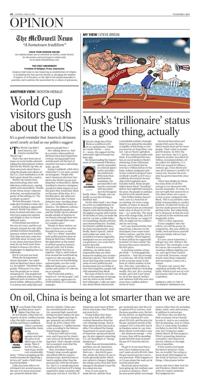
Musk's 'trillionaire' status is a good thing, actually
JONAH GOLDBERG
I am not a huge fan of Elon Musk as a political activist or commentator. I think he's made Twitter — sorry, X — worse. His support for the nationalist right in Europe has been ugly.
His tenure leading the Department of Government Efficiency mostly amounted to a missed opportunity and often descended into little more than performative vandalism. His personal life is not exactly consonant with my preference for bourgeois family values. Though, one can hardly accuse him of being a deadbeat dad.
On the other hand, I am a huge fan of his accomplishments in business and engineering. He helped create the foundations of the digital economy with PayPal. At the helm of Tesla, he made the electric car into a viable industry (something climate activists once lionized him for). Starlink, his internet satellite business, has been transformative. And, finally, there's SpaceX, which went public last week. It's a testament to human ingenuity, immigrant success and American greatness, on a scale that is hard to describe.
If Musk is successful in his ambitions, he will be more responsible than any other human for making ours an interplanetary species. That would mean that long after nearly every name of every politician and businessman you can think of have been forgotten, people will still remember Elon Musk.
But none of that is very relevant to the explosion of outrage over his status as the world's first trillionaire. I offer my opinions about Musk only because a remarkable number of people think if you defend the morality or legality of him being so rich you must be on Team Elon. I am not. I am on Team Capitalism.
But the confusion hardly ends there. If you followed the reaction on social media to Musk's shattering of the trillionaire barrier, you'd think that he now has a trillion dollars in the bank. Indeed, indignant politicians rushed to propose taxes on Musk's wealth as if it was a suddenly discovered treasure ship (with laughably questionable math). Many people talked about Musk "hoarding" dollars that rightfully belong to the poor, the people or perhaps Social Security beneficiaries.
That trillion dollars doesn't exist, save as a function of accounting. He owns a large number of shares in SpaceX. Those shares have an estimated book value of about $1.03 trillion — as I write this. The stock price will change daily, and if it dips in the future, as I expect it will, he might not be a trillionaire for very long.
Let's say, heaven forbid, that SpaceX has a disaster on the launchpad, loses some major NASA contract, and the stock price tumbles. What happens to those dollars he supposedly hoarded? Do they vanish? No, because they never existed in the first place.
A shocking number of people think — or demagogically pretend to — that the economy is a static pie. All of the wealth in the economy exists in the form of a finite number of dollars. This zero-sum fallacy is why people think he's hoarding wealth. He's not. He's creating wealth, and I don't just mean for all of the SpaceX welders and cafeteria staff who now own more than a million dollars' worth of stock.
Increased innovation and productivity grow the pie, which means more pie for more people. That's what economic growth means. In 1969, the year I was born, the U.S. gross domestic product was about $1 trillion, in nominal dollars. (If you adjust for inflation, U.S. GDP was around $1 trillion a century ago.) Does Musk now own all of America's wealth? Of course not, because the economy has grown massively since then.
Other than dislike for Musk, the main driver of all this outrage is our obsession with income inequality. To some, it's just not right that anyone be so rich when others are so poor — or feel so poor compared with Musk. This is an aesthetic complaint masquerading as a policy position. In objective terms, no one was made poorer by Musk getting richer. But subjectively, we're all poorer in that the richest person in the world became marginally richer.
That's a vibes argument. If your neighbor wins the lottery, you will be poorer in comparison. But your ability to clothe, feed and house yourself and your family will not have changed.
If I cure cancer tomorrow, I will get very rich. Where's the injustice? The world gets a cure for cancer, the economy saves countless billions fighting cancer, and I get to buy a bunch of cool stuff. Everyone, except maybe some drug companies and oncologists, comes out a winner.
I'll never cure cancer. But capitalism probably will, eventually. Which is just one of a trillion reasons why I am on Team Capitalism.
Goldberg is editor-in-chief of The Dispatch: thedispatch.com.
On oil, China is being a lot smarter than we are
FROMA HARROP
We can thank China that gasoline prices aren't higher than they are. By last month, China had cut imports of oil by 3 million barrels a day, the daily consumption of Italy and France combined.
China's economy, meanwhile, hums along.
Americans agonize over how the price of oil affects gas at the pump. Were it not for China, a tank of gas would cost considerably more. "China is propping up the world economy by importing a lot less oil," reads a Wall Street Journal headline.
China has been able to cut oil imports for several reasons, but one is its move away from gas-powered vehicles into electric vehicles. China also has invested heavily in electric-powered high-speed rail, letting travelers replace oil-guzzling short flights and trips in gas-powered cars with train travel. By 2030, China's EVs could displace 2.7 million barrels a day, according to the International Energy Agency.
If the war with Iran is truly over, and it may not be, Americans' price of oil should be coming down. That's already started, but economists warn that the decline will be slow.
Thus, President Donald Trump's long crusade against electrified vehicles and promotion of gas-powered ones is hard to explain other than his personal ties with the oil industry. The U.S. is producing more fossil fuel, but much of it is being exported to other countries willing to pay a lot for it. Get this: If Americans want more of their fuel to stay home, they'll have to pay more for it.
Trump hollers that Americans must drill, drill, drill to cushion themselves from the cost of foreign energy. And so what did he do first day back in office? He ordered the Energy Department to restart exports of American-produced natural gas. He also supports exporting U.S. oil, branding it as "energy dominance."
Other than environmentalists, and bless you all, Americans tend not to care what powers their cars — electricity, gasoline, whale oil. Buyers of cars or trucks generally prefer whichever option is cheaper. Happily, the energy source that does least damage to the planet is now the less expensive one.
True, it costs more to make electric vehicles than gas-powered ones. But the cost to operate EVs is a lot less. And the more gasoline costs, the better the electric car deal becomes.
A Chevy Equinox EV costs about $35,000, and the price for the gas-powered version of the compact SUV is $30,000. But if an Equinox owner in, say, Iowa drives about 11,000 miles a year — the American average — over 10 years, they will be spending nearly $10,000 more to power the gas SUV than the electric one.
We get it. If you must have a new Chevy Equinox now and can't spare an extra $5,000, then the gas version may be a necessary purchase. What happens 10 or 15 years down the road can be worried about later.
Electricity prices had also been going up, but nowhere near as much as oil prices. That's because power plants use energy sources other than oil, including hydro, wind, solar and nuclear, in addition to natural gas.
But those who can plan for their economic future should be onto it. And so are countries that do planning, such as China. The U.S. tried under President Joe Biden to electrify the economy, but Trump has undermined almost all that progress. What's promoting American consumers' new interest in electric vehicles is the high price of gasoline.
If this country had made the kind of advances China has, we wouldn't be caring so much about what happens in the Strait of Hormuz. On some things, China knows better.
Harrop, who lives in New York City and Providence, Rhode Island, writes for Creators Syndicate: fharrop@gmail.com.