
Target tries to regain consumer trust

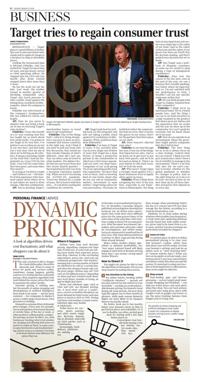
Target CEO Michael Fiddelke speaks last week at Target's Financial community Meeting at Target headquarters in Minneapolis.
MINNEAPOLIS — Target plans to spend billions of dollars this year to end a persistent sales slump and to regain its image as a fun place to shop at affordable prices.
Guiding the turnaround plan is Michael Fiddelke, who has worked for Target for more than 20 years and previously served as chief operating officer. He stepped into the CEO role last month after Brian Cornell stepped down after more than 11 years.
He has his work cut out for him. Last week, the retailer turned in another quarter of declining comparable sales. Target also faced pressure to take a public stand against the immigration crackdown in Minneapolis, where the company is based.
Fiddelke was interviewed at the company's headquarters; this was edited for clarity and length.
AP: How do you prove to skeptics that you bring a fresh set of eyes to reversing Target's sales malaise?
Fiddelke: I have the benefit of a 23-year running start that has taught me so much about how retail works. I've gotten to see Target at its very best. I've gotten to see us when we are not at our very best, and that leads (to) a real clear view for me of when we're hitting on all cylinders. It means even being candid on the stuff that I had my fingerprints on. I was COO for two years. I was CFO for some times that were great, and some times that weren't.
So as long as I'm able to couple — and I believe I can — the benefit of that experience with cleareyed candor about where we're at and where we need to drive change, I like that combination.
AP: You're pushing Target's merchandise buyers to travel more to get inspiration?
Fiddelke: One of the things that's critical to being designled is you have to have an environment that fosters creativity in the right way. And I think if you were to pull any buyer into this discussion, they would say that outside stimulus of what's different, what did I just see, that can often come in travel to other markets. The Alpine Chalet that you saw in our stores just this recent (fourth quarter) — the inspiration for that was from a European Christmas market trip. Where we lost it was during the (COVID-19) pandemic. Travel was limited for a couple of years. We're back to full form now. … it's all about creating the conditions for creativity.
AP: Target took heat for pulling back on DEI programs and now not taking a public stand against ICE crackdowns in Minneapolis. What could have been done differently?
Fiddelke: I've been at Target 23 years. It has certainly been true in every single one of those 23 years that Target has a deep history of being a productive partner in the communities in which our 2,000 stores operate. And our roots run deep there.Companies of our scale giving 5% of our operating profits back into community. You don't find a lot of those. And so knowing kind of core truths about who we are, our role in community, matters. Investment in team matters. Target being a place for everyone matters. The teams we build that reflect the communities that we serve, that's true for the guests in our stores, that's for the partners that find a place on our shelf.
AP: Have boycotts affected your sales?
Fiddelke: As we went through last year, it was one of the things that impacted our sales. And so we know we've got trust to win back with guests, and we'll be focused on doing it. There's no easy button to win back trust, but we'll do the work.
AP: Why hasn't Target taken a stronger stand against ICE? I know businesses have to legally allow agents in stores.
Fiddelke: When I think about navigating the start of the year here, especially in our hometown in Minneapolis, the thing that we have kept front and center every single day is the safety of our team. And so the safety of the team and the safety of our guests has been our North Star for decision making, and that's guided every decision that we've made.
AP: Has Target seen a pullback of Hispanic customers as some are too afraid to shop during a time of immigration crackdowns?
Fiddelke: Even over the course of the last year, even at the end of the year, we saw a business that, broadly speaking, was below where we expected. And so, I'm not satisfied with our performance in total. I wouldn't call out any specific subgroups within that.
AP: Do you think people hold Target to a higher standard than other companies?
Fiddelke: I think we're an emotional brand. We're a brand people love. And the thing I can say is we hold ourselves to a high standard in the product that shows up on our shelves and the experience that we create and the way we show up in the community. So I can't speak for everyone, but we know where we're focused.
AP: How do you operate in an environment where the president might punish companies that don't fall in line?
Fiddelke: The best thing for us to do is always focus on a clear strategy. Control what we can control. I think over the past several years, there's been a lot of volatility to manage in the environment. There's a lot that falls into the we-can't-control-it bucket, whether it's the global pandemic or whether it's changes in policy. And so the right thing for us to do is to be laser-focused on how do we best show up for all those families and guests that depend on us every day.