

Transplant revolution
New developments led to more donations but concerns remain
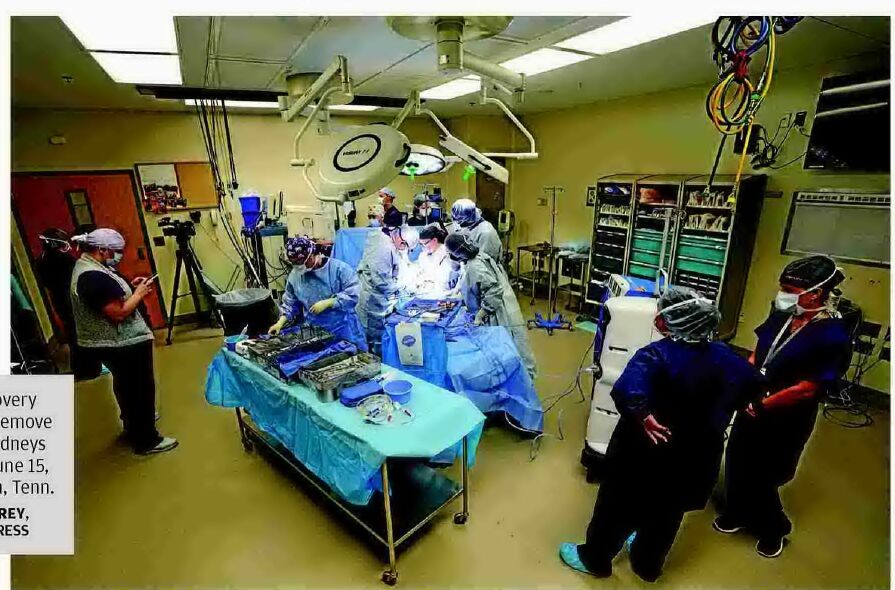
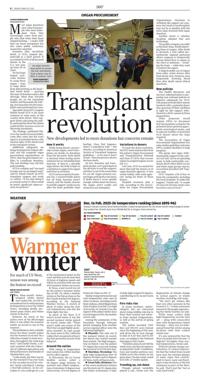
An organ recovery team works to remove the liver and kidneys from a donor June 15, 2023, in Jackson, Tenn.
ORGAN PROCUREMENT
Most organ donations once came from peo-ple who were brain-dead. Now, they increasingly come from people who died when their heart stopped beating — a major shift that can boost transplants but also raises public confusion, researchers reported.
Donation after circulatory death, or DCD, jumped dramatically in a short period: It accounted for 49% of all deceased donors in the U.S. last year, up from 2% in 2000.
Technology helped overcome barriers to using those organs — ways to keep them from deteriorating as the heartbeat winds down — spurring this type of donation amid a dire shortage. More than 100,000 people are on the transplant waitlist and thousands die waiting. Just more than 49,000 transplants were performed last year.
Specialists from NYU Langone Health found DCD is far more common in some parts of the country than others. That suggests better educating the public and hospitals about the option could further increase access to lifesaving transplants.
The findings, published Feb. 26 in the medical journal JAMA, came after some rare but scary reports of potential donors who showed signs of life shook trust in the transplant system.
Additional safeguards are being developed by federal officials and the nonprofit organ procurement organizations, or OPOs, that the government certifies to coordinate donation. The new findings may aid that policymaking.
DCD is complex and "we need to make sure we are doing it well," said Dr. Babak Orandi, an NYU transplant surgeon and study co-author. "If we stop doing it or severely restrict it, there would be pretty significant repercussions for patients."
How it works
While living donors can provide certain organs, most transplants are thanks to donations from the deceased. Brain death is declared when testing shows someone has no remaining brain function. If they're a possible organ donor, the body is kept on a ventilator to support the organs until they're retrieved.
DCD can be an option if someone has a nonsurvivable injury but all brain function hasn't ceased, and the family chooses to end life support. Death occurs after the heart gradually stops beating. Once that happens, there's a mandatory wait — five minutes, according to American Society of Transplant Surgeons guidelines — to be sure it won't restart. Then the person's doctor declares death.
By law, donation and transplant groups can't participate in the decision to end life support, and they're not in the room when it's cut off.Organ retrieval cannot begin until death is declared. If death doesn't occur quickly enough, within about two hours, the organs aren't usable and retrieval is not attempted.
Variations in donors
To track the donor evolution, the NYU team analyzed data from the nation's Organ Procurement and Transplantation Network and from 55 OPOs that recover organs in assigned regions across the U.S.
Last year, DCD accounted for more than half the donors at 24 organ donation agencies. It also varied widely, with some agencies seeing far fewer of those donors.
Hospital resources play a role, according to the Association for Organ Procurement Organizations. Decisions to withdraw life support are common, but small or rural hospitals may not be as familiar with the extra steps involved with organ donation.
Another factor is whether hospitals adopted that new technology.
The quality of organs can suffer as the heart stops, briefly depriving them of oxygen. After death is declared, a tool called normothermic regional perfusion allows surgeons to temporarily restore blood flow to organs in the chest or abdomen — avoiding the brain — while they work to remove the organs.
It helped enable use of organs from older, sicker donors after their hearts stop. However, even temporarily restoring blood flow after death raised ethical questions.
New policies
The Health Resources and Services Administration is preparing new national policies to improve safeguards for DCD. One proposal would allow anyone involved with a potential donor who questions if their condition is right for life-support withdrawal to call for a pause in those preparations.
Other proposals would require OPOs to document that the hospitals caring for the potential donor perform appropriate neurological exams, and to educate families of potential DCD donors about the steps required.
The Association of Organ Procurement Organizations has some similar guidelines and some OPOs created checklists to help hospitals.
The group also urges withdrawing life support in the critical care unit, not in an operating room, to help avoid public confusion about when death occurs and when organ groups step in, association president Jeff Trageser said.
DCD "requires a lot of buy-in from the community, including the local hospitals, to make this happen," Orandi said. "A couple of cases out of many, many cases has led to a loss of trust."