

North-carolina
NFL
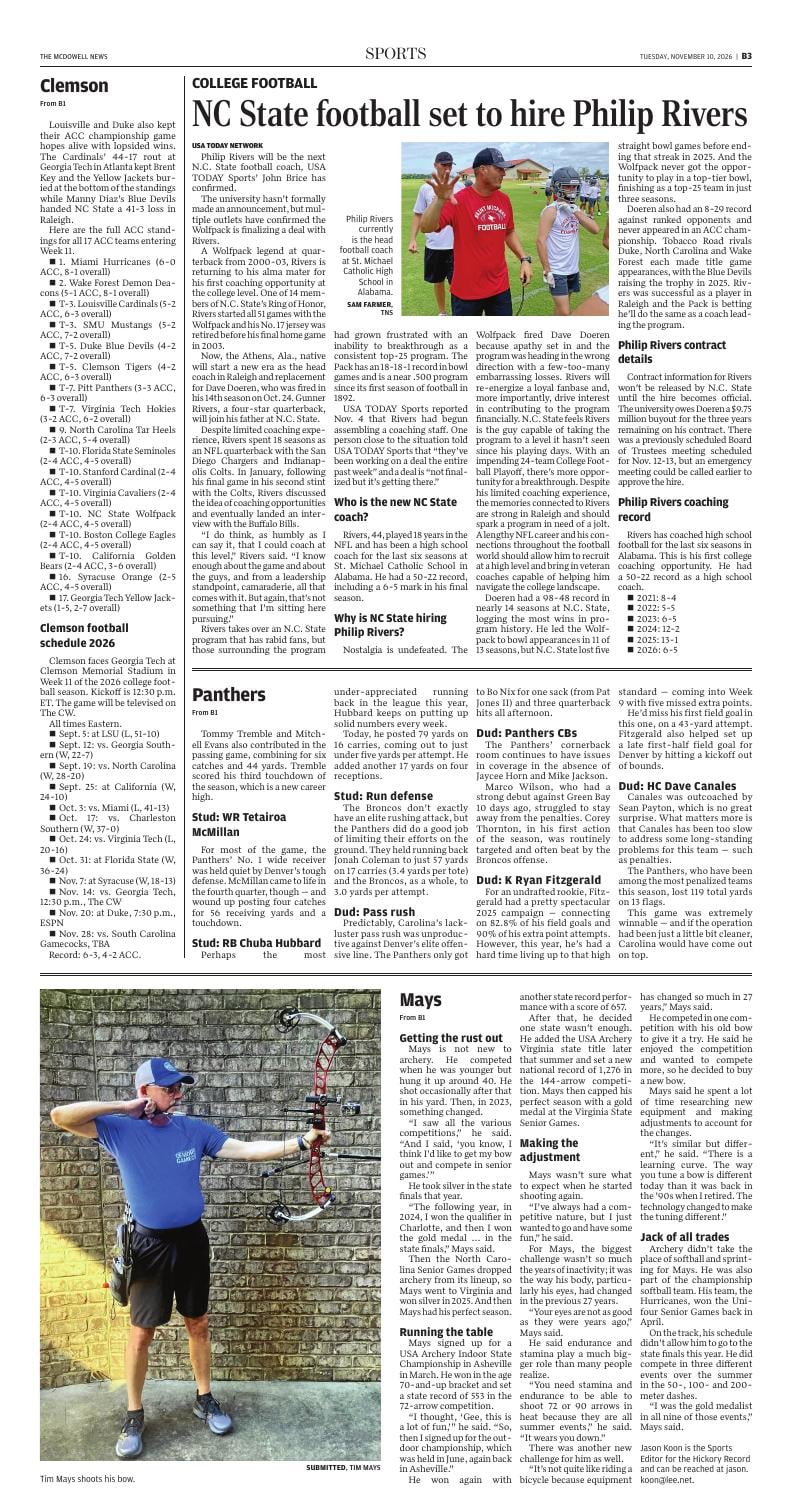
Did Broncos get away with key non-calls in their Week 9 win over Carolina Panthers?

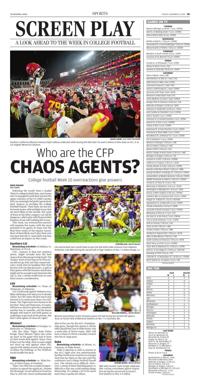
Carolina Panthers quarterback Bryce Young (9) reacts during the second half against the Denver Broncos on Sunday at Bank of America Stadium.
Sure, the Carolina Panthers didn't play the cleanest game in their Week 9 loss to the Denver Broncos. But they certainly didn't get any help from all the dirty laundry, or lack thereof, from the officials on Sunday.
The most egregious call, or non-call, came late in the third quarter with the Panthers up 14-13. Odd play-calling aside, an incompletion on a first-and-goal from the Broncos' 1-yard line would be controversially overturned into an interception on what many initially believed to be a late challenge by head coach Sean Payton.
As it turns out, the red flag did come out before the next play from Carolina was run. What really should be in question is what the refs were seeing when Panthers tight end Tommy Tremble was interfered with by linebacker Justin Strnad …
From there, Denver went on a 13-0 run off back-to-back touchdown drives to keep the game out of reach.
Tremble was asked about the play after the 26-21 defeat …
On top of that, the Broncos were not penalized for ripping off the helmet of tight end Felipe Franks nor for a few very late hits by linebacker Alex Singleton. Oh, there was also this one — on the Panthers' last breath of the contest — in the fourth quarter …
The Panthers did wind up getting a first down on this particular play, so that miss wasn't incredibly damaging. It was the next snap, which resulted in a strip-sack of quarterback Bryce Young, that did them in.
By day's end, Carolina was flagged 13 times for a total of 119 yards. Denver, meanwhile, drew eight whistles for 50 yards.
Ultimately, however, the Panthers made too many of their own mistakes to pin this one solely on the refs.
'Quad God' evolved
Malinin returns to the ice a changed skater
When did Ilia Malinin realize he loved figure skating?
Evidently, on the day that "will forever be known as the worst day of my life."
Everyone saw the "Quad God" shockingly fall apart during the 2026 Winter Olympics, not winning a medal in men's singles — a result few saw coming. While everyone tried to figure out what happened to the gold-medal favorite and wondered what was next for him, the 21-year-old truly found solace in the unraveling.
"It really showed that I truly care about this sport, and I'm not doing the sport just because I want the medals, or I need the prize money, or I need the records, or I need some kind of name," he said. "I just keep doing it because it's my passion. It's my inspiration. It's the thing that keeps me going every day."
Keep going he will.
After winning another world championship and spending the spring and summer skating freely on the ice across the country, Malinin has geared up for a new season, using that experience to power him into this vastly different person from nine months ago. He will kick off his 2026-27 slate at Skate America, Nov. 13-15 in Everett, Washington.
In his first media availability of the season on Thursday, Nov. 5, Malinin was asked several times about what unfolded in Milano-Cortina. A believer of everything happens for a reason, he still has no regrets regarding the events that led up to and occurred during the Olympics, seeing it as something "that I needed to go through to get the experience, to get all the nerves, get all the experiences, the opportunities out" of what was a pressure-packed season.
All of it has made for a vastly different approach this time around. Instead of trying to live up to expectations, Malinin wants to challenge himself and improve.
The skater described his approach to 2026-27 as "trying to have the hardest programs in the world," noting they are stepups technically and artistically. He sought difficult transitions, trying to test his abilities on the ice. He has spent the past two months ramping up his training for Skate America, and during that process, one thing was clear: this was the most fun he's had skating in the past four years.
"I definitely have surprised myself with the programs this year," he said. "I know that 100% that I would not be able to pull any of these programs off if it were done a few years ago."
Whether it's his demeanor or his words, it's easy to tell this isn't the same Malinin from before. The outside standard remains for him to win every competition, but his handle of it differs, learning from everything he goes through to become a more knowledgeable skater.
It makes you wonder if we have entered a new stage of Malinin. He became a star through the "Quad God" nickname, dazzling audiences with his famed quadruple Axel no skater could match. While the move likely stays in his arsenal (he hasn't given any indication of what elements he will perform), the "Quad God" persona he owned came from a youthful and whimsical personality.
Malinin is still young, but he appears to have matured overnight. Is this a new version of the "Quad God," or something different?
"I would say that it's definitely a mix of both," Malinin said. "The best way to describe it is definitely an evolution of someone that I could possibly be, but also, just from everything that I experienced from my career, from my life has really just changed everything, kind of almost rewired my brain and rewired my perspective on life. Everything just feels like not necessarily new, but it feels like a little more foreign."
The new stage of Malinin sets up him for another successful campaign, all leading toward a fifth consecutive U.S. title and fourth consecutive world championship. There's great importance at Skate America, which should show him how his conditioning handles the program, how audiences perceive it and how he responds to any pressure. From there, it's refining and tweaking parts of it.
It's the start of a grueling cycle, yet Malinin still has excitement. While expectations remain, he's not focusing on placement or awards like he spent the years leading up to the Olympics, trying to validate his quick rise up the sport. Instead, he's going to ride the roller coaster of it with happiness, actually enjoying the skating.
All thanks to that day where everything changed, setting up Malinin on a quest toward enjoying the journey that kicks off the road to the 2030 Winter Olympics.
"I believe I want to go to bigger and greater heights," Malinin said. "I think this is really just the start and the stepping point for what's to come next."
"I definitely have surprised myself with the programs this year. I know that 100% that I would not be able to pull any of these programs off if it were done a few years ago."
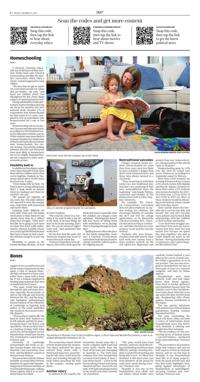
Ilia Malinin, U.S. figure Skater
Hamlin survived, de Miguel did not
Woods Curry, an emergency medicine physician who was part of the team that saved Buffalo Bills safety Damar Hamlin in 2023, had a non-medical update about the NFL player this week.
"It looks like he's going be a starting safety" in the Bills' next game, Curry told USA TODAY Sports. "That's what the news says."
But recent news about the world of emergency medicine and sports has been grim.
Hamlin, 28, has made a remarkable comeback since he suffered sudden cardiac arrest during a Monday Night Football game between the Bills and Cincinnati Bengals Jan. 2, 2023 at Paycor Stadium in Cincinnati.
But Jesus de Miguel, a 30-year-old professional soccer player in Spain died after a jarring on-field collision with the opposing team's goalkeeper. El Dia and Canarias7 reported the preliminary autopsy report cited "accidental chest trauma" as the cause of death.
There are conflicting media reports about when CPR was administered in Spain and if an automated external defibrillator (AED) that can shock a heart back into normal rhythm was used. Elvira González, president of Spain's Association of Nurses, Emergency Medics and Caregivers, told the Associated Press on Wednesday that the organization is seeking more details.
"There is contradictory information," Gonzalez said. "The first thing we need to know is where and when he supposedly recovered a pulse."
Curry, an Associate Professor of the University of Cincinnati Clinical Emergency Medicine and physician at UC Health, said both CPR and AED were critical in saving Hamlin.
"For every minute that you delay shocking someone (with the AED) from the time of collapse, their chance of survival goes down about 10%,'' he said. "In the United States, an ambulance arrives on average eight to 12 minutes, after you call 911. So you can imagine how much lower survival gets if you wait for EMS to arrive rather than if you just go ahead and start doing chest compressions and put on the AED.''
The use of CPR and AED are "equally important," Curry said.
Spain's police have opened an investigation, a standard procedure for non-natural deaths.
"We can't say if they acted correctly or incorrectly, but we can demand that all the emergency procedures follow international standards of correct practice," Gonzalez told the AP.
The Spanish soccer federation's regulations require the presence of a physician for the entirety of a game and that an ambulance with "advanced life support" must be present at every match.
Stadium protocols
AEDs should be in place at all sporting events and AED availability at professional soccer games would be considered the standard of care, according to Jonathan A Drezner, Director of the University of Washington Medicine Center for Sports Cardiology.
FIFA, which oversees the World Cup and is the global self-regulatory governing body of soccer, recommends pitch-side AEDs and has so for years, Drezer added.
"Survival from Sudden Cardiac Arrest is higher in North America and European countries with better emergency preparedness and access to AEDs, with lower survival in less-resourced countries,'' Drezner told USA TODAY Sports.
The NFL requires multiple AEDs in stadiums. The night Hamlin went down, the defibrillator was on the home sideline at the 30-yard-line, according to Curry. He said it was stationed with the rest of the emergency equipment and field paramedics that night.
The defibrillator was applied by the field paramedics in the first few minutes after they arrived at Hamlin's side.
While Hamlin survived, Curry acknowledged the variety of outcomes in emergency situations – even with well-trained medical staff.
"In general we still see unfortunately collapses and cardiac arrests all over the world where good-meaning people who are well trained kind of fall into that that trap … of what's most likely rather than what's most deadly," Curry said.
That would be sudden cardiac arrest. That would require CPR and an AED.
"And you know in an emergency scenario, people sometimes forget to do the things that I think come naturally."