
Tapatío hot sauce to expand
Demand for spicy sauce rising with use of weight-loss drugs
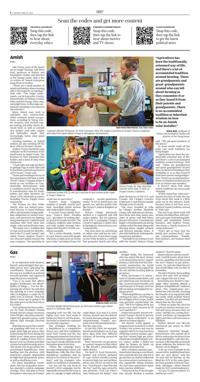
After bottles of Tapatío hot sauce are filled and labeled, they continue down a conveyer to be boxed at the manufacturing facility on April 8 in Vernon, Calif. The company, founded in 1971 by Mexican immigrant Joseluis Saavedra, was recently acquired by Dallas-based private investment firm Highlander partners.
FOOD
For 55 years, the family behind Tapatío has refused to write down the recipe for Los Angeles' iconic hot sauce, passing its secret formula only from lip to ear in closed rooms.
The Saavedra family put the ingredients on paper for the first time earlier this year as they sold the brand to backers who plan to make their salsa picante even bigger. It is a weight off the shoulders of Luis Saavedra, the founder's son and one of the few people who knew the recipe.
"We didn't want anyone to know what we were using," he said in an interview at Tapatío's factory in Vernon, California. "That always scared my sisters, because what if something happens?"
Demand for hot sauces had taken off for unexpected reasons just as the Saavedras were looking to sell. As millions of people on Ozempic and other weightloss drugs tend to crave more flavor, the values of some sauce companies have skyrocketed. Bachan's, a Japanese barbecue sauce brand, was acquired in February for $400 million.
While the Dallas private investment firm that bought Tapatío, Highlander Partners, wouldn't share the terms of the deal, the company's new chairman, Jeff Partridge, said it hopes to capitalize on the growing appetite for more heat to splash on proteins.
"Whether it's GLP-1 or desire for proteins, Tapatío and hot sauces enhance that experience," he said. "Consumers are increasingly seeking flavors."
Red peppers drive Tapatío's taste, though the company won't share which exact peppers are used. The thin sauce uses garlic, salt and other spices for a tangy, peppery punch. It has a mild heat that doesn't linger.
The big acquisition is a long way from the brand's birth in founder Jose-Luis Saavedra's kitchen more than 50 years ago.
Saavedra, originally from Mexico City, dreamed of making his way north. He landed in Chicago in his late 20s, working as a Spanish translator. He met his wife and moved to Southern California, where he worked at an aerospace parts manufacturer. The homemade hot sauce he brought for lunch was a hit with co-workers who asked for more. When he was laid off in the late '60s, he started selling bottles of his sauce.
As sales rose, he rented a space for production in Maywood, California, and it became a business in 1971. The whole family pitched in. His son, Luis, remembers twisting on caps and attaching labels to bottles when he was 13.
About five years in, the company made enough for Saavedra to quit the two part-time jobs he had picked up to keep the business afloat. Operations remained in Maywood for 14 years before expanding to a 7,000-square-foot building in Vernon.
In 1996, the company splurged on a 30,000-square-foot building.
In the same facility today, the aroma of spices tickles visitors' noses. The precise portioning of the secret ingredients, matching the ratios of the founder's original formula, happens in a room locked off from employees. The mix is then rapidly poured into a long line of empty bottles along a conveyor.
It's the legacy of the founder, who refused to be deterred by naysayers or obstacles to growth, said Saavedra's son.
"Let's go around it," the younger Saavedra said, quoting his father's mantra in the face of problems. "Let's go under. Let's go above it."
His father's stubbornness paid off in court as the company was sued for its name. It was once called Cuervo — his wife's original last name — and tequila giant Jose Cuervo came after it. Saavedra had already trademarked the name in California, so it got a big payout to give up the name.
Saavedra briefly entertained the name "Charro," a reference to Mexican cowboys, before landing on Tapatío, a nickname used for people born in Guadalajara, Jalisco, where all three of his children were born. Its logo evolved into a beaming cowboy with bright blue eyes in a widebrimmed hat.
The Tapatío name was also challenged. Del Monte Foods sued Saavedra in the '80s, claiming the name was too similar to its brand "Patio." Saavedra won that case.
Today, Tapatío is shaken over meals around the globe, though its dominance is strongest in California. It has been used in collaborations with other companies to spike mashed potatoes, protein powder, pickles and ramen. Tacked to a wall at the Vernon factory is an old photo of the dozen people who were there to launch the brand's new facility 30 years ago. Some of the employees still work there, including Jorge Cuervo, the production supervisor, and Fabian Diaz, who mans the forklift.
Under the new ownership, all 25 current employees were retained, and the firm has committed to hiring more.
The family began exploring options for a sale in late 2024, right after the founder, now 97, suffered a stroke. Jose-Luis Saavedra had remained closely involved in day-to-day operations despite his age.
As he took on all his father used to do, the younger Saavedra was getting burnt out and started to worry that keeping the company family-owned could hurt the brand.
"Work was really devouring me," Luis Saavedra said. "It was a tough decision, very difficult. We cried together as a family, then we said, 'In the long run, it's better.'"
Once it let potential suitors know the company was in play, the offers poured in. The family considered offers from around 40 companies before choosing Highlander Partners.
New leadership has grand plans for the brand, hoping to build more facilities and add new products.
Meanwhile, the Saavedra family still has a minority stake in the company and will continue to help manage it.
"They are the essence of the brand, and really understand the heartbeat of the brand," said Partridge, Tapatío's new chairman. "We certainly want to make sure that they always have a voice."