
BEYOND THE BARN
Most Amish now work off the farm, data shows
Adam Troyer displays the largest knot his father, Troyer's Rope Co. founder Andrew Troyer, has tied during a tour of the small company in Conneautville, Pennsylvania.
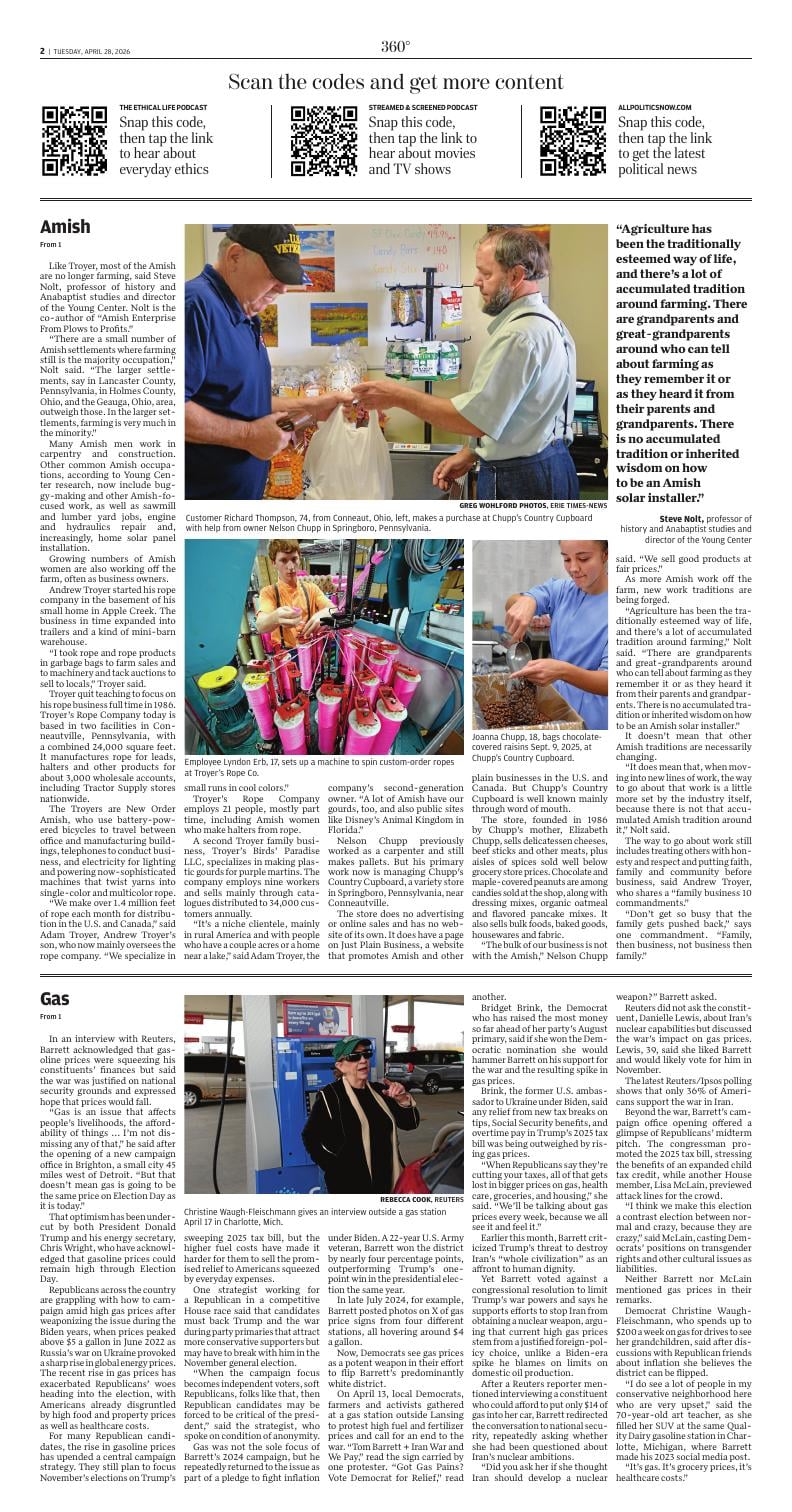
Customer Richard Thompson, 74, from Conneaut, Ohio, left, makes a purchase at Chupp's Country Cupboard with help from owner Nelson Chupp in Springboro, Pennsylvania.
Employee Lyndon Erb, 17, sets up a machine to spin custom-order ropes at Troyer's rope Co.
Joanna Chupp, 18, bags Chocolatecovered raisins sept. 9, 2025, at Chupp's Country Cupboard.
RELIGION
Andrew Troyer was teaching in his Amish settlement's school in Wayne County, Ohio, in 1977 when his pupils began relaying orders for rope.
Troyer had brought his handmade, hand-twisting machine to school so his students could make jump ropes. The machine was a variation on rope-making machines made by his father, Mose Troyer, beginning a dozen years earlier.
"The next day one of the pupils said, 'My dad wants one-half dozen lead-ropes with bull snaps,'" Andrew Troyer recalled in his new book, "Learning the Ropes, 49 Years of Family Business Facts."
Within a week, the young teacher had two more orders — and 24 lead ropes to be made.
"Lena, they are getting excited," Troyer told his newlywed wife of the orders. "We had better get excited, too."
It was the beginning of Troyer's Rope Company LLC, now based in western Pennsylvania.
In these predominantly rural communities traditionally associated with farming, more Amish are increasingly moving out of the field and into other careers. Less than 10% of households in some Amish communities now receive their primary income from farming, according to the Young Center for Anabaptist and Pietist Studies at Elizabethtown College in Lancaster, Pennsylvania.
Pennsylvania has the highest Amish population in the United States, at more than 95,000. Ohio ranks second, with more than 86,000 Amish people. Those populations are growing, but at a time where the smallest farms are disappearing and megafarms of more than 2,000 acres are expanding.
Some Amish people now have their own small businesses producing everything from wooden furniture and small barns to quilts and baked goods. Many Amish men work in residential and commercial construction or in factories, the Young Center says. Some are even installing solar panels.
While Andrew Troyer was raised on his family's farm in Apple Creek, Ohio, he chose other work.
"Plowing fields, I would get bored," Troyer said. "I was always involved in fixing and innovating. Innovation and creating are my cup of tea more than repetitious work. I was selling fish lures when I was grade-school age."
Like Troyer, most of the Amish are no longer farming, said Steve Nolt, professor of history and Anabaptist studies and director of the Young Center. Nolt is the co-author of "Amish Enterprise From Plows to Profits."
"There are a small number of Amish settlements where farming still is the majority occupation," Nolt said. "The larger settlements, say in Lancaster County, Pennsylvania, in Holmes County, Ohio, and the Geauga, Ohio, area, outweigh those. In the larger settlements, farming is very much in the minority."
Many Amish men work in carpentry and construction. Other common Amish occupations, according to Young Center research, now include buggy-making and other Amish-focused work, as well as sawmill and lumber yard jobs, engine and hydraulics repair and, increasingly, home solar panel installation.
Growing numbers of Amish women are also working off the farm, often as business owners.
Andrew Troyer started his rope company in the basement of his small home in Apple Creek. The business in time expanded into trailers and a kind of mini-barn warehouse.
"I took rope and rope products in garbage bags to farm sales and to machinery and tack auctions to sell to locals," Troyer said.
Troyer quit teaching to focus on his rope business full time in 1986. Troyer's Rope Company today is based in two facilities in Conneautville, Pennsylvania, with a combined 24,000 square feet. It manufactures rope for leads, halters and other products for about 3,000 wholesale accounts, including Tractor Supply stores nationwide.
The Troyers are New Order Amish, who use battery-powered bicycles to travel between office and manufacturing buildings, telephones to conduct business, and electricity for lighting and powering now-sophisticated machines that twist yarns into single-color and multicolor rope.
"We make over 1.4 million feet of rope each month for distribution in the U.S. and Canada," said Adam Troyer, Andrew Troyer's son, who now mainly oversees the rope company. "We specialize in small runs in cool colors." Troyer's Rope Company employs 21 people, mostly part time, including Amish women who make halters from rope.
A second Troyer family business, Troyer's Birds' Paradise LLC, specializes in making plastic gourds for purple martins. The company employs nine workers and sells mainly through catalogues distributed to 34,000 customers annually.
"It's a niche clientele, mainly in rural America and with people who have a couple acres or a home near a lake," said Adam Troyer, the company's second-generation owner. "A lot of Amish have our gourds, too, and also public sites like Disney's Animal Kingdom in Florida."
Nelson Chupp previously worked as a carpenter and still makes pallets. But his primary work now is managing Chupp's Country Cupboard, a variety store in Springboro, Pennsylvania, near Conneautville.
The store does no advertising or online sales and has no website of its own. It does have a page on Just Plain Business, a website that promotes Amish and other plain businesses in the U.S. and Canada. But Chupp's Country Cupboard is well known mainly through word of mouth.
The store, founded in 1986 by Chupp's mother, Elizabeth Chupp, sells delicatessen cheeses, beef sticks and other meats, plus aisles of spices sold well below grocery store prices. Chocolate and maple-covered peanuts are among candies sold at the shop, along with dressing mixes, organic oatmeal and flavored pancake mixes. It also sells bulk foods, baked goods, housewares and fabric.
"The bulk of our business is not with the Amish," Nelson Chupp said. "We sell good products at fair prices."
As more Amish work off the farm, new work traditions are being forged.
"Agriculture has been the traditionally esteemed way of life, and there's a lot of accumulated tradition around farming," Nolt said. "There are grandparents and great-grandparents around who can tell about farming as they remember it or as they heard it from their parents and grandparents. There is no accumulated tradition or inherited wisdom on how to be an Amish solar installer."
It doesn't mean that other Amish traditions are necessarily changing.
"It does mean that, when moving into new lines of work, the way to go about that work is a little more set by the industry itself, because there is not that accumulated Amish tradition around it," Nolt said.
The way to go about work still includes treating others with honesty and respect and putting faith, family and community before business, said Andrew Troyer, who shares a "family business 10 commandments."
"Don't get so busy that the family gets pushed back," says one commandment. "Family, then business, not business then family."
"Agriculture has been the traditionally esteemed way of life, and there's a lot of accumulated tradition around farming. There are grandparents and great-grandparents around who can tell about farming as they remember it or as they heard it from their parents and grandparents. There is no accumulated tradition or inherited wisdom on how to be an Amish solar installer."
Steve Nolt, professor of history and anabaptist studies and director of the young Center