
Pressing the press
Journalists' subpoenas raise concerns about First Amendment right
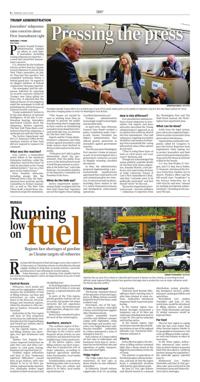
President Donald Trump refers to a printed copy of one of his social media posts as he speaks to reporters July 8 in the new Qatari-gifted air Force One after changing planes to return to Washington from Britain.
TRUMP ADMINISTRATION
President Donald Trump's administration ramped up efforts to curb leaks to journalists, including issuing subpoenas to reporters — a move that raised First Amendment concerns.
U.S. Attorney for the Southern District of New York Jay Clayton issued subpoenas to several New York Times journalists on July 10. They had "few specifics" but compelled testimony before a federal grand jury "in regard to an alleged violation of federal criminal law," the paper reported.
The newspaper said the subpoenas followed its reporting on security concerns related to Trump's new Qatar-gifted Air Force One. It reported that the Federal Bureau of Investigation asked the newspaper to hold off publishing the article because of national security concerns.
Trump nominated Clayton to be the next director of national intelligence. At his July 15 confirmation hearing, lawmakers questioned Clayton about the subpoenas, Reuters reported. The New York Times filed a court motion to block the subpoenas, a spokesperson said later that day.
The Justice Department and the U.S. Attorney's Office for the Southern District of New York did not respond to requests for comment.
What was the reaction?
Clay Calvert, a nonresident senior fellow at the American Enterprise Institute, called the subpoenas "par for the course" in what he described as the Trump administration's "war on a free press in the United States."
Press freedom advocates, including groups like the National Press Club, the International Press Institute and the Committee to Protect Journalists, as well as The New York Times itself, echoed those sentiments in respective statements.
"This brazen act should be seen as nothing more than an attempt to prevent the public from knowing what is happening in their country by intimidating journalists from doing their jobs," said David McCraw, an attorney for The New York Times.
Experts said the Trump administration's subpoenas and other actions against journalists could make sources more hesitant to disclose information to the news media.
"If the press isn't able to gather information about the government, then the public loses access to the information it needs to hold the government accountable at the ballot box," said Gabe Rottman, vice president of policy at the Reporters Committee for Freedom of the Press.
What do the feds say?
Justice Department spokeswoman Emily Covington told The New York Times that "reporters are not the targets; those leaking classified information are."
Trump's administration increasingly sought to investigate and penalize leaks.
In April 2025, then-Attorney General Pam Bondi revoked a policy established under Democratic former President Joe Biden's administration that offered greater protection to journalists against government searches.
The FBI searched a Washington Post reporter's home in January as part of an investigation into a government contractor accused of illegally retaining classified documents.
In May, the administration proposed implementing a governmentwide nondisclosure agreement that could lead to civil and criminal penalties for violators. It referenced leak incidents, including those related to the U.S. raid in Venezuela in January and immigration enforcement operations.
How is this different?
Past presidential administrations issued subpoenas to journalists, but experts and press advocates described the Trump administration's approach as an escalation that could run afoul of the First Amendment. They said subpoenas targeting journalists should be a rare means of obtaining vital or potentially life-saving information when other options do not exist.
"They're using these types of tools as a first resort, not a last resort," Rottman said.
Though she acknowledged the sparse publicly available details on The New York Times subpoenas, Amanda Martin, a law professor and supervising attorney at Duke University School of Law's First Amendment Clinic, said they "certainly seem to be politically motivated" and that should "never" be the case.
The Justice Department previously issued — but later withdrew — subpoenas to reporters from the Washington Post and The Wall Street Journal, the Washington Post reported in June.
What can be done?
Aside from the legal system, press advocates supported legislation to protect journalists from government interference.
Organizations and media companies called for Congress to pass the Protect Reporters from Exploitative State Spying Act to protect journalists and their sources from government probes. It passed in the House in 2024 but stalled in the Senate.
U.S. Sen. Ron Wyden, D-Oregon, and U.S. Rep. Becca Balint, D-Vermont, introduced the Privacy Protection Updates Act in March. Wyden's office said the bill would close "loopholes" in the Privacy Protection Act of 1980 that he said were "abused by multiple presidential administrations," including in the January FBI raid.