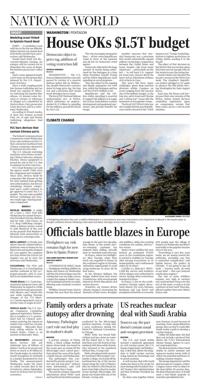


Up in smoke
Exposure to haze from wildfires poses risk of serious health issues
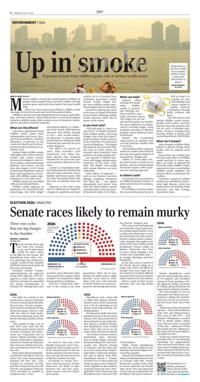
People look out July 16 as smoke from Canadian wildfires clouds a view of the Detroit River in Detroit.
ENVIRONMENT| Q&A
Massive wildfires around the world blanketed millions of people under pungent haze caused by smoke carrying noxious gases and particulate matter that pose health risks. More toxic than normal air pollution, wildfire smoke can linger in the air for weeks and travel thousands of miles.
Wildfires can burn not only vegetation but also vehicles and buildings, and their contents. Along with particles of soil and biological materials, wildfire smoke often contains traces of chemicals, metals, plastics and other synthetic materials.
What are the effects?
Laboratory experiments found wildfire smoke causes more inflammation and tissue damage than air pollution, said Kent Pinkerton, co-director of the Center for Health and the Environment at the University of California, Davis.
Studies linked wildfire smoke with higher rates of heart attacks, strokes and cardiac arrests, increases in emergency room visits for asthma, weakened immune defenses and poorer survival rates after surgery. A 2023 study in Maryland identified a spike in heart and lung illnesses associated with wildfire smoke originating up to 2,100 miles away.
Wildfire smoke also was linked with eye and skin problems.
Wildfire smoke exposure in pregnancy was associated with miscarriage, low birth weight and preterm delivery. A California study found a link between exposure and cellular damage in firstand second-trimester placentas. A separate study found exposure during the third trimester may raise the risk of an autism diagnosis.
The effects can persist for years. After Australia's 2014 Hazelwood Coal Mine fire, heart disease rates remained elevated for two and a half years and respiratory illnesses for five years.
A 2026 U.S. study linked wildfire smoke exposure with elevated risks for lung, colorectal, breast, bladder and blood cancer, with the risks increasing along with the level of pollution from the fires.
Exposure to the 2018 Camp Fire in California was linked to changes in cognition and brain activity six to 12 months later, California researchers found. Several studies linked longer-term wildfire smoke exposure to higher risks for dementia.
Data from California also show an increase in fungal infections in the months following wildfire smoke exposure, likely due to spores in the smoke.
Is any level safe?
"The bad news is, there's no safe level" of inhaled particles from wildfire smoke, said Doug Brugge, who chairs the Department of Public Health Sciences at the University of Connecticut School of Medicine. "The higher the exposure, the worse the risks, but even at levels below the national safety standards, these particles can make people sick."
Any amount of inhaled particles will trigger inflammatory responses in the body. Children, the elderly and people with chronic illnesses are most vulnerable.
Some effects of exposure — such as sore throats, excessive phlegm, coughing, headaches and brain fog — can appear immediately and persist long after the smoke plume is gone, said Keith Bein of the Air Quality Research Center at UC Davis.
What can help?
Experts advise wearing N95 masks when wildfire smoke is present and limiting outdoor activities, especially strenuous sports. The longer you are out-side and the harder you breathe, the more pollution you inhale, said Dr. Jasvinder Singh, a lung medicine specialist at Medstar Franklin Square Medical Center in Baltimore.
Experts also recommend using indoor air purifiers that can trap particles smaller than 2.5 microns.
"Air purifiers reduce exposure and in our studies reduced blood pressure and cognitive impacts of air pollution," Brugge said.
Online, UC Davis offers simple instructions to build an air purifier, and the Environmental Protection Agency offers guidance for reducing exposure.
Is indoors safe?
On average, the concentration of wildfire pollutants indoors is about half of what it is outdoors, Singh said.
If a building is poorly sealed, the concentration may be up to 70% of what it is outside, he said. Old buildings may expose people to greater amounts of pollution through drafty windows and doors.
The EPA advises that during wildfire smoke events, people avoid indoor activities that put more fine particles into the air, such as smoking cigarettes, frying or broiling food, burning candles or incense, and vacuuming without a HEPA filter.
What isn't known?
More frequent wildfires likely linked to climate change mean people will be exposed more often.
Researchers are looking into the long-term effects of wildfire smoke particles in water supplies, on crops or ingested by livestock; urban wildfire smoke; exposure in utero; and whether wildfire smoke amplifies the adverse effects of extremely hot weather.
Nutrients carried in wildfire smoke may contribute to downwind algal blooms, which has implications for drinking water reservoirs and lake ecology, researchers warn.