
IN HOT WATER
Soaring temperatures strain Europe's fishing industry, native species
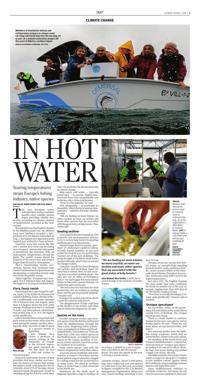
Members of Asociacion Amicos and collaborators prepare to release rocks carrying cultivated kelp into the sea Aug. 24 as part of a seabed restoration project off the coast of Ribeira, northern Spain.
Above: Workers with Asociacion Amicos tend to material used to cultivate kelp Aug. 24 at the organization's laboratory in Comoxo, Spain.
Left: a woman holds a rock filled with microscopic seedlings of kelp.
An octopus is splayed on a rock in august 2025 at Porthkerris reef off Cornwall, Britain. this once-are species for the area is thriving in warmer waters.
Rico Ordas
CLIMATE CHANGE
This year, European waters notched their hottest summer months since satellite sensors began providing reliable data in 1982, according to a Reuters analysis of temperatures recorded at the seas' surface.
Records fell from the English Channel to the Mediterranean Sea. An offshore buoy near Mallorca recorded a temperature of 91.44 degrees Fahrenheit on Aug. 5 , the highest ever registered in the Spanish port authority's buoy network.
Scientists warn that events like this year's marine heat waves are becoming more frequent, intense and widespread as greenhouse-gas emissions drive up atmospheric temperatures around the globe. The world's oceans absorb the majority of the excess heat and retain it longer than the land or atmosphere.
That's transforming marine ecosystems. Species that sustained some coastal communities for generations are disappearing, as unfamiliar arrivals surge into newly hospitable waters.
Taken together, European seas averaged 70.9 F between June and August, the highest in 45 years of available data.
Flora, fauna vanish
Stretching from Cape Ortegal in Galicia, Spain, to the Pointe de Penmarch in southern Brittany, France, the Bay of Biscay's traditionally cool waters averaged 70.5 F between June and August, more than 4.4 degrees above the 1991-2020 average. Readings from the U.S. National Oceanic and Atmospheric Administration peaked Aug. 13 at 74 F, the highest of the satellite era.
Galicia benefits from strong winds that push warm surface water away from the coast during the summer months, allowing cold, deep-sea water to take its place in a process known as upwelling.
Jose Manuel Rico Ordas, a professor of marine ecology at the University of Oviedo in the Asturias region, has spent summers on the bay since he was a child and studies its transformation. Extensive underwater forests of kelp provided vital food, shelter and nurseries for dozens of species that sustain the region's small-scale fisheries. But he estimates about 95% of the large, brown seaweed stands disappeared, based on sampling along the Asturias coast since 2010. He attributes the decline primarily to climate change.
Kelp needs cold water — typically below 68 F — to survive. Higher temperatures were once exceptionally rare in the bay, Rico Ordas told Reuters.
"Now, it's the opposite," he said. Fish overgrazing — in particular by dreamfish, which thrive in warmer temperatures — added to the kelp's decline, he said.
"We are finding no more lobster, no more crayfish, no more sea urchins and many other species that are associated with the good status of kelp forests," Rico Ordas said.
Seeding seafloor
Concerned fishermen teamed up with scientists and environmental activists to try to restore kelp forests by planting seedlings grown in laboratories.
Manuel Angel Reiriz Gonzalez, president of a fishermen's guild in Galicia, recently ferried members of one such project in a boat he uses for sport fishing charters out of the port of Ribeira. The group brought a box full of small stones seeded with kelp, which they tossed into the choppy waters.
Gonzalez's family has been diving for sea urchins and harvesting clams for more than a century. Now, he said, recurring heat waves hurt shellfish stocks. The area also saw an influx of Portuguese man o' war and trigger fish from warmer climes to the south, species that prey on native fish and crustaceans.
"We had some very bad years for clam production, but we worked on seeding them, and the species gradually adapted," Gonzalez said.
He hopes the seabed restoration efforts can do the same for kelp forests.
The disappearance of kelp could lead to the decline of sea urchins and other species fishermen depend on, he said.
Species on the move
In other European waters, new, invasive species from the Red Sea and beyond enter the Mediterranean through the Suez Canal, displacing native populations, reshaping food chains and threatening fisheries, researchers say. There are more than 1,000 non-native s pecies in the Mediterranean, according to a recent report by the Cyprus Academy of Sciences, Letters and Arts, based on surveys by scientists in 11 countries.
Some native species cope with the warmer temperatures better than others.
A massive swarm of jellyfish shut down reactors at France's Gravelines nuclear power plant in August when they clogged its cooling system for the second time in as many years. The plant in northern France is cooled from a canal connected to the North Sea.
Fishermen on the south coast of England reported a surge in landings of common octopus. About 2,600 metric tons were caught last year and upward of 3,000 tons so far this year, according to figures compiled by the U.K. Marine Management Organization. Before last year, annual landings amounted to less than 30 tons.
Octopus larvae are carried into British waters on currents from breeding grounds further south, said Bryce Stewart, senior research fellow at the Plymouth-based Marine Biological Association. Previously, many didn't survive the frigid temperatures.
But since 2022, the English Channel has been under heat wave conditions for about six months out of the year on average, logging more than 900 days in all, the Reuters analysis found.
"Now they're actually breeding in U.K. water quite prolifically," Stewart said of octopus.
'Octopus apocalypse'
For Ian Perkes, owner of the eponymous fish merchants in the south Devon seaside town of Brixham, the octopus bloom proved a boon.
There is a ready market in southern Europe for the once-rare species and no fishing quotas, he said. "There was one week where we had 200,000 kilos (200 tons)."
Not everyone profits from the shellfish-loving octopuses, which feed on native lobsters, brown crabs and scallops.
For members of the South Devon and Channel Shellfishermen's cooperative, 2026 has been an "octopus apocalypse," according to its executive officer, Beshlie Pool. One recent fishing trip yielded a single crab all day, she said.
The MBA estimates the octopus bloom could account for about $13.25 million in lost shellfish catches against about $15.9 million in octopus landings between January and September 2025.
Some shellfishermen switched to catching octopuses, but many do not have the necessary equipment, Pool said.
"We are finding no more lobster, no more crayfish, no more sea urchins and many other species that are associated with the good status of kelp forests."
Jose Manuel Rico Ordas, a professor of marine ecology at the university of Oviedo in Spain