

Some Republicans criticize Iran deal
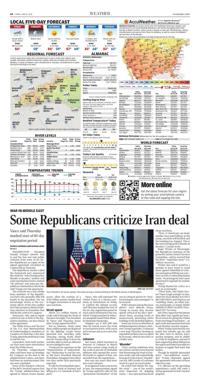
Vance said Thursday marked start of 60-day negotiation period

Vice President JD Vance speaks Thursday during a media briefing at the White House in Washington.
WAR IN MIDDLE EAST
WASHINGTON — President Donald Trump's interim deal to end the Iran war met public criticism from some of his fellow Republicans as copies of the signed agreement circulated on Capitol Hill on Thursday.
One Republican senator called the framework pact announced this week the "worst foreign policy blunder in decades," another said some reported provisions seemed "ill-advised," and some pro-Republican commentators also broke with Trump over the agreement.
The criticism was a rare rebuke from members of the Republican Party who generally offer full loyalty to the president, but are increasingly restive as the economic effects of the Iran conflict hurt their prospects ahead of midterm elections in November that will decide control of Congress.
Democrats, who seek to regain control of one or both of the legislative chambers, are also critical of the agreement.
The White House sent the text of the U.S.-Iran Memorandum of Understanding to members of Congress on Thursday, a day after Trump signed the preliminary deal to end the war.
Lawmakers from both parties say they want more information from the White House.
By Thursday, congressional aides said there were no briefings for Congress on the deal or the administration's plans, and there had been no announcement that any were scheduled.
Some of the sharpest criticism of the MOU involved reports that the Trump administration has agreed to release frozen Iranian assets, allow the creation of a $300 billion private wealth fund to trigger investment in Iran and ease sanctions.
Strait opens
About 12.5 million barrels of crude sailed through the Strait of Hormuz overnight, Vice President JD Vance said Thursday, hours after Trump signed the MOU.
But in Lebanon, where more than a million people are displaced by the fighting, Israeli forces launched new airstrikes early Thursday, raising doubt about how far Trump will go to force his wartime allies to halt an offensive he now pledged to end.
Trump put his signature on the "memorandum of understanding" Wednesday to end the war, as did Iran's President Masoud Pezeshkian, bringing it into effect two days earlier than previously expected.
It calls for the immediate opening of the Strait of Hormuz and lifting of a U.S. blockade of Iran's ports.
Vance, who will represent the United States at a formal ceremony in Switzerland on Friday to confirm the interim accord, said Thursday marked the start of the 60-day negotiation period to reach a final settlement to the war, which Trump launched in February alongside Israeli Prime Minister Benjamin Netanyahu.
Shippers say it will still take time for transit across the strait to reach prewar levels, with a need yet to ensure safe access and clear mines.
Lebanon
But Israel, which launched an invasion of Lebanon in March and since seized a large swath of the south in pursuit of Hezbollah militants who opened fire across the border in support of Iran, was excluded from the negotiations.
Iran says any peace deal must also cover Lebanon.
In an apparent major concession to Iran, the memorandum signed by Trump explicitly calls for the "permanent termination" of the war in Lebanon and for its "territorial integrity and sovereignty" to be ensured.
With Lebanon among the peace effort's most delicate issues, Trump in recent days became openly critical of his ally's operations there, accusing Israel of unnecessarily destroying entire buildings to hit Hezbollah fighters.
Israel says it has no intention of withdrawing from Lebanon, whatever Trump negotiates. It released a new map Thursday showing an expanded southern area occupied by its troops, which it describes as a buffer zone.
'Blunder'
"Iran's nuclear ambitions were not curbed, and they have learned that threatening the Strait of Hormuz works and will undoubtedly leverage it in the future," Republican Sen. Bill Cassidy of Louisiana wrote in a post on social media.
He noted that before the war, the strait — one of the world's most important oil shipping routes — was open and Iran faced steep sanctions. "Now, 13 Americans are dead, families have paid billions at the pump, sanctions will be lifted, and the bombing has stopped. This is the worst foreign policy blunder in decades," Cassidy wrote.
Roger Wicker of Mississippi, the Republican chairman of the powerful Senate Armed Services Committee, said he worried that the MOU "negotiates away" U.S. military successes.
Wicker also said it would be a mistake to force Israel to stand down against Hezbollah in Lebanon and opposed lifting any sanctions on Iran or unfreezing Iranian funds, "in exchange for Iran's mere agreement to negotiate for another 60 days."
Trump blasted his critics in a post on social media.
"These fools, who think I haven't been tough enough on Iran, when the Stock Market Just Hit A RECORD HIGH, and Oil prices are 'tumbling' down, are either jealous, bad people, or stupid. MAKE AMERICA GREAT AGAIN!!! President DJT" he wrote.
But critics argue that the interim deal offers Iran significant benefits in return for giving the United States two things it had before — an open strait and a promise from Iran to not develop a nuclear weapon.
When Trump launched the war nearly four months ago, he said his aims were to destroy Iran's nuclear program, end its ability to strike its neighbors, prevent it from supporting allied militants in the region and make it possible for Iranians to topple their hard-line leaders.
Though he initially demanded Iran's "unconditional surrender," Trump ultimately signed the agreement with none of those objectives met.
U.S. officials say the upcoming negotiations could still yield a strong agreement on Iran's nuclear program.