
Judicial muster
What Supreme Court's test for firearms rules could mean for AR-15s
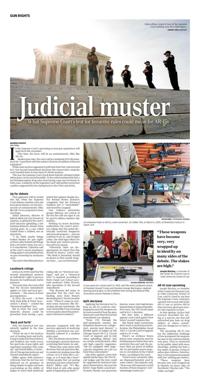
Police officers stand in front of the Supreme Court building June 30 in Washington.
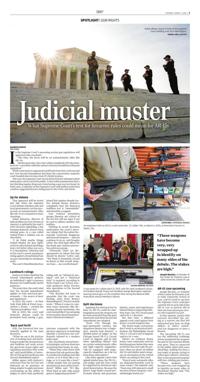
An employee holds an Ar-15, a semi-automatic .22 caliber rifle, on March 6, 2025, at Pewnitions Factory in Salem, Ore.
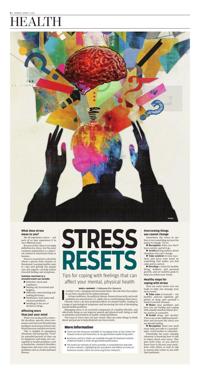
A man poses for a photo April 27, 2025, with life-sized cardboard cutouts of President Donald trump and President George Washington, depicted wearing tactical gear, on the exhibition floor during the National rifle association annual meeting in Atlanta.
SPOTLIGHT| GUN RIGHTS
In the Supreme Court's upcoming session gun regulations will again be in the crosshairs. This time, the focus will be on semiautomatic rifles like AR-15s.Modern gun rules, the court said in a landmark 2022 decision, must be "consistent with this nation's historical tradition of firearm regulation."
While some justices appeared to pull back from that controversial test, two Second Amendment decisions the conservative-majority court handed down in June show it's firmly in place.
This year, the Supreme Court struck down Hawaii's attempt to limit where guns can be carried in public. It also ruled unanimously that a law blocking regular drug users from having a gun was too broad. In both cases, a majority on the Supreme Court said neither restriction could be supported by laws dating back to the 1700s and 1800s.
Up for debate
That approach will be tested this fall, when the Supreme Court debates whether state and local governments can ban possession of semiautomatic rifles like AR-15s as a response to mass shootings.
Aidan Johnston, director of federal affairs for Gun Owners of America, is optimistic the court's 2024 decision upholding a law banning domestic abusers from owning guns, in a case called United States v. Rahimi, was an aberration.
"I do think maybe things looked bleaker for gun rights activists after Rahimi and things look a lot better when you see a 9-0 smackdown," Johnston said of the court's recent unanimous ruling against a broad federal ban on gun ownership by marijuana users.
The court's three liberal justices joined that opinion despite Justice Ketanji Brown Jackson's complaints that the historical tradition test is "unworkable" and should be scrapped.
Gun violence prevention groups likewise are critical of the test but still see signs it can be used to address modern-day realities.
Nothing in recent decisions undermines the court's previous rulings that the nation historically restricted dangerous and unusual weapons — and can continue to do so, said Douglas Letter, the chief legal officer for the Brady gun violence prevention advocacy group.
"Obviously, there are disagreements on where that line should be drawn," Letter said. "We think it absolutely should be drawn so that assault weapons bans … are constitutional."
Landmark rulings
Justices in 2008 ruled that the Second Amendment protects an individual's right to possess firearms for traditionally lawful purposes.
Two years later, the court ruled that the Second Amendment applies to state and local governments — the source of most gun regulations.
In 2022, the court — in New York State Rifle & Pistol Association v. Bruen — created the "historical tradition" test.
But in 2024, the court said domestic abusers could be prevented from having a gun, ruling only an "historical analogue" and not a "historical twin" is required, according to Notre Dame Law School associate professor Haley Proctor, who specializes in the Second Amendment.
"The decision led many to speculate that the court was backing away from Bruen's demanding test," Proctor recently wrote. "When it comes to common-sense measures like disarming abusive boyfriends, the court seemed like it was not going to be too picky about the government's historical evidence."
Still, the historical test was robustly applied in the June decisions.
"What we see is the justices sort of tacking back and forth, trying to make this Bruen history and tradition test work across the spectrum of gun rights and regulation questions that come up," said Darrell Miller, a University of Chicago law professor and Second Amendment expert.
Miller agrees with Jackson's criticisms that the test has not delivered on its promises of being simpler to apply and more constraining on the ability of judges to reach their preferred outcome compared with the previous approach of analyzing whether a restriction was sufficiently tailored to a modern policy goal.
Plus, the debates about historical analogies can leave observers scratching their heads, he said.
"When they come down with decisions that ask questions like, Is a modern jet airplane more like a horse, or is it more like a carriage, or is it more like a boat?' I think people that are paying attention just feel a little bewildered," Miller said. "It's like, What kind of odd, elite parlor game is happening up there?'"
Split decisions
Applying the historical test to bans on AR-15s could be challenging because the weapons are far more powerful than the guns Americans used when the Second Amendment was adopted.
"From 1791 through the mid-nineteenth century, the ubiquitous firearm was a singleshot, muzzle-load firearm," a divided panel of judges on the Chicago-based 7th U.S. Circuit Court of Appeals said in July when upholding Illinois' ban on certain semiautomatic rifles and high-capacity magazines. "AR-15s equipped with largecapacity magazines are a far cry from these antecedents."
Like other appeals courts that upheld similar bans, the 7th Circuit judges said the laws could be supported by historical rules about Bowie knives. Because the knives' large blades caused particularly bloody and gruesome injuries, many state legislatures banned them or imposed prohibitive taxes, the 7th Circuit panel said in its 2-1 decision.
But days later, a different appeals court ruled against New Jersey's assault weapons ban.
The Bowie knife restrictions don't work as an historical justification, the Philadelphia-based 3rd U.S. Circuit Court of Appeals said in a 10-5 vote.
There's no evidence Bowie knives were commonly used for lawful purposes before they were restricted, the court said. By contrast, there are about 24 million AR-15s and similar sports weapons in circulation in the United States, according to the court.
"Even if semi-automatic rifles are disproportionately used in some crimes," the majority said, "those may still represent a small fraction of those weapons' overwhelmingly lawful use."
AR-15 case upcoming
Joseph Blocher, co-founder of the Center for Firearms Law at Duke University School of Law, said it's hard to see how the Supreme Court could give a partial win to each side in the AR-15 case as justices did in their decision about gun owners who regularly use pot.
In that opinion, Justice Neil Gorsuch described the ruling as a narrow one that left untouched gun bans on drug addicts or others considered too dangerous to have a firearm.
The upcoming AR-15 case has the additional challenge of how prominent the weapons became in the national debate over guns. They're connected in the public mind with mass shootings, making the bans a top target of groups trying to reduce gun violence. However, they're also immensely popular with law-abiding gun owners.
"These weapons have become very, very wrapped up in identity on many sides of the debate," Blocher said. "The stakes are high."
"These weapons have become very, very wrapped up in identity on many sides of the debate. The stakes are high."
Joseph Blocher, co-founder of the Center for Firearms Law at duke university School of Law