
Verizon wants to end landlines
Some customers worry the move could leave them disconnected
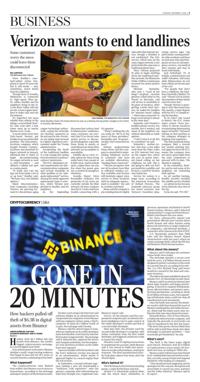
Steve Bradley's mustard-yellow rotary telephone is about 50 years old. But it still works — and, sometimes, much better than his cellphone.
Though most of Scandia, Minnesota, is connected to high-speed fiber-optic cables, Bradley and his neighbors living in the St. Croix River Valley still rely on old-school copper landlines to make calls and surf the internet.
It's imperfect but more reliable than cellular in the foliage-covered bluff, Bradley said, even after a new tower went up in nearby Marine on St. Croix.
A recent letter from New York-based Verizon put Bradley in an uncomfortable position. The telecommunications company, which bought Frontier Communications and absorbed its legacy network in January, informed him it wants to begin decommissioning its copper network as soon as mid-November — and offered a cellular hot spot as a replacement.
"It really just cuts the legs out from under a lot of us up here," Bradley said. "We have very, very limited options."
Major telecommunications companies, including Verizon, are pressing forward to discontinue aging copper technology nationwide, saying the networks are obsolete, expensive to fix and used by few. Providers are taking steps forward in a lighter regulatory environment under the Trump administration.
Accelerating the death of the traditional landline is a rule change this spring from the Federal Communications Commission.
The FCC eliminated certain requirements for telecommunications companies and revised standards of what qualifies as an "adequate replacement" service. Among the newly approved replacement types is wireless, which Verizon now pitched to Bradley and his neighbors.
As the impending disconnection notices land in Minnesotans' mailboxes, some customers are worried they'll be forced onto spotty service or disconnected altogether, especially those living in exurbs or rural Minnesota where fiber networks are incomplete or unavailable.
Satellite also is a less-viable option for those living under heavy tree canopy or in hilly areas. And in remote spots, copper lines can stay live when the power goes out, a comfort in emergency situations.
Scandia Mayor Steve Kronmiller estimates 100 properties in his town are currently outside the fiber network. He fears residents near the St. Croix could have trouble connecting with a 911 operator.
"There's nothing the city can really do. We're at the mercy of these providers," Kronmiller said. "If one person dies, that's more than we need."
Verizon spokeswoman Diana Alvear said the company is committed to maintaining telephone service to customers who have no available alternatives, "keeping them connected."
"Verizon recognizes that not all locations have fiber or sufficient wireless service available, and Verizon will maintain copper voice service to these locations until an adequate replacement is available," she said in a written statement.
Alvear said the company is also winding down its digital subscriber line internet service, though a timeline is not established. The DSL service, which runs on the same copper network, is not protected in the same way as traditional phone lines.
Since Verizon proposed its plan to begin shutting down the traditional landline network, the Minnesota Public Utilities Commission received two dozen protest letters.
Michael Bonnette, who runs a "Lord of the Rings"-inspired vacation getaway called Shire in the Woods in McGrath, said cell service is unreliable at his place of business. After getting a letter from Verizon, he ended his landline for internet-based calling — which stays connected "as long as your phone is always in the same spot."
Bonnette said Frontier's landline phone service was terrible, but it worked, and many of his neighbors are without affordable or viable options.
"I don't miss it at all. But it's a problem," he said.
Bonnette's mother-inlaw, who lives a few miles away from the Shire, relies on DSL internet that runs on the copper line, which she uses to power internet-based calling on her cellphone, he said. She is not going to dish out $120 per month for a satellite, and he fears a cutoff by Verizon may isolate her.
Service for seniors is a larger issue, according to the American Association of Retired Persons. The nonprofit advocacy group has raised concerns over Verizon's transition plan, saying service gaps "are particularly consequential" for older residents and those in rural areas who need telephone services to call emergency services, run medical alert systems and stay in touch with family.
Jack Setterlund, 79, of Duluth, a retired lawyer and AARP volunteer, said many older Minnesotans do not have cellular service because of the cost.
"For people that don't have a cellphone, the landline is basically a lifeline," he said. "I know a lot of seniors who members of their family check in every day."
Though Verizon is pushing to start disconnections this month, a legal dispute with the PUC is complicating the timeline.
In its latest rule issued in March, the FCC claims states cannot "force providers to devote resources to maintaining deteriorating legacy networks." Verizon is relying on that position as the company attempts to leapfrog state regulators.
The telecommunications company filed a lawsuit last month claiming federal approval from the FCC means the company does not need a green light from the state commission to proceed with its plan. The dispute is ongoing.
In the meantime, Bradley said he and some of his neighbors are evaluating their options.
As yet another backup, Bradley recently installed the satellite service Starlink — an option he has because of his relatively clear view of the sky.
So far, he said, "It's OK."