MIDDLE EAST | Q&A
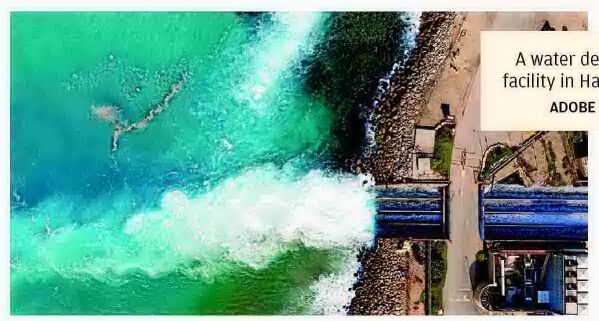
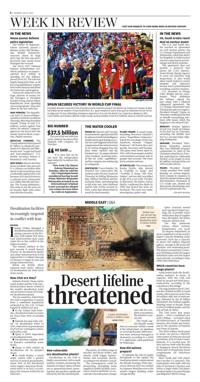
Iranian strikes damaged a desalination plant in Kuwait, raising concerns in the Persian Gulf region that more vital infrastructure may come under fire as the conflict in the region escalates.
The Iranian military in the past warned it would launch attacks on desalination plants and other infrastructure in the region if the U.S. follows through on threats to target its fuel and energy infrastructure.
Below are details about regional Arab states' reliance on desalination for their basic water needs.
How vital are they?
Bahrain, Kuwait, Oman, Qatar, Saudi Arabia and the UAE combined produce about a third of the world's desalinated water and are home to many of its largest desalination plants.
The six countries, which form the Gulf Cooperation Council, have a combined population estimated by the U.N. to have topped 61 million last year.
■ In the United Arab Emirates, desalinated water accounts for more than 80% of potable water.
■ Bahrain became fully reliant on desalinated water in 2016, with 100% of groundwater reserved for contingency plans, authorities said.
■ Qatar is 100% dependent on desalinated water.
■ Desalination supplies 90% of Kuwait's residential water needs.
■ Oman is 86% reliant on desalination for its people's needs.
■ In Saudi Arabia, a much larger nation with a greater reserve of natural groundwater, about 50% of the distributed water supply came from desalinated water as of 2023, according to the General Authority for Statistics.
How vulnerable are desalination plants?
Desalination in the Gulf is highly concentrated, with a small number of plants producing the majority of output. Many of them are co-generation plants, meaning they also produce significant electricity for the national grid.
The plants sit within range of missiles and drone strikes, and attacks could trigger humanitarian and economic shocks, according to the Atlantic Council.
The consequences could be devastating, disrupting water supplies to public facilities, businesses, houses and hotels, or cascade into citywide power outages and calls for complete evacuations, the Atlantic Council said.
The Saudi capital Riyadh would have to evacuate within a week if the Jubail plant, its pipelines or associated power infrastructure were seriously damaged or destroyed, according to a 2008 U.S. diplomatic cable published by WikiLeaks.
How did nations prepare?
To mitigate the risk of supply disruptions to the capital, the Saudi government commissioned the Riyadh Strategic Water Reservoir, which in 2023 was verified by Guinness World Records as the world's largest drinking water storage facility.
Qatar assessed several years ago that it risked running out of potable water within three days if supplies were disrupted, the prime minister said last year.
The tiny peninsula nation, where summer temperatures can reach 122 degrees Fahrenheit, in 2018 completed 15 of the world's largest concrete drinking water reservoirs. Each has a capacity of about 100 million imperial gallons, enough to fill about 180 Olympic-size swimming pools. The project earned Qatar a Guinness World Record for the largest individual tanks and the largest such network, according to state utility firm Kahramaa.
Which countries have mega-plants?
Saudi Arabia leads the desalination industry in terms of capacity, with the UAE and Israel in second and third place, respectively, according to the consultancy Blackridge.
The largest plant is the $7.2 billion Ras Al Khair facility in Saudi Arabia, able to process more than 105 million cubic feet of water per day, followed by the $1 billion Jubail plant. Ras Al Khair supplies drinking water to Riyadh, home to about 8 million people, and the city of Hafr Al-Batin.
The UAE hosts four major plants — with a combined cost of $5.3 billion — in Dubai's Jebel Ali industrial port, at Taweelah between Abu Dhabi and Dubai, and in the emirates of Fujairah and Umm Al Quwain.
The $500 million Sorek plant in Israel can process 640,000 cubic meters of water per day and contributes 20% to Israel's water demand. It is located near Tel Aviv and was built with the help of Singapore-based Hutchison Water, part of Hong Kong-based conglomerate CK Hutchison Holdings.
Most Saudi and UAE plants don't involve U.S. investors. The Saudi plants were built with the help of Germany's Siemens and France's Engie while UAE plants involved Spain's Acciona Energia and Belgium's BESIX Group.