

Fast forward
Is your walking up to speed? Here's how to make strides beyond the leisurely stroll


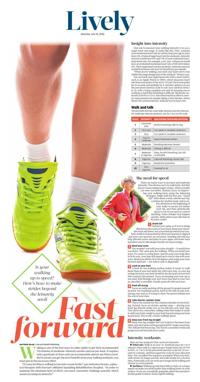
Walking is one of the best ways for older adults to get their recommended 150 minutes of moderate-intensity aerobic exercise per week. It requires only a good pair of shoes and can accommodate almost any fitness level. But to ensure you get the most benefits from your walking workouts, you must put in the necessary effort.
"It's easy for fitness walking to turn into casual strolls," says Antonina Stevens, a physical therapist with Harvard-affiliated Spaulding Rehabilitation Hospital. "In order to maintain the minimum level of effort, you must constantly challenge yourself, which means focusing on intensity."
Insight into intensity
One way to measure your walking intensity is to use a target heart rate range. It works like this. First, estimate your maximum heart rate by subtracting your age in years from 220. A typical target heart rate for moderate-intensity exercise is between 65% and 75% of your estimated maximum heart rate. For example, a 60-year-old person would have an estimated maximum heart rate of 160 (220 minus 60). Their target heart rate for moderate-intensity exercise would be between 104 and 120 heartbeats per minute.
"When you're walking, you want your heart rate to stay within this range during most of the workout," Stevens says.
You can track your target heart rate with a smart watch, such as an Apple Watch or Fitbit, which measures heart rate from your pulse at the wrist. Or just check your pulse for 15 seconds and multiply by 4. Another option is to use the perceived exertion scale to rate your exertion from 1 to 10, with 1 being complete rest and 10 meaning you're working so hard that breathing is difficult. Moderate-intensity activity is 5 or 6. Perceived exertion often is a better measurement for people taking a beta blocker, which blunts the normal exercise-induced rise in heart rate.
The need for speed
There are many ways to increase and maintain intensity. The obvious one is to walk faster. But that doesn't mean taking longer strides, which actually can slow you down. Instead, focus on improving your walking form using the following strategies. Begin with the first one, "Stand tall." After about a week, add the next tip, continue for another week, and so on. Pay attention at the beginning of your walks to ensure you follow each tip, and then periodically check to see if you need to correct anything. Some changes may happen quickly, while others may take time to become a habit.
1 Stand tall
Extend your spine as if you're being lifted from the crown of your head. Keep your shoulders back and down, not scrunched up toward your ears.
Your stride is more powerful when your posture is aligned and your core muscles are activated. Standing tall will also help alleviate aches and pains in your upper and lower back and allow you to take deeper breaths for more energy.
2 Bend your arms
You wouldn't run with your arms straight — it would slow you down. The same goes for walking. When you bend your arms, it's easier to swing them. And because your body likes to be in sync, your legs will speed up to stay in step with your arms. Bend your elbows 85 to 90 degrees and swing your arms forward and back — not side to side or diagonally.
3 Land on your heel
A heel-to-toe walking motion makes it easier to walk faster than if your foot lands flat with each step. As your leg swings forward, your heel should be the first part of your foot that contacts the ground. Focus on keeping your toes up as you land. Roll through your foot from your heel to your toes as smoothly as possible. Finally, push off with your toes.
4 Push off strong
Focus on really pushing off the ground to propel yourself forward. For maximum power, bend at the ball of your foot, raising your heel as if trying to show the person behind you the sole of your shoe.
5 Take shorter, quicker steps
This is the remedy for the common mistake of overstriding. Instead, focus on shorter, quicker steps — placing your front leg directly under you as you fall into your next step. This allows for a smoother, rolling stride that makes it easier to shift your body weight to your front leg and swing your back leg forward. The result: a faster walking speed.
6 Keep your front leg straight
Keep your leg straight (but not locked at the knee) from when your foot lands on the ground until it's under your body. This will prevent bouncing. You'll have a smoother stride and propel yourself forward more easily.
Intensity workouts
Here are two workouts that can boost intensity:
■ Intervals: Walk at an easy-to-moderate pace for 3 to 4 minutes, then walk at a vigorous pace (target heart rate of 75% to 85%, or 7 to 9 on the perceived exertion scale) for 30 seconds to a minute, and then repeat the cycle for your allocated time. You can adjust the sequence as needed: When you start, walk slower for longer periods and walk briskly for a shorter time. Eventually, you can work up to longer brisk walking and shorter recovery periods.
■ Inclines: Walking up and down hills or stairs at a slower speed can make you work harder than walking faster on a flat surface. If you use a treadmill, gradually adjust the machine's incline grade to mimic slower uphill walking.