ELECTION 2026| Q&A
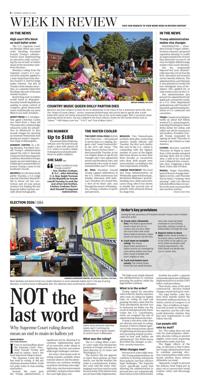
If you've seen headlines about the Supreme Court, President Donald Trump and mail-in ballots, here's the most important thing to know:
The Supreme Court did not ban mail-in voting. It did not eliminate absentee ballots. It did not order states to stop sending mail ballots.
Instead, the court gave the Trump administration a significant win by allowing it to continue implementing parts of an executive order aimed at tightening election procedures while legal challenges continue.
For voters, that means mail-in voting remains available where state law allows it. But the administration can continue working on policies involving voter eligibility data, election enforcement and ballot-mail procedures while the court fight plays out.
What was the ruling?
The 6-3 ruling lifted a lower-court order that blocked key portions of Trump's election-related directive in 23 states and Washington, D.C.
The justices did not approve or reject these policies on their merits, nor decide whether the order is constitutional. Rather, the court said the states challenging it may have sued too early because many of the policies have not yet been fully implemented.
The high court simply allowed the administration to continue pursuing the policies while the legal battles continue.
What is in the order?
Trump signed his executive order in March, Reuters reported, after years of calling for tighter rules on voting by mail and pushing the false claim that his 2020 presidential election loss to Democrat Joe Biden was the result of widespread voter fraud. Under the U.S. Constitution, states are assigned the role of administering federal elections.
Trump's executive order does not directly end mail-in voting. Instead, it directs federal agencies to take several actions aimed at tightening election procedures and increasing federal involvement in how mail ballots are administered. The White House described the changes as election-security measures.
What changes now?
Not much for voters right away.
The Trump administration can continue to develop and pursue these policies, but they still face legal challenges. The Supreme Court specifically noted that allowing the administration to proceed does not automatically mean future action will be lawful.
Another key point: a separate nationwide injunction still blocks implementation of certain USPS ballot-mail procedures.
That means some of the most controversial election-related changes remain tied up in court.
The legal battles come less than three months before the November midterm elections, in which control of Congress is at stake. Tens of millions of Americans rely on mail-in voting, Reuters reported, and the rule's fate could determine whether they face new requirements to cast ballots this fall.
Can people still vote by mail?
Yes. The ruling does not end vote-by-mail programs, eliminate absentee voting or prevent eligible voters from requesting mail ballots under state law.
The bigger effects of the Aug. 24 decision is that it gives the Trump administration room to continue pursuing election-related policies while courts decide whether those actions ultimately can stand.
Opponents sought to prevent the policies from being put in place out of concern they would confuse voters and discourage voting.
Order's key provisions
Among the key provisions of President Donald Trump's mail-in ballots executive order:
■ Create voter citizenship lists: The federal government would create lists of U.S. citizens who are 18 or older and share them with states before federal elections. States would not have to use the lists.
■ Crack down on ineligible voting: The Justice Department would put a higher priority on investigating cases where ballots may have been issued to people who aren't eligible to vote.
■ Track mail ballots more closely: The United States Postal Service would develop new rules requiring ballot envelopes to use tracking barcodes, making it easier to follow ballots through the mail.
■ Require states to share data: States would provide information about mailed ballots to the USPS so the agency can verify ballot envelopes meet mailing requirements. The USPS would not decide who can or cannot vote.