
US Steel takeover spurs changes
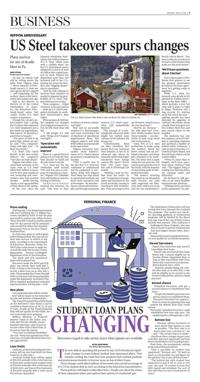
Plans unclear for site of deadly blast in Pa.
The U.S. Steel Clairton Coke Plant is seen on March 20, 2024, in Clairton, Pa.
NIPPON ANNIVERSARY
On July 20, Bernie Hall will be sitting across the table from Nippon Steel — whose takeover of Pittsburgh-based U.S. Steel one year ago he did not support — and bargaining for the workers' share of the blockbuster deal sealed a year ago.
Hall is the director of District 10 of the United Steelworkers of America, the downtown Pittsburgh-based union that counts 11,000 U.S. Steel workers as members.
Though the current contract expires Sept. 1, giving the 13 unions that represent U.S. Steel employees just a few weeks for negotiations, Hall expects "it should be a good time to bargain."
"The price of steel is up pretty high. Orders are up," he said. "The company's doing well right now — in their own words."
U.S. Steel CEO David Burritt, in his own words, believes the company's "best days are truly ahead."
Nippon executives reassured their investors of the same, even as U.S. Steel tallied $48 million in losses over its first nine months of new ownership and steelworkers who had received chunky profit-sharing checks a year ago grumbled at their absence this spring.
In the year since the Japanese steelmaker finalized its $14.9 billion takeover of U.S. Steel, which came with a "golden share" for the U.S. government and an obligation to invest at least $11 billion into capital projects by 2028, Nippon has dispatched more than 100 technical staff to the U.S., fanning out across its facilities and "digging deeper" into its operations.
"And we will continue to increase their numbers as needed to improve the profitability of U.S. Steel," Nippon told investors in May.
Three campuses — Edgar Thomson, Irvin and Clairton — make up U.S. Steel's integrated steelworks in southwest Pennsylvania's Mon Valley.
When people ask Hall how the company has changed since Nippon assumed control, he tells them time will tell.
"I tell people it's still early. Things don't happen overnight."
'Operation will undoubtedly improve'
There is a special kind of patience in an industry that took decades to build and decades more to recede.
"U.S. Steel was the top steelmaker until around 1970 and was once a company we regarded as a mentor," Nippon CFO Takahiko Iwai said during an investor briefing in February.
Underinvestment reversed the fortunes, he said. "The level of their workforce, however, remains very high."
Iwai said he personally monitors U.S. Steel progress each week, overseeing a list of hundreds of operational improvement items that Nippon expects will yield $500 million in annual profit in the near future.
Nippon executives have spoken about improvements at U.S. Steel as almost guaranteed, considering the baseline.
"This is partly due to the fact that U.S. Steel has continued to underinvest and its equipment is outdated, along with Nippon Steel being one step ahead in operational methods and know-how," executives said in November. "By introducing our advanced technologies and through equipment renewal, U.S. Steel's operation will undoubtedly improve."
This concept of a technologically advanced white knight has rubbed some veterans in the industry the wrong way.
"Unfortunately, there are false narratives that persist that our American steel industry is not in an advanced age, where we currently need technologies transferred from foreign sources like Japan," Nucor Steel CEO Leon Topalian said in Pittsburgh last month.
"Nothing could be further from the truth," he said. "Companies in Europe, Japan and elsewhere in the world are finally turning to investing in EAF technologies. They are racing to catch up. However, America has a 60-year head start."
Electric arc furnaces — the only kind that Charlotte, North Carolina-based Nucor operates — use electricity to melt scrap metal into steel products.
Some 70% of U.S. steel production is made using this method, which has fewer carbon and air pollutant emissions and fewer jobs attached to its facilities. The other 30% is made using iron ore and coal. The ratio is reversed in the rest of the world, with the majority of steel being made in integrated steel mills.
"We weren't investing that much in our integrated mills because our mini mills supported our fiduciary duty, which was to do best for our stockholders," Burritt said in March. "You have to allocate resources to the parts of the business that make you the most money."
'We'll have questions about Clairton'
This is what makes USW's Bernie Hall anxious to see the planned investments included in the labor agreement he's getting ready to negotiate.
While U.S. Steel has released some details for its planned $2.4 billion investment in the Mon Valley — which includes a new hot strip mill it plans to build at Edgar Thomson and a slag recycler it's starting on by the end of the year — nothing specific has been allocated for upgrades at Clairton Coke Works, where a deadly blast in August cost two workers their lives and sent several others to the hospital.
The explosion has cost the company some $33 million in operating expenses and spawned a number of federal safety violations, a critical report from the U.S. Chemical Safety Board, and lawsuits from widows of the workers killed.
"When it comes time to bargain, we'll have questions about Clairton," Hall said. "The biggest thing is making sure that the plants are running safely and efficiently."
He declined to talk specifics or say which facilities need particular attention.
"Making steel is very hard on the equipment," he said.