This content is unavailable. Please contact customer service for more information.
Already a subscriber? Login or Activate your account.
You've reached the end of the standard E-Edition.
This content is unavailable. Please contact customer service for more information.
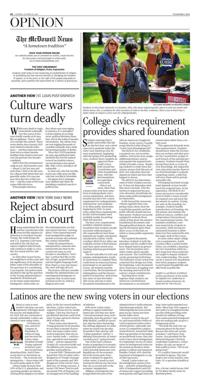
Culture wars turn deadly
ANOTHER VIEW | ST. LOUIS POST-DISPATCH
While every death is tragic, seven deaths nationally over the course of two years hardly sounds on its face like an epidemic. That is, until you consider the context: Those seven deaths since January 2025 were related to measles infections — and they represent more than twice as many measles fatalities than America had seen over the previous two decades combined.
Add to that the sustained new surge in non-fatal measles cases — almost 2,300 last year and more than 3,400 so far this year, for a disease that before that was generally under 100 cases per year since the turn of this century — and the scope of the issue comes fully into focus.
When people reference the culture wars now raging in America, it's a metaphorical description of our deep socio-political divisions these days. But in the realm of measles vaccinations, the culture wars are now logging thousands of casualties annually and a small but growing number of deaths.
Since the COVID pandemic six years ago politicized what should be the strictly medical issue of vaccination science, vaccine hesitancy has spread like, well, a virus, leaving us all vulnerable . ...
So wear any color hat you like, watch any cable news you like, vote how you like in November — but please don't endanger your children and others by mistaking a medical issue for a political one.
Reject absurd claim in court
ANOTHER VIEW | NEW YORK DAILY NEWS
Having undermined the law and the Constitution with some terrible opinions in deference to President Donald Trump, this week brings the new U.S. Supreme Court term, and with it the risk that our nation's highest judicial body will continue to make us a less fair, less moral and less safe society.
As with other recent terms, the weightiness of the court and the significance of its decisions belies some of the absurdity of the questions it is considering. Case in point, the justices have decided to take up the question of the Trump administration's mandatory detention policy for many undocumented immigrants, which relies on the reinterpretation of a federal statute that bars "arriving aliens" from requesting bond from immigration judges to include everyone who entered the country unlawfully.
Under this preposterous interpretation, someone who entered who has been in the country for years or even decades is classified as "arriving," a notion that flies in the face of logic, proportionality and the English language itself. Now, there's a very real chance the court will sign off on it.
The justices will also consider whether the administration can send deported immigrants to countries they've never been and have no ties to, which is illogical and cruel.
College civics requirement provides shared foundation
Students at Ohio State University in Columbus, Ohio, talk about
registering their peers to vote last month with Allison Russo,
left, a candidate for Ohio secretary of state in the Nov. 3
election. Ohio is one of more than a dozen states to require a
civics class for undergraduates.
USA TODAY NETWORK VIA REUTERS CONNECT
JUSTIN VAUGHN
Students entering Ohio's public universities this fall are the first four-year cohort expected to graduate under the state's new American civic literacy requirement. Beginning with the spring 2030 graduating class, students must complete an approved three credit course built around the Constitution and other foundational texts, with limited exemptions for equivalent coursework. Ohio is not alone. More than a dozen states now have some form of undergraduate civics course requirement, and Iowa recently enacted a two-course requirement for undergraduates entering four-year programs at its three public universities beginning in 2028. As more states adopt these requirements, faculty and lawmakers need workable models for putting them into practice.
The best civics requirements establish a limited common foundation that students should encounter while leaving faculty responsible for how those materials are taught, interpreted and placed in context. South Carolina's REACH Act offers one workable version of that balance, and I have spent several years teaching American government under it.
The law took effect in 2021 and requires undergraduates at public institutions to complete three credit hours in American history, government or an equivalent course. All students read the Constitution, the Declaration of Independence and the Emancipation Proclamation. Instructors also select at least five Federalist essays and one or more documents foundational to the African American struggle for freedom. In my course, I usually assign Martin Luther King Jr.'s "Letter from Birmingham Jail."
The REACH Act establishes a required core, not an entire syllabus. Instructors may assign additional primary sources and organize the required texts within a broader course. Requiring students to study these documents ensures that this part of their civic education does not depend on which electives they happen to choose.
The REACH Act determines some of what students encounter. It does not determine what they must conclude. That distinction is important because civic education should help students make political judgments for themselves.
In life beyond the classroom, citizens regularly hear competing claims about what the Constitution permits and how public officials should exercise their power. Students are poorly equipped to evaluate those claims if they know the nation's foundational documents only through political rhetoric. Reading the documents gives them direct access to the texts on which so many public arguments depend.
The required documents introduce students to both the principles and the conflicts that have shaped American government. The Declaration articulates claims about equality and consent. The Constitution creates governing institutions. The Federalist essays reveal how contested that design was from the beginning. Later documents show Americans struggling over the meaning and reach of the nation's stated commitments.
Teaching these works together helps students see American constitutional development as an extended conversation rather than a settled creed.
This approach demands more than memorization. Students should know when the Declaration was written and what powers the Constitution assigns to each branch of the national government. Students benefit from having these facts as a base of civic knowledge. But impactful civic education teaches them to use that knowledge to evaluate competing claims, a skill that will serve them well in private and public life.
Developing that kind of judgment depends on how faculty teach the assigned texts. In my experience, the REACH Act leaves instructors considerable room to build a course around its required core and teach the documents in context. During our unit on the founding, for example, students handle reproductions of founding-era documents and examine the political choices, conflicts and compromises that produced the constitutional system. The mandate establishes common material for students to encounter, while leaving me substantial freedom to determine how that material fits into the larger work of the course.
As more states adopt college civics requirements, South Carolina offers a useful model. States can establish a meaningful civic foundation while faculty shape how those materials are taught to deepen students' civic understanding. The result can be a shared civic foundation that better prepares students to participate thoughtfully and effectively in public life.
Vaughn is a professor of political science and director of the Center for Applied Civic Leadership at Coastal Carolina University. He wrote this for The Fulcrum.
Latinos are the new swing voters in our elections
MARY ELLEN KLAS
Almost as soon as next month's elections are over, arguments will begin about the lessons and implications for 2028. But one conclusion is already undeniable: Latinos are America's new swing voters.
If Democrats win control of Congress in November, it will be in large part because the Latino voters President Donald Trump captured in historic numbers in 2024 have abandoned him. And if Democrats don't act decisively on two fronts — the economy and immigration — these voters will be up for grabs again in 2028.
Latinos make up more than 20% of the U.S. population, and a growing number are demonstrating little allegiance to either party. In the last several midterm elections, Latino voters have supported Democrats by sizable margins. That was also true of presidential elections until 2024, when Trump captured a historic 48% of their vote.
These voters were drawn to Trump primarily by his promise to ease their economic frustrations. But many Latino voters work in industries that rely on cross-border trade — construction, agriculture and manufacturing — and are squeezed by Trump's ill-conceived tariffs and the inflated costs of groceries, gasoline and healthcare.
A recent NBC/Telemundo poll found that 74% of Latino voters disapprove of Trump's management of the economy and 78% disapprove of the way he's handled cost-of-living concerns. A recent CBS News/YouGov poll also found 74% of Hispanic voters disapproved of his handling of inflation. Polls show Latino voters willing to support individual Democrats, but they also show "a broad movement away, institutionally, from the parties," says Mike Madrid, a political consultant who has been chronicling the shifting alignment of Latino voters for nearly two decades. He predicts that what he calls "Latino populism" will be "a defining characteristic of American democracy" going forward.
One of the most common strains of populism is economic, and poll after poll shows Latino voters favoring Democrats over Republicans on the economy. But if the Democratic Party wants to deepen its appeal to Latino voters, it needs to start owning the debate over the issue they see as second only to the economy: immigration.
Millions of immigrants live in legal limbo because of the administration's indiscriminate and inhumane policies. But while Republicans have clearly gone too far, Democrats have mostly fallen short.
A recent survey by the policy and research firm Unidos of 3,000 registered Latino voters of both parties, nationally and across 32 competitive congressional districts, found that while their top priorities in November are pocketbook issues, they also want to hear about immigration. In a September survey of Latino voters in battleground states for the American Business Immigration Coalition and American Families United, 63% cited the treatment of immigrants as one of their top issues.
Overall, Latino voters say the immigration system is broken — and 64% of Republicans, 68% of independents and 85% of Democrats support providing work permits and legal status for long-term undocumented residents. More than 70% support a new policy to strengthen border security while providing work permits for millions of longterm undocumented immigrants who are working and can pass a background check.
"You built the wall, but can someone please fix the door? Because the entry exit system is broken,'' said Pastor Tony Suarez, vice president for the National Hispanic Christian Leadership Conference. Latino leaders, he said, are aware of their political clout: "We're not going away."
It's a reality Democrats would be foolish to ignore. The challenge is not a lack of policy solutions. It's a question of political will.
Klas, a former capital bureau chief for the Miami Herald, writes for Bloomberg News.
Click and hold your mouse button on the page to select the area you wish to save or print.
You can click and drag the clipping box to move it or click and drag in the bottom right corner to resize it.
When you're happy with your selection, click the checkmark icon next to the clipping area to continue.