

LOWER TAXES FOR ALL?
Legislature OKs bill capping individual income tax rate; measure places state constitutional amendment on Nov. 3 ballot
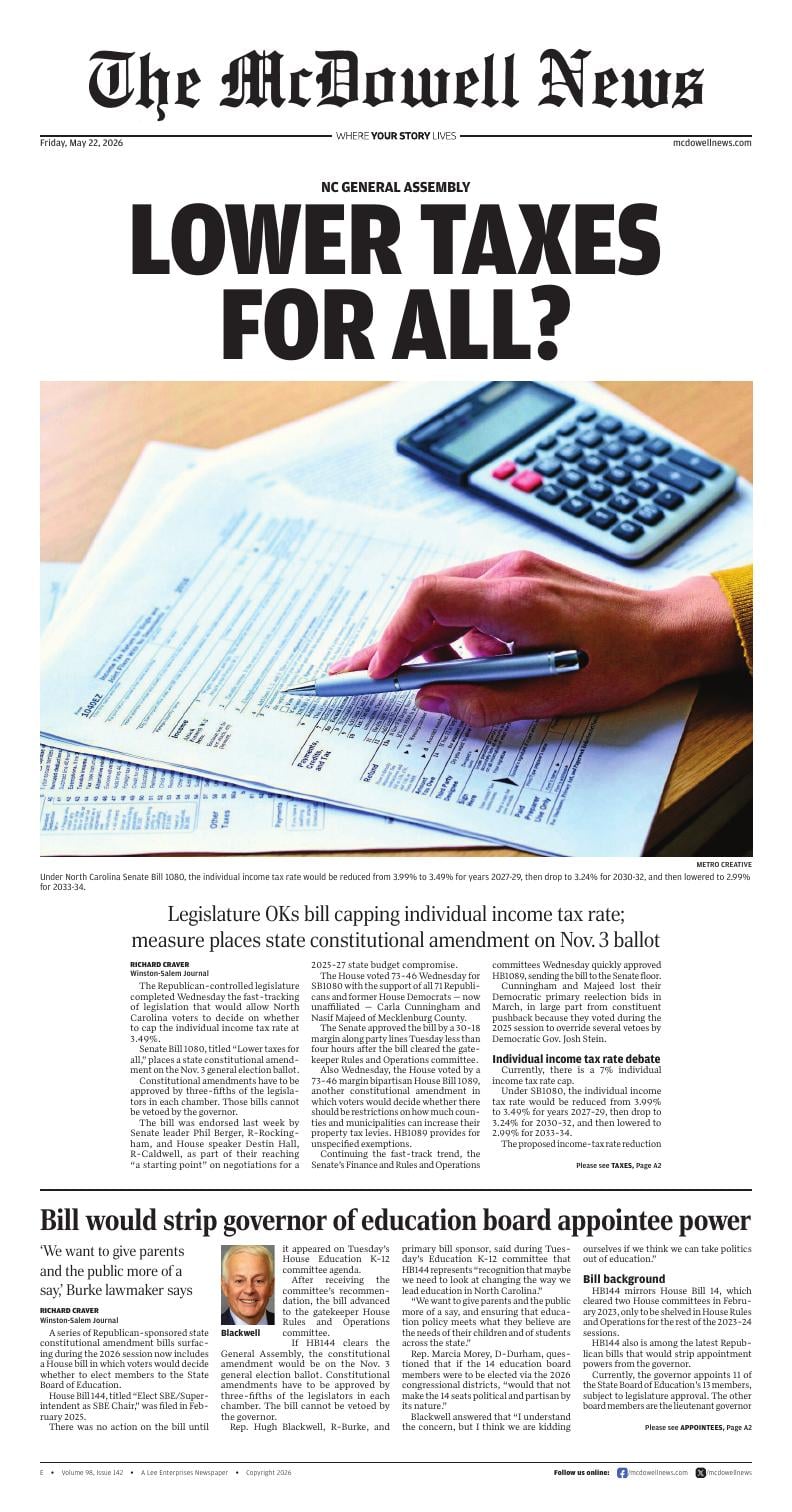
Under North Carolina Senate Bill 1080, the individual income tax rate would be reduced from 3.99% to 3.49% for years 2027-29, then drop to 3.24% for 2030-32, and then lowered to 2.99% for 2033-34.
NC GENERAL ASSEMBLY
The Republican-controlled legislature completed Wednesday the fast-tracking of legislation that would allow North Carolina voters to decide on whether to cap the individual income tax rate at 3.49%.
Senate Bill 1080, titled "Lower taxes for all," places a state constitutional amendment on the Nov. 3 general election ballot.
Constitutional amendments have to be approved by three-fifths of the legislators in each chamber. Those bills cannot be vetoed by the governor.
The bill was endorsed last week by Senate leader Phil Berger, R-Rockingham, and House speaker Destin Hall, R-Caldwell, as part of their reaching "a starting point" on negotiations for a 2025-27 state budget compromise. The House voted 73-46 Wednesday for SB1080 with the support of all 71 Republicans and former House Democrats — now unaffiliated — Carla Cunningham and Nasif Majeed of Mecklenburg County.
The Senate approved the bill by a 30-18 margin along party lines Tuesday less than four hours after the bill cleared the gatekeeper Rules and Operations committee.
Also Wednesday, the House voted by a 73-46 margin bipartisan House Bill 1089, another constitutional amendment in which voters would decide whether there should be restrictions on how much counties and municipalities can increase their property tax levies. HB1089 provides for unspecified exemptions.
Continuing the fast-track trend, the Senate's Finance and Rules and Operations committees Wednesday quickly approved HB1089, sending the bill to the Senate floor.
Cunningham and Majeed lost their Democratic primary reelection bids in March, in large part from constituent pushback because they voted during the 2025 session to override several vetoes by Democratic Gov. Josh Stein.
Individual income tax rate debate
Currently, there is a 7% individual income tax rate cap.
Under SB1080, the individual income tax rate would be reduced from 3.99% to 3.49% for years 2027-29, then drop to 3.24% for 2030-32, and then lowered to 2.99% for 2033-34.
The proposed income-tax rate reduction schedule would eliminate the requirement of meeting state revenue targets to trigger tax cuts.
"This constitutional amendment gives North Carolinians the chance to have a greater say in how their government taxes them," said Sen. Benton Sawrey, R-Johnston.
Sen. Michael Lee, R-New Hanover, said that sales tax revenue "obviously grows as people move here and spend money here without us even having to touch the particular rate."
Sen. Jay Chaudhuri, D-Wake, said he is concerned about the potential regressive and burdensome nature on lower-income North Carolinians in depending more on sales tax revenue.
Lee answered by saying since Republican tax reform initiatives began in 2013, "our revenues have increased by a $1 billion on average every single year. If we're using history as our guide, it will probably be a $1 billion over where we are today next year and the following year."
Lee said in terms of depending more on sales tax revenue, "people do feel what's going on today with the economy with the price of gas and prices in the grocery store."
"This is to shore up our commitment to the people. We've told them we're going to reduce the tax rate. We reduced the tax rate. This is to give them confidence that moving forward, we're not going to go back on our word.
"And if we need to change something, we can go back to the voters."
During Wednesday's House floor debate on SB1080, Rep. Robert Reives, D-Chatham, and House minority leader, said the legislation "ties the hands of future legislatures and makes it harder for our state to provide adequate public services and jeopardize our credit ratings."
"It will really handcuff our ability to address and respond to urgent situations and emergencies at a time the federal government is shifting more of those expenses and unfunded mandates on education, SNAP, Medicaid onto the states."
Alexandra Sirota, executive director of the left-leaning NC Budget & Tax Center, said state lawmakers are advancing constitutional amendments "that would lock North Carolina into an economy designed to benefit wealthy households and profitable corporations, while making it harder for everyone else to afford life, build security and get ahead."
"Whatever magic math appears in the June budget proposal, legislative leaders have already made their priorities unmistakably clear: first, lock their ideology into the state constitution by protecting tax breaks for the wealthy at our expense; second, offer shortterm, inadequate solutions to the real affordability challenges families face every day."
Sirota said that Republican legislative leaders "now suggest voters should be asked to shoulder the responsibility for tax policy choices they were never consulted on in the first place.
"State leaders created this affordability crisis through years of choices that prioritized tax giveaways over the well-being of the people of North Carolina.
"If they are unwilling to take responsibility for the consequences, it's time for North Carolinians to hold them accountable."
rcraver@wsjournal.com 336-727-7376 @rcraverWSJ