
DRONE LEARNING CURVE
US looks to Ukraine, Iran to evolve its use of unmanned aircraft

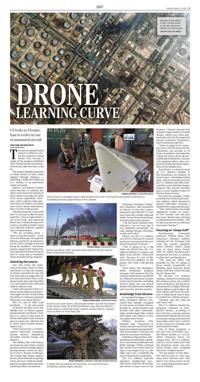
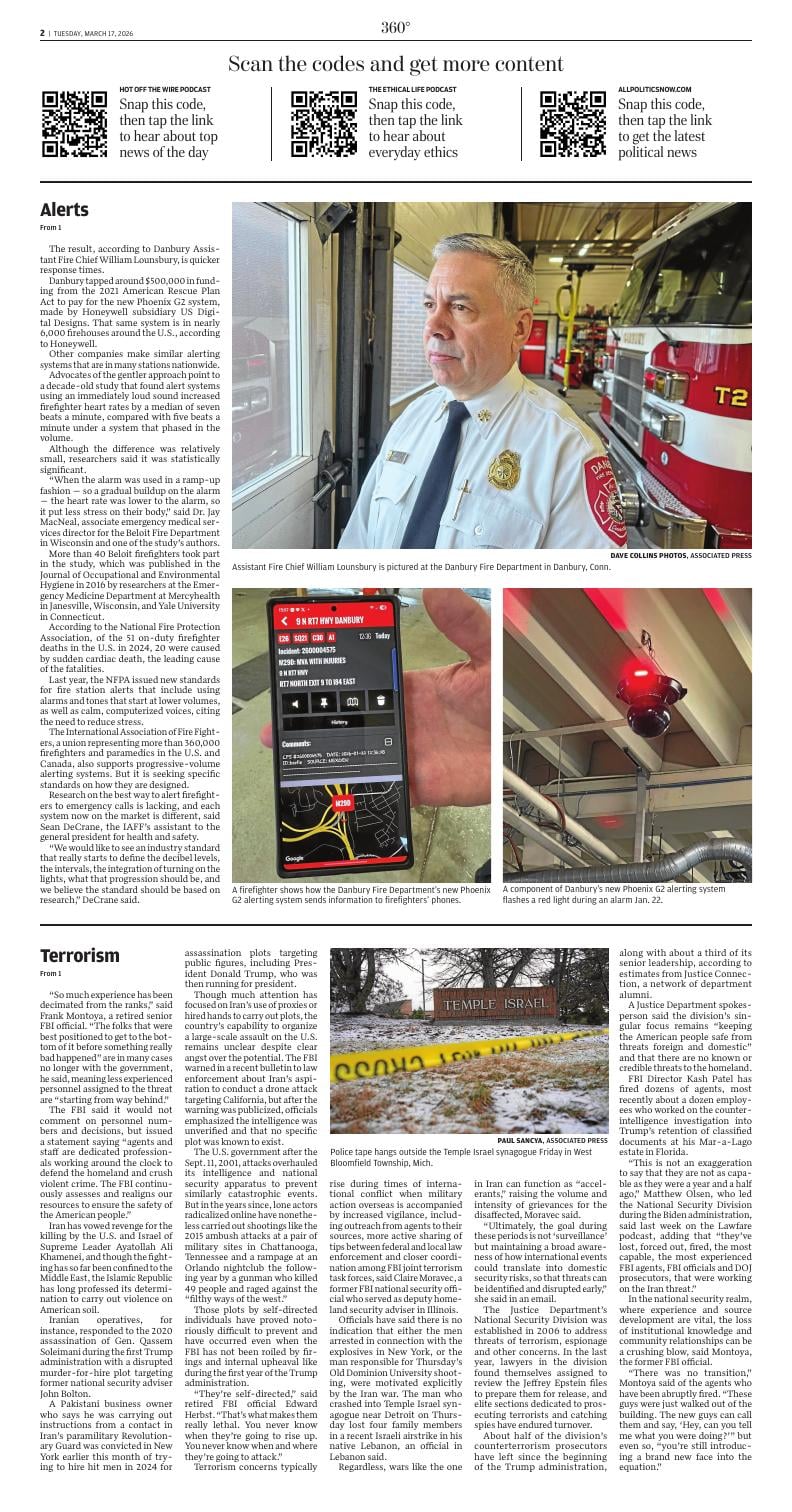
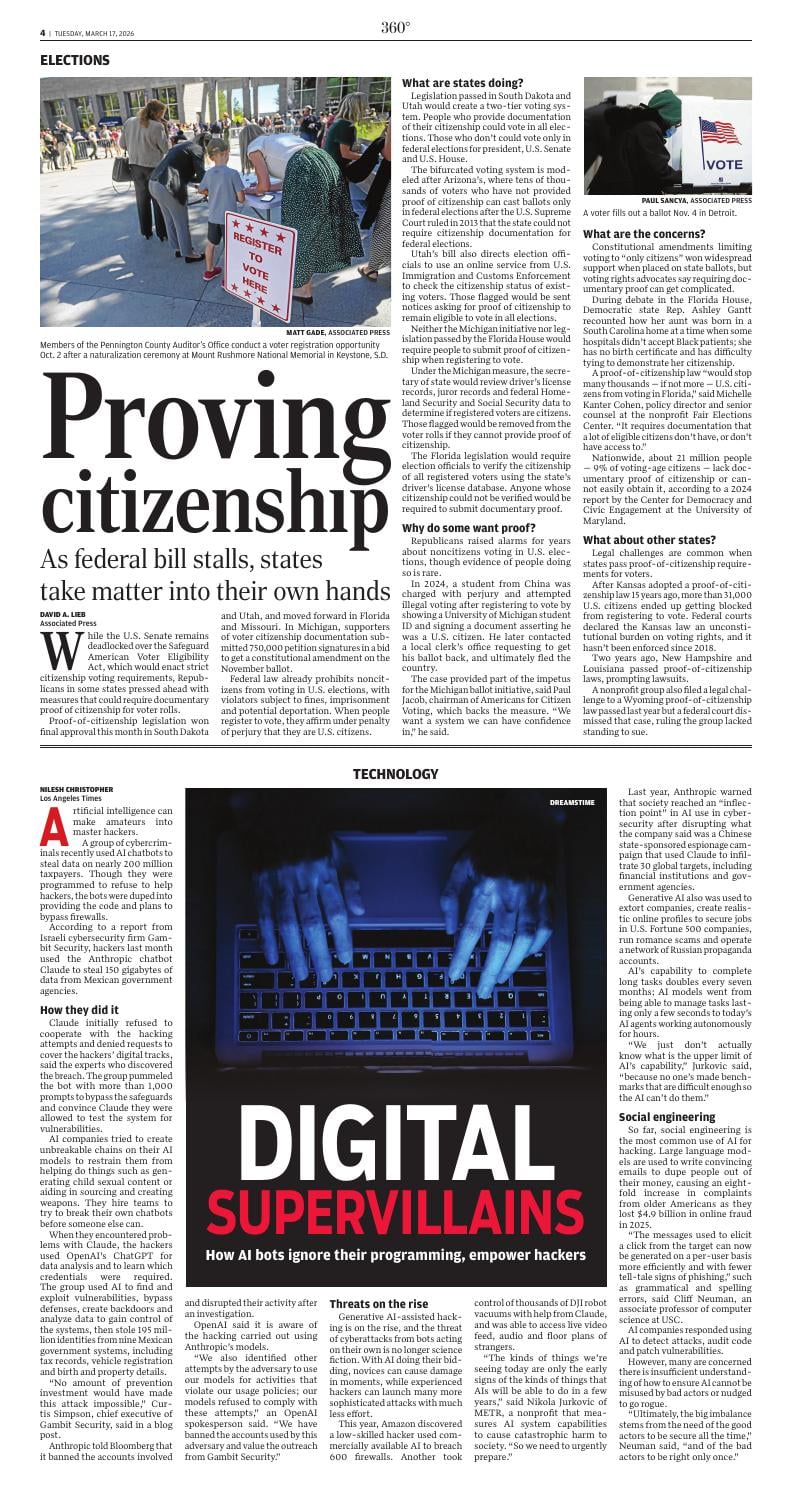
A soldier fires at a Russian FPV drone Feb. 27 on the front line in Druzhkivka, Donetsk region, Ukraine.

An Army carry team moves a flag-draped transfer case with the remains of Sgt. Declan Coady, 20, of West Des Moines, Iowa, who was killed in a drone strike at a command center in Kuwait, during a March 7 casualty return at Dover Air Force Base, Del.

Smoke rises March 1 after an Iranian drone attack in the port area of Dubai, United Arab Emirates.

Visitors look at a damaged Iranian-made Shahed drone June 27 during the International Conference on Expanding Sanctions Against Russia in Kyiv, Ukraine.

Damage is seen March 2 after a drone attack on the Ras Tanura oil refinery in Saudi Arabia.
The Iran war quickly tested America's ability to com-bat the swarms of cheap drones that became a staple of the modern battlefield after Ukraine and Russia demonstrated how effective they could be.
The Islamic Republic launched so many drones at once, some slipped through defenses — including a strike that killed six U.S. soldiers at an operations center in Kuwait.
Experts and defense leaders stress that the U.S. military was able to shoot down the majority of Iran's drones and take out much of its drone capabilities. However, critics said too often missiles that cost millions of dollars were used to down small drones that cost tens of thousands.
Ukraine proposed a deal with the U.S. last year to off er its drone expertise. Such an agreement is yet to be made, and American forces face a steep learning curve as they scramble to deploy more cost-efficient defenses against Iran's Shahed drones.
"We are crushing them — there's no doubt about it — but if even one drone gets through our defenses and hurts an American, for me, that is enough to warrant fixing the problem," said drone warfare expert Brett Velicovich, who operated Predator drones in the U.S. Army and co-founded a drone manufacturing company.
Attacking the source
Gen. Dan Caine, the chairman of the Joint Chiefs of Staff, said March 10 that the number of drones launched by Iran fell 83% since the war began Feb. 28. Iran launched more than 2,000 drones in the days after the initial U.S. and Israeli attacks, other top military off cials said.
Caine told reporters that U.S. forces struck military and industrial targets in Iran "to deny them the ability to continue to generate those one-way attack drones."
The U.S. and its allies used hundreds — if not thousands — of Patriot missiles across the Middle East to defend against Iranian missiles and drones. Now, the U.S. seems to rely more on attack helicopters and machine guns as a more cost-effective way to shoot down Iranian drones, experts say.
"Now we have low-cost interceptors effectively combating Iranian drones," Republican President Donald Trump said March 9.
The military also will bring in an American anti-drone system proven to work in Ukraine against Russian drones, which are similar to Iran's. Known as Merops, the system flies drones against drones, fits in the back of a pickup truck and uses artificial intelligence to navigate when electronic communications are jammed.
Ukrainian President Volodymyr Zelenskyy told journalists on March 10 that his country proposed a deal with the U.S. last year to provide cutting-edge and battle-tested drone technology, including interceptor drones.
"I do not know whether they refused it. I'm not sure, but it was definitely postponed," he said, adding Ukraine still hopes to sign such a deal.
Experts say the U.S. military was slow to overhaul its arsenal and tactics to respond to the new threat from fleets of drones.
"This is going to be a big wake-up call for how the U.S. military defends its citizens and fights wars forever," Velicovich said. "Because it's sort of like we're the best military on the planet, but stuff's still getting by us."
Travis Metz, the Pentagon's drone dominance program manager, told senators that the Defense Department committed $1.1 billion to buy drone systems in the next 18 months, including 30,000 small, one-way attack drones to be delivered to military units over the next five months.
Knowledge from Ukraine
In classified briefings to Congress, Pentagon off cials conceded they initially struggled to stop waves of Iranian drones, leaving U.S. service members and Persian Gulf allies vulnerable. High-profile targets like a Dubai skyscraper and airports across the region were struck.
Defense Secretary Pete Hegseth said, "thousands of Iranian missiles and drones have been intercepted and vaporized." Still, he conceded, "this does not mean we can stop everything."
Available in big numbers, Shahed drones showed their capability to oversaturate air defenses and inflict damage. While a Shahed flies slowly at just more than 110 mph, it can range as far as 1,240 miles and carry a relatively big load of 88 pounds of explosives.
The U.S. military typically operated complicated reusable drones that fire off missiles and return to base, such as the Predator. Ukraine showed that relying on large numbers of cheap drones, which carry their payloads directly into the target and become warheads themselves, can be extremely effective.
"There is going to be a learning curve, but the more that the Ukrainians can provide us in terms of guidance and expertise I think the better off we all are," said Brandon Blackburn, a former CIA targeting off cer who conducted counterterrorism operations in the Middle East.
Ryan Brobst, a scholar focused on U.S. defense strategy at the Foundation for Defense of Democracies, a Washington think tank, said social media posts by the U.S. military and allies indicated the use of relatively cheaper weapons like aircraft machine guns or laser-guided rockets to destroy drones in Iran.
He cited, for example, a video posted by the United Arab Emirates military, which showed an Apache helicopter shooting a Shahed with a large machine gun.
"The United States has made significant strides in counter-UAS warfare over the past few years," Brobst said, referring to unmanned aerial systems. "But it's also true that we can still learn more from Ukraine."
Focusing on 'cheap stuff'
Northwestern University professor William Reno, who researches Ukraine's military training for the Pentagon and visits the country regularly, noted Ukraine found cheap ways to shoot down drones with .50-caliber machine guns mounted in the back of a pickup or other fast-moving drones.
"The long-run effect will probably be that it's going to focus minds wonderfully on thinking more seriously about cheap stuff that comes through the air," Reno said.
For decades, U.S. military strategy counted on dominating the airspace above any conflict it got involved in, but the focus was primarily at higher altitudes where fighters and bombers fly. Now drones will force the military to think about what it does to control low-altitude airspace.
"Ukraine was the wake-up call," Reno said.
The U.S. military already has programs centered on inexpensive drones, according to Jerry McGinn, a former Defense Department off cial who focused on manufacturing and industrial base policy and is now a scholar at the Center for Strategic and International Studies.
One of those programs is the Low-cost Uncrewed Combat Attack System, or LUCAS, which American forces are using in Iran. The U.S. military said in a social media post that the American-made, one-way attack drones were "modeled after Iran's Shahed drones."
"It's not public on how effective they've been or how they were used," McGinn said. "But there's very much a focus in the U.S. of learning from the experience in Ukraine."