This content is unavailable. Please contact customer service for more information.
Already a subscriber? Login or Activate your account.
You've reached the end of the standard E-Edition.
This content is unavailable. Please contact customer service for more information.
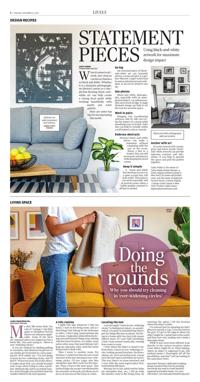
STATEMENT PIECES
Using black-and-white artwork for maximum design impact
CATHY HOBBS Tribune News Service
Abstract art adds movement and interest.
ADOBE STOCK PHOTOS
Black-and-white photography adds personality.
DESIGN RECIPES
When it comes to art-work, few choices can feel as timeless as black and white. Whether it is a dramatic photograph, an abstract canvas or a simple line drawing, black-and white art can help create a strong focal point while working beautifully with nearly any color palette.
Here are some top tips for incorporating this motif.
Go big
An oversized piece of black-and-white art can instantly anchor a room and give it a gallery-like feel. Larger works tend to read as intentional and confident, so do not be afraid to size up.
Use photos
Black-and-white photography, especially with an unexpected subject, can add personality and a touch of edge. A single dramatic image can help to set the tone for an entire space.
Work in pairs
Hanging two coordinating canvases side by side can create the impact of a mural while remaining easy to install. Pairs also can help to visually widen a wall behind a sofa or console.
Embrace abstracts
Abstract black-and-white pieces can make a statement without competing with the rest of the room. Above a bed or a mantel, they can add movement and interest while keeping the mood serene.
Keep it simple
A black-and-white line drawing can serve as a quiet accent that still feels artful. These pieces can work especially well in neutral rooms where a subtle graphic moment is all that is needed.
Anchor with art
In rooms layered with creams, grays and warm woods, black-and-white artwork can provide welcome contrast and definition. It can help to ground the space and pull the palette together.
Cathy Hobbs is the owner of Cathy Hobbs Design Recipes, a home staging company based in New York City (www.cathyhobbs.com), and the owner of Highland Passive House, a Home Staging + Design Center based in New York's Hudson Valley (www.highlandpassivehouse.com).
Doing the rounds
Why you should try cleaning in 'ever-widening circles'
LAURA WHEATMAN HILL Apartment Therapy
LIVING SPACE
My dad, like many dads, has a lot of "sayings," cute little quips or metaphors that he throws out whenever appli-cable. Some of his most oft-repeated advice has helped me live a better life. One such saying is, "Move in ever-widening circles."
It was his method for finding parking or a location, and whenever he got lost or our family got frustrated in a busy parking lot, he'd calmly say, "I'm just going to move in ever-widening circles, and I'll find it." When you zoom out on this advice, it might mean that you should broaden your scope when trying to solve a problem. Methodically and in an orderly fashion, work through your problem from the smallest detail to the most general.
A tidy routine
I apply this idea whenever I tidy my home. I start in the living room, and as I find things that belong in the bedrooms or office, I don’t ping-pong between the locations. I make piles while still in the living room and then put things away starting with the closest location. As I widen, I may notice other areas that need tidying, but I keep my epicenter static until the entire living room is dealt with.
Then I move to another room. For instance, I could move into my son’s room and start at the bed. Moving in ever-widening circles, I’ll toss Legos into bins and gather lone dirty socks for the hamper. Then, I’ll go to the next space. This method helps me not get overwhelmed by the enormity of the task and allows me to focus on one area of the house at a time.
Locating the lost
I can also apply “move in ever-widening circles” to finding lost objects. As an individual, I’m great at remembering where I put my things like keys or phone. But living in a home with two busy kids means objects move. If I can’t find something, I don’t look around chaotically, running from room to room.
I start where the object is meant to be. From there, I move in ever-widening circles, looking around furniture, the floors, shelves, etc. If it’s not in that room, I move on to the next space and widen my search. This way, there’s no stone unturned, and I start with the most logical place first, maintaining efficiency.
Moving out in this spiral motion helps me remember that, yes, I did go from the laundry room to the living room. By reversing the spiral, I hit the location where the object resides.
I’ve noticed that by repeating my dad’s phrase to myself as I go, I stay focused on the goal. If I get to the edge of where the object might be, I spiral back to the center and then start over, making sure I make a thorough sweep.
While it may seem more efficient to go directly to the various locations where a lost object might be or, when tidying, where an object is supposed to go, this method means I thoroughly hit all the possibilities and don’t end up looking in the same place twice.
Apartment Therapy is dedicated to helping people transform their lives by providing everything they need to create beautiful, organized and healthy homes. For more information, visit www.apartmenttherapy.com.
Click and hold your mouse button on the page to select the area you wish to save or print.
You can click and drag the clipping box to move it or click and drag in the bottom right corner to resize it.
When you're happy with your selection, click the checkmark icon next to the clipping area to continue.