
'It's a whole different world'
NIL, transfer portal force roster revolution
WOMEN'S COLLEGE BASKETBALL
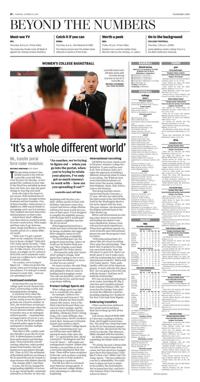
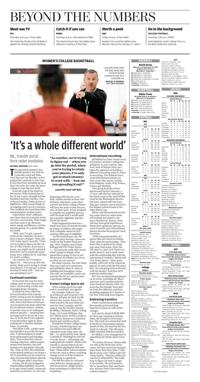
This upcoming women's basketball season is the 20th for Louisville coach Jeff Walz. Over the past two decades, as he's guided the Cardinals to four trips to the Final Four and piled up more than 500 wins, he's seen the sport change in ways big and small.
Fresh off a trip to the Sweet 16 last season, Walz retained four of his six top scorers, brought in three freshmen and four transfers. One of those transfers, Amiya Joyner, is eligible for a fifth season thanks to an ongoing court case in Louisiana. The Cardinals also have three international players on their roster.
Asked about what's different now than when he started in terms of roster construction, Walz laughs and then sums it up. Between name, image and likeness, and the transfer portal, it's a whole different world.
"Well, now I've got a spreadsheet on my computer, because I have to know a budget," Walz told USA Today Sports recently. "Then you're trying to figure out the values. It's like a house. If you have a house, you might say it's valued at $500,000, but if somebody wants to pay you a million for it, well then it's worth a million.
"As coaches, we're trying to figure out — when you go into the portal, when you're trying to retain your players, I've only got so much (money) to work with — how are you spreading it out?"
Continued evolution
As has been the case for every college sport in over the past few years, constructing a roster and managing keeps changing.
It started in 2018, when the NCAA introduced the transfer portal, easing access for players to go from one school to another. In 2021, the restrictions on that process loosened even more when the NCAA allowed student-athletes to transfer once as an undergrad without penalty — meaning they no longer had to sit out for a season. In 2024, the NCAA updated it transfer policy again to allow undergrads to transfer multiple times, no penalty.
Then there is NIL, a policy went into full effect across the NCAA in 2021. It allowed players to profit from endorsement and branding deals. That evolved into schools starting collectives, which pooled money from boosters, fans and businesses to pay players through NIL. Then, in 2025, the settlement of the federal antitrust case House v. NCAA paved the way for schools to share revenue with athletes directly.
The changes didn't stop there. In June, the NCAA changed its longstanding eligibility structure to an age-based model, commonly referred to as the five-in-five rule. Beginning with the day a student-athlete enrolls or their 19th birthday, whichever comes first, current and future college athletes will have five years to play five seasons of their sport. It was designed to simplify the eligibility process, with the hope that it would quell the countless eligibility lawsuits the NCAA faced.
What happened instead was a whole new wave of lawsuits brought by dozens of athletes who began their collegiate careers in 2022 seeking a fifth year of eligibility.
"As the football guys say, the goalposts keep moving. I guess we could say the baskets keep moving," West Virginia coach Mark Kellogg told USA Today Sports. "... You honestly really don't know what's going to change, what injunction is going to stay or not. We just put our blinders on, focus on what we can control."
For many coaches, the only thing they can count on is uneasiness and ambiguity when it comes to building and managing a roster. The rules are bendable, courts can overrule the NCAA, and the landscape keeps shifting.
Protect College Sports Act
What college sports has right now is, essentially, free agency.
For example, Auburn's Jessica Peterson and Syracuse's Tyi Skinner will play for their fourth schools this season. Iowa is the third school in the past three seasons for Dani Carnegie, and the same is true for Florida's Kiyomi McMiller, Oklahoma State's Yuting Deng, LSU's Jada Williams, Baylor's Skylar Jones, North Carolina's Achol Akot, Tennessee's Fatmateh Janneh and countless others.
Should the Protect College Sports Act pass, transferring every season will become more difficult. Among its many other aims, the bill — co-sponsored by Sens. Maria Cantwell (D-Washington) and Ted Cruz (R-Texas) — will require any undergraduate student-athlete who transfers a second time to sit out a year before playing for their new team. There will be some exceptions to the rule, such as when a coaching change occurs or if the student is transferring as a graduate.
The bill also aims to curb predatory behavior among agents. It will also prevent college athletes from unionizing or collectively bargaining.
International recruiting
Jeff Mittie has been a head coach in Division I women's college basketball for 31 years and has seen it all. Now at Kansas State, he's taken the approach of building a different mousetrap when it comes to recruiting. The Wildcats have seven international players on their roster this season, hailing from Belgium, Spain, Italy, France, Greece and Slovenia.
That group includes returning forward Nastja Claessens, a 21-year-old who was selected in the third round of the 2024 WNBA Draft by the Washington Mystics but never signed with the team. This past summer, she featured for the Belgian national team at the FIBA World Cup.
Mittie said international recruiting comes down to connections and making sure players coming to Manhattan, Kansas, from overseas have great experiences. When that reputation spreads via word of mouth, past international players become the program's best recruiters.
"With international kids, it's almost like old school recruiting. They value the relationships. They know they're going to be a long way away from home. Now, the NIL piece is a part of it, there's no doubt about it, but it really starts with the relationship first with the international students," Mittie told USA Today Sports. "Now, quite frankly, with a lot of the American players, it starts with the NIL piece first. Are you going to be in the mix with the money? And then we'll build the relationship."
BYU has six international players on its roster, including All-Big 12 selection and Canadian national team standout Delaney Gibb. Syracuse has five foreign-born players from five different countries, including reigning ACC Rookie of the Year Uche Izoje from Nigeria.
Embracing transfers
Other coaches have embraced the transfer portal and done their best to keep up with all the changes.
Last season, ahead of Molly Miller's first year coaching at Arizona State, she brought in seven transfers. The result was a team that went to the NCAA Tournament and produced 24 wins, the most for the Sun Devils in a decade. This offseason, Miller reloaded with five transfers.
For Miller, roster management is something she thinks about every day.
"It's funny, because I always joke I'm still on the front nine of my career, but how much has changed since those first three holes? I feel like it's been a lot," Miller told USA Today Sports. "The best ability for coaches is adaptability. You really have to figure out how to adapt to the market, the environment. We've leaned into that, and that's why Arizona State is becoming a school of choice."
"As coaches, we're trying to figure out — when you go into the portal, when you're trying to retain your players, I've only got so much (money) to work with — how are you spreading it out?"
Louisville coach Jeff Walz