
IRAN DEFIANT ON STRAIT OF HORMUZ
Trump tells Americans to brace for continued high fuel prices
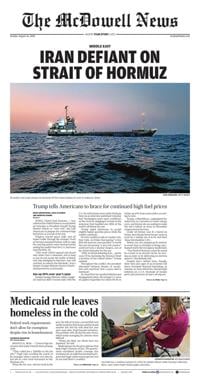
Oil tankers and cargo vessels are anchored off Port Sultan Qaboos on June 21 in Muscat, Oman.
MIDDLE EAST
DUBAI, United Arab Emirates — Iran called on the United States to accept defeat on Saturday as President Donald Trump blasted Tehran as "very evil" and told Americans to prepare for continued high fuel prices as a result of the war.
Progress toward peace talks and oil tanker traffic through the strategic Strait of Hormuz remained halted, with no sign the warring parties were moving toward ending the conflict that the U.S. and Israel launched Feb. 28.
"This strait will be opened and closed only under Iran's command, and so long as you do not accept the reality of defeat and stop indulging in fantasies, Iran will continue to enforce the blockade," Iran's Deputy Foreign Minister Kazem Gharibabadi posted on social media.
Gas up 29% over year's span
Iranian Foreign Minister Abbas Araghchi said Iran didn't resume talks with the U.S. He told Iranian news outlet Shahrara News in an interview published Saturday that Washington must meet conditions on the strait for shipping to resume in the waterway that handled one-fifth of the world's oil before the war.
Trump urged Americans to accept slightly higher gasoline prices while the conflict continues.
He told a political rally in Garden City, New York, on Friday that paying "a tiny little bit more for your gasoline" is worth the cost of ensuring "a very evil country" could not have a nuclear weapon, one of his stated rationales for the war.
"After we finish defeating Iran … pretty soon I'll be declaring the Hormuz Strait a territory of the United States," Trump claimed.
Throughout the conflict, the president alternated between threats of escalation and assertions that a peace deal is imminent.
In a trend that has sparked inflation and disappointed voters, the average U.S. price of a gallon of gasoline was about $4.08 on Friday, up 29% from a year earlier, according to AAA.
Trump, a Republican, campaigned for reelection on a promise to lower energy costs, and Democrats are seeking to make the war's fallout an issue in November congressional elections.
Crude oil futures rose $1 a barrel on Friday. Benchmark Brent futures were on track for a weekly rise of 6.0% and West Texas Intermediate 5.4%.
Tehran, too, has stepped up its rhetoric in recent days as attempts to bring a permanent end to the war appear deadlocked.
"The Strait of Hormuz cannot be seized by a tweet or an aircraft carrier, by issuing an order or by delivering an election speech," Gharibabadi said.
Despite Iran's defiant tone, though, there were also signs of an economic toll there. President Masoud Pezeshkian, in remarks on state television, blamed high inflation on a U.S. blockade of Iranian ports and sanctions on Iran's oil exports.
Strait locked up
Trump and Treasury Secretary Scott Bessent each pledged to inflict more financial damage on Iran. Bessent told Newsmax's "Rob Schmitt Tonight" program on Thursday that announcements of more measures against Iran were coming next week.
Tehran calls its enforcement of strait traffic a blockade — the term Washington uses for its threat against Iranian vessels leaving their ports.
"What we're doing is a great service for the world, not only for ourselves … and we're really doing a great job," Trump said.
Only two vessels passed through the Strait of Hormuz on Friday with no crude oil shipments visible, according to analysis from ship-tracking firm Kpler. Some ships could cross the strait undetected with their transponders off, but the figures are nowhere near the more than 130 ships that traversed it daily before the war.
Vessels that dare navigate the strait without Iranian permission risk missile or drone strikes.
The UAE accused Iran of attacking a third vessel operated by Abu Dhabi National Oil Company that was transiting the strait on Friday, the Emirati state news agency WAM reported, after blaming it for two other incidents involving ADNOC vessels in the strait on Thursday evening.
Attacks in Lebanon
Meanwhile, Israeli strikes killed at least 11 people in southern Lebanon on Saturday, Lebanon's health ministry said.
The Israeli military said it struck Hezbollah infrastructure overnight in what it described as a security zone in south Lebanon in response to actions against its soldiers.
Seven people were killed when Israeli warplanes struck a house in the southern village of Ansar, while four others were killed in a strike on the village of Deir El Zahrani, Lebanon's official National News Agency said.
Nineteen people were wounded in the attacks.
The strikes were among the deadliest in the weeks since Lebanon agreed to a U.S.-mediated peace framework with Israel. The deal leaves Israeli troops inside occupied southern Lebanon until Hezbollah is disarmed and the Lebanese army takes control, terms the Iran-backed group has rejected as surrender.
NNA also reported several other airstrikes across southern Lebanon, including on a strategic area north of the Litani River known as Ali al-Taher hill.
One Israeli airstrike, targeting a valley next to Ansar, was the deepest strike into Lebanon in two months.
In a statement, Hezbollah said the attacks on Lebanon would be "met with what they deserve."
The seven killed in Ansar included three children and two women, state news said.