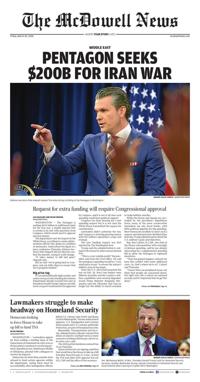

PENTAGON SEEKS $200B FOR IRAN WAR
Request for extra funding will require Congressional approval

Defense Secretary Pete Hegseth speaks Thursday during a briefing at the Pentagon in Washington.
MIDDLE EAST
WASHINGTON — The Pentagon is seeking $200 billion in additional funds for the Iran war, a sizable amount that is certain to be met with questions from Congress, which would need to approve any new money.
The department sent the request to the White House, according to a senior administration official who spoke on condition of anonymity. Asked about the figure at a press conference Thursday, Defense Secretary Pete Hegseth did not directly confirm the amount, saying it could change.
"It takes money to kill bad guys," Hegseth said.
But he said "we're going back to Congress and our folks there to ensure that we're properly funded."
Big price tag
It's an extraordinarily high number and comes on top of extra funding the Defense Department already received last year in President Donald Trump's big tax cuts bill. Such a request would need to be approved by Congress, and it is not at all clear such spending would have political support.
Congress has been bracing for a new spending request but it is not clear the White House transmitted the request for consideration.
Lawmakers didn't authorize the war, and Congress is showing growing unease with the military operation's scope and strategy.
The new funding request was first reported by The Washington Post.
Trump said the administration is asking for the money for other reasons beyond Iran.
"This is a very volatile world," the president said from the Oval Office. He said the emergency spending would be a "very small price to pay" to ensure the nation's military stays in top shape.
Since the U.S. and Israel launched the war on Feb. 28, Iran's top leaders were killed in airstrikes and the country's military capabilities were severely degraded. Israeli Prime Minister Benjamin Netanyahu said late Thursday that Iran no longer has the ability to enrich uranium or make ballistic missiles.
While the House and Senate are controlled by the president's Republican Party, many of the more conservative lawmakers are also fiscal hawks, with little political appetite for big spending. Most Democrats are likely to reject such a request and demand more detailed plans from the Trump administration about the U.S. military's goals and objectives.
Rep. Ken Calvert, R-Calif., the chair of the House subcommittee with oversight of defense spending, said he was already advocating for a supplemental spending bill to allow the Pentagon to replenish munitions.
"That was going to happen, and now we have this conflict with some additional costs. So, that's where we're at," Calvert said Thursday.
"I know there are peripheral issues out there that people are concerned about, but right now, this is about our national security and it's important that we get this done."
But Rep. Betty McCollum, D-Minn., the ranking Democrat on the House subcommittee with oversight of defense spending, said the president took the U.S. into a war without coming to Congress and she's demanding more details.
"This is not going to be a rubber stamp for the president of the United States," McCollum said.
She said Congress is still waiting for the administration to explain where it would spend the additional $150 billion funding that went to the Pentagon through Trump's tax and spending cut bill.
It's also waiting on the president's budget request for this year.
"I'm not writing blank checks to the Department of Defense," McCollum said.
The requested amount would be a hefty boost to the Pentagon's annual budget, which Congress approved at more than $800 billion for the current fiscal year.
That's on top of some $150 billion that Congress gave the Defense Department in last year's tax cuts bill, much of it for specific projects and overall upgrades to the Pentagon's operations.
Attacks on energy
Iran intensified its attacks on oil and natural gas facilities around the Gulf on Thursday, raising the stakes in a war that is sending shock waves through the global economy.
The strikes, in retaliation for an Israeli attack on a key Iranian gas field, sent fuel prices soaring and risked drawing Iran's Arab neighbors directly into the conflict.
Tehran's targeting of energy production further stressed global supplies already under pressure because of Iran's stranglehold on the Strait of Hormuz, a strategic waterway through which a fifth of the world's oil is transported.
Underscoring the danger to ships in the region, a vessel was set ablaze off the coast of the United Arab Emirates and another damaged off Qatar.
But efforts to bypass the strait were also under pressure: An Iranian drone hit a Saudi refinery on the Red Sea, which the country hoped to use as an alternative exit route.
Brent crude oil, the international standard, spiked to as high as $118 a barrel, up more than 60% since Israel and the United States started the war.
The European benchmark for natural gas prices rose 17% on Thursday and has doubled in the past month.
Qatar, Saudi Arabia and the UAE denounced the Iranian attacks. Arab League Secretary-General Ahmed Aboul Gheit called them a "dangerous escalation."
But Iran showed no signs of backing down. Saudi Arabia said its SAMREF refinery in the Red Sea port city of Yanbu was hit. Saudi Arabia had begun pumping large volumes of oil west toward the Red Sea to avoid the Strait of Hormuz.
In Israel, more than a half-dozen waves of Iranian attacks targeting large parts of the country sent millions of people to shelters. The strikes caused damage to buildings but no significant casualties were reported.
Israel said Thursday it struck Iranian targets in the Caspian Sea for the first time.
Israeli military spokesman Lt. Col. Nadav Shoshani said the strikes hit dozens of targets, including ships, a shipyard and a command center.