
'TAR HEEL BOYS OF SUMMER'
COVID project becomes sweeping history of NC baseball players
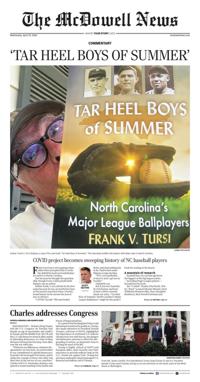
Author Frank V. Tursi displays a copy of his new book "Tar Heel Boys of Summer." The new book profiles 501 players with deep roots in North Carolina.
SCOTT SEXTON
COMMENTARY
Frank Tursi burst out laughing when asked what prompted him to write the definitive book on baseball players native to North Carolina.
Not because he thought the question silly, though it was a fairly predictable thing to ask an author.
Rather Frank, I can call him by his first name because he was an institution here at the Journal way back when I started, found humor in his answer because it was so obvious.
"COVID," he said. "We were locked down, and I had nothing else to do. I had to have something to occupy my time.
"If it's not profitable, at least it won't get me in trouble."
Definitely not. But if you love baseball, its rich history and have at least a little curiosity about our state, "Tar Heel Boys of Summer: North Carolina's Major League Ballplayers" might be the perfect book for reading at the beach.
A mountain of research
Baseball fans of a certain age know the biggest of the big league names — including Negro League players — included in the book.
Jim "Catfish" Hunter (Hertford), Walter "Buck" Leonard (Rocky Mount), Hoyt Willhelm (Huntersville), Enos Slaughter (Roxboro), Rick Ferrell (Durham) and Luke Appling (High Point) are in the National Baseball Hall of Fame. Anybody who grew up scouring batting averages printed in agate on Sundays has heard those names.
Locals, even those who only vaguely followed baseball, know the name Ernie Shore, the longtime sheriff of Forsyth County. Shore roomed with Babe Ruth when both men played for the Boston Red Sox.
Fun fact for trivia night: Shore, a right-handed pitcher from Yadkin County, threw what should be considered a perfect game in 1917 by retiring 27 hitters in a row.
But he and Ruth are only credited with a combined no-hitter because Shore came on in relief of Ruth, who was tossed out of the game after walking the first batter.
"I knew about those guys, so I started there," Tursi said.
And because Frank is a prolific, talented writer, he started writing them as profiles and posting them on social media for his friends to enjoy.
Once the snowball started rolling downhill, compiling them into a book was a natural next step. He'd retired from a second career working for the N.C. Coastal Federation and long ago had decamped to the coast he loves dearly, so he had the time.
"The internet made it easy," Tursi said. "I was able to sit in my house in Swansboro and do a lot of the research. Everything is online now. Five, 10 years ago, it would have been impossible."
His rules for inclusion were simple: a guy had to have been born in North Carolina. Those who later lived here or played minor league ball in the state were culled.
That meant Appling, a shortstop for the White Sox who was born in High Point before his family moved to Atlanta, was included.
Yankee great Derek Jeter, who played for the Greensboro Hornets in the South Atlantic League and Wilmer "Vinegar Bend" Mizell, who pitched for the Cardinals, Pirates and New York Mets before settling in Davidson County and later getting elected to Congress, didn't make the cut.
"I had to cut it off somewhere," Tursi said.
A sly answer
All told, Frank identified 501 men born in North Carolina who made it to the show before the 2024 season.
At least 50 native-born players logged time in the Negro Leagues. And because Frank is thorough, has a deeply ingrained sense of justice and grew up in New York cheering for the Brooklyn Dodgers — remember Jackie Robinson broke the color barrier in 1947 — there was no doubt he'd include as many Negro League players as possible.
"Their stories were harder to research," he said, "because of the inherent racism."
That meant plenty of what old-school reporters like Frank call "shoe leather" reporting. That means visiting cities and towns in person, knocking on doors and scouring microfiche in public libraries.
Not all 501 players got the full profile treatment; 34 did. The rest were covered in shorter thumbnail accounts.
Frank is scheduled to talk about "Tar Heel Boys of Summer" next month at Muse Winston-Salem as part of a book launch that's still taking shape. Which leads to another predictable question: What's your favorite story?
"I'll tailor that to wherever I'm speaking," he said with a cackle. "I'll have an Ernie Shore story for Winston-Salem."
Despite the pro-level cagey answer, Tursi admits to harboring a soft spot for Negro League player Charlie Smith, born in Hamlet, N.C., but often erroneously listed as a native of South Carolina.
"He went to school in South Carolina. Hamlet's on the border," Tursi said. "He very well may be the best hitter who ever played. It's a small sample size. (Smith) had a .400 lifetime average, but it's a small sample size. He only played four seasons before he died of cancer.
"(Hall of Fame pitcher) Satchel Paige always said that while Josh Gibson was the toughest hitter, Smith was the best."
Scott sexton has been a bemused observer of daily life — and occasional thorn in the side of elected officials — in Winston-salem since 2005. ssexton@wsjournal.com 336-727-7481 @scottsextonwsj