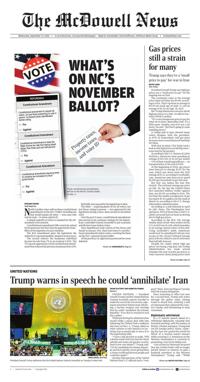

NC constitutional amendments on 2026 ballot. Here's what you should know
North Carolina voters will see three constitutional amendments on the Nov. 3 ballot, including one that would require all voters — even ones who vote by mail — to show a photo ID.
A simple majority of voters is required for the referendums to be enacted.
Constitutional amendment bills cannot be vetoed by the governor, but they must be approved by three-fifths of the legislators in each chamber.
The first amendment gives the legislature the authority to cap municipalities' property tax increases.
The second reduces the maximum individual income tax rate from 7% to an eventual 2.99%. The 7% cap was approved in a 2018 constitutional amendment that reduced the previous maximum from 10%.
Both bills were passed by the legislature in May.
The third — requiring photo ID for all voters, not just those voting in person — was approved by the legislature during a lame-duck session in December 2024.
Over the past 15 years, constitutional amendments have proven to be a primary strategy for the Republican-controlled General Assembly to put economic and divisive issues before voters.
Since Republicans took control of the House and Senate in January 2011, there have been 13 constitutional amendments before voters, counting the three on the Nov. 3 general election ballot.
Of the previous 10, eight have passed and two were defeated.
The N.C. Constitution does not allow for voters to petition for a constitutional amendment referendum.
Alexandra Sirota, executive director of the left-leaning NC Budget & Tax Center, said state Republican lawmakers are advancing constitutional amendments "that would lock North Carolina into an economy designed to benefit wealthy households and profitable corporations, while making it harder for everyone else to afford life, build security and get ahead."
Property tax amendment
Voters will have the ability to restrict counties' and municipalities' abilities to increase their property tax levies.
The property tax constitutional amendment is based on House Bill 1089, which emerged from recommendations by a bipartisan state House committee established by House Speaker Destin Hall, R-Caldwell. The bill provides for unspecified exemptions.
Voters are being asked to approve allowing the legislature to set a property tax levy cap that has not been announced by bill sponsors. State law currently limits the authorization of municipality property tax levies to $1.50 per $100 of value.
"Property taxes are out of control, and some local governments are abusing their power by overtaxing and underdelivering for their constituents," Hall said after the House vote.
"It’s time for real reform, and this constitutional amendment on levy limits will help stop runaway property tax hikes and protect North Carolina taxpayers."
Proponents of a levy limit say it would prevent local governments from increasing total property tax beyond a certain threshold, likely tied to inflation and population growth.
"It is the next step toward a modern, fairer and more predictable property tax system," said Rep. Brian Echevarria, R-Cabarrus.
Echevarria stressed his belief that the constitutional amendment will pass "because North Carolinians are ready for this. Property tax bill growth has exceeded inflation in eight out of last 10 years.”
House Democrats opposed to SB1080 said counties and municipalities are facing funding and services pressures.
"Many of our counties and towns are paying for essential services that are supposed to be paid for by the state, that are supposed to be paid for by this body." said Rep. Brandon Lofton, D-Mecklenburg.
"We know that these counties and towns primarily rely on property taxes to fund these essential services.
"So, if we know that our counties are stretched because they're doing our job, before we impose any revenue limits, we need to ask ourselves, how many teachers are we willing to risk losing? How many DAs, court personnel and police officers, are we willing to risk losing?"
Residential property tax rates are increasingly in the spotlight in large part because the Republican-controlled legislature has reduced the corporate tax rate from 6.9% in 2012 to 2% in 2026.
At 2%, the rate is already the lowest among the 44 states with a corporate tax rate. The rate is on track to reach 1% in 2028 and will be phased out in 2030.
This leaves property, retail sales and hotel occupancy taxes as the primary revenue streams for local municipalities and counties.
For example, Forsyth County Manager Shontell Robinson listed in her 2026-27 county budget proposal that the largest amount would come from property taxes at $365.97 million, or 61%. Sales tax is second at $107.29 million, representing 18%, followed by intergovernmental funds at $44.95 million, or 8%.
The legislation faced significant pushback and opposition from the N.C. League of Municipalities and several county commissions, including Forsyth, whose board approved a resolution opposing the legislation.
Income tax amendment
Senate Bill 1080, titled "Lower taxes for all," would reduce the individual income tax rate from 3.99% to 3.49% for years 2027-29, then drop to 3.24% for 2030-32, and then lowered to 2.99% for 2033-34.
The proposed income-tax rate reduction schedule would eliminate the requirement of meeting state revenue targets to trigger tax cuts.
"This constitutional amendment gives North Carolinians the chance to have a greater say in how their government taxes them," said Sen. Benton Sawrey, R-Johnston.
Sen. Michael Lee, R-New Hanover, said that sales tax revenue "obviously grows as people move here and spend money here without us even having to touch the particular rate."
Sen. Jay Chaudhuri, D-Wake, said he is concerned about the potential regressive and burdensome nature on lower-income North Carolinians in depending more on sales tax revenue.
Lee answered by saying since Republican tax reform initiatives began in 2013, "our revenues have increased by a $1 billion on average every single year. If we're using history as our guide, it will probably be a $1 billion over where we are today next year and the following year."
Lee said in terms of depending more on sales tax revenue, "people do feel what's going on today with the economy with the price of gas and prices in the grocery store."
"This is to shore up our commitment to the people. And if we need to change something, we can go back to the voters."
Rep. Robert Reives, D-Chatham, and House minority leader, said the legislation "ties the hands of future legislatures and makes it harder for our state to provide adequate public services and jeopardize our credit ratings."
"It will really handcuff our ability to address and respond to urgent situations and emergencies at a time the federal government is shifting more of those expenses and unfunded mandates on education, SNAP, Medicaid onto the states."
Photo ID
State Republican leadership is trying again to convince voters to approve expanding the photo voter identification law.
Senate Bill 921 requires voters to show a form of photo identification at all forms of voting, not just in-person. That includes during the early voting periods and on Election Day, as well as when voting absentee by mail and provisionally.
Proponents of SB921 claim the proposed constitutional amendment just expands and clarifies the intent of the 2018 Photo ID constitutional amendment.
“Voter ID is a commonsense security measure that needs to apply equally to all voters,” said Sen. Warren Daniel, R-Burke.
“As voting has evolved over the years, protecting against fraud needs to as well. We shouldn’t treat one form of voting differently, and our Constitution should reflect that.”
The state NAACP chapter sued in 2018, shortly after voters approved the photo-ID constitutional amendment.
The NAACP argues that any constitutional amendment is unconstitutional because of illegal racially gerrymandered districts in the state.
“Such provisions not only risk disenfranchising voters, but also perpetuate harmful stereotypes within our communities, eroding public trust in our electoral system.”
On Aug. 19, 2022, the 4-3 Democratic majority on the N.C. Supreme Court ruled the Republican-controlled state legislature did not have the authority to place state constitutional amendments on the ballot because lawmakers were elected from a district map that was found to be "unconstitutionally racially gerrymandered."
On April 28, 2023, the 5-2 Republican majority on the N.C. Supreme Court reversed that ruling, allowing the voter ID law to take effect.
“Whether you like the ideas or not, we all should remember that voters would make the ultimate decision about extending voter ID," said Mitch Kokai, senior policy analyst with conservative think tank John Locke Foundation.
“Lawmakers place constitutional amendments on the ballot. Only voters can approve or reject them.”