
HOUTHIS ENTER IRAN WAR
More US forces arrive as strikes continue in month-old conflict
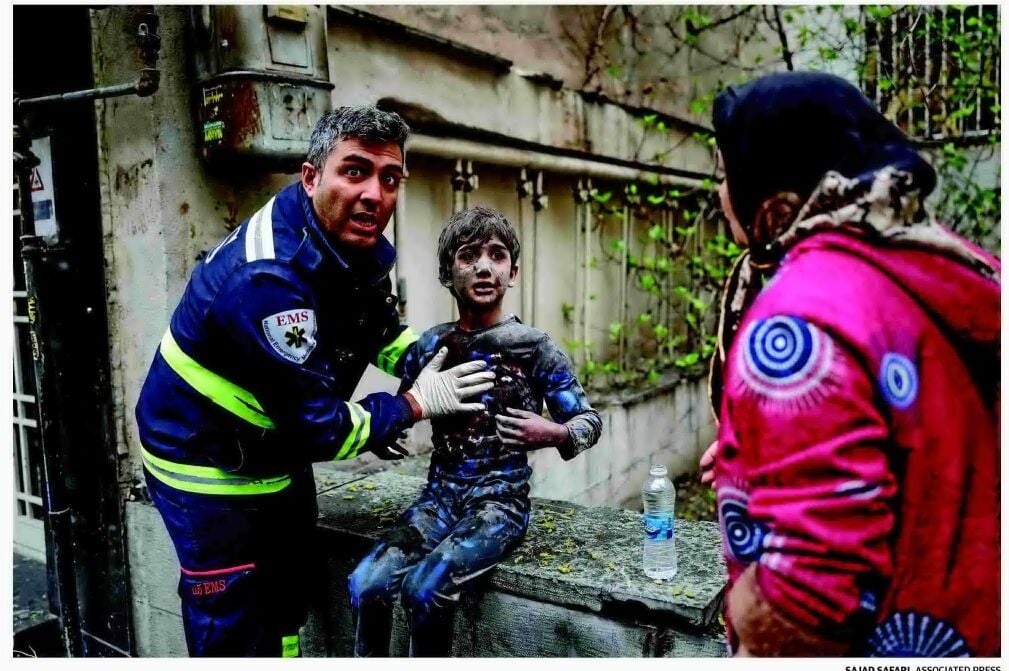
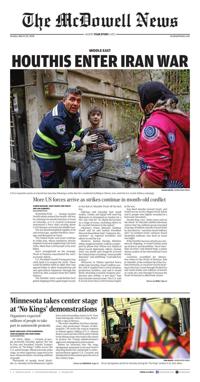
A first responder assists an injured boy Saturday following a strike that hit a residential building in Tehran, Iran, amid the U.S.-Israeli military campaign.
MIDDLE EAST
WASHINGTON — Iranian-backed Houthi rebels entered the month-old war by claiming two missile launches at Israel on Saturday, as U.S. Central Command announced a Navy ship carrying about 2,500 Marines arrived in the Middle East.
The war threatened global supplies of oil and natural gas, sparked fertilizer shortages and disrupted air travel.
The United States and Israel continue to strike Iran, whose retaliatory attacks targeted Israel and neighboring Gulf Arab states. More than 3,000 people so far were killed.
Iran's stranglehold on the strategic Strait of Hormuz exacerbated the war's economic fallout.
U.S. President Donald Trump gave Iran until April 6 to reopen the strait. There could be limited relief in sight after Iran agreed Friday to allow humanitarian aid and agricultural shipments through the waterway after a request from the United Nations.
The Houthis' entry could further hurt global shipping if they again target vessels in the Bab el-Mandeb Strait off the Red Sea.
Pakistan said Saturday that Saudi Arabia, Turkey and Egypt will send top diplomats to Islamabad on Sunday for a two-day visit for "in-depth discussions on a range of issues, including efforts to de-escalate tensions in the region."
Pakistan's Prime Minister Shehbaz Sharif said he and Iranian President Masoud Pezeshkian held "extensive discussions" on regional hostilities and efforts to end the war.
However, Iranian Foreign Minister Abbas Araghchi told his Turkish counterpart by phone that Tehran was skeptical about recent diplomatic efforts. Iranian state-run media said Araghchi accused the United States of making "unreasonable demands" and exhibiting "contradictory actions."
Witnesses in Tehran reported heavy strikes late Saturday. Israel's military earlier said it targeted Iran's naval weapons production facilities, and said it would finish attacking essential weapons production sites within "a few days." Iran fired missiles toward Israel. The U.S. said it struck more than 11,000 Iranian targets in the war.
Iran fired missiles toward Israel, and Israeli rescue service Magen David Adom said 11 people were lightly wounded in a town near Jerusalem.
Houthi Brig. Gen. Yahya Saree said on the rebels' Al-Masirah satellite television station that the militant group launched a barrage of ballistic missiles toward what he described as "sensitive Israeli military sites" in southern Israel. Lebanon-based Hezbollah militants also fired on Israel overnight.
If the Houthis increase attacks on commercial shipping, it would further push up oil prices and destabilize "all of maritime security," said Ahmed Nagi, a senior Yemen analyst at the International Crisis Group.
Countries scrambled for alternative routes to the Strait of Hormuz. Bab el-Mandeb, at the southern tip of the Arabian Peninsula, is crucial for vessels heading to the Suez Canal through the Red Sea and Saudi Arabia sent millions of barrels of crude oil a day through it because the Strait of Hormuz is effectively closed.
About 12% of the world's trade typically passes through Bab el-Mandeb and about 10% of global maritime trade — including 40% of container ship traffic — passes through the Suez Canal each year.
Houthi rebels attacked more than 100 merchant vessels with missiles and drones, sinking two vessels, between November 2023 and January 2025, saying it attacked in solidarity with Palestinians in Gaza during the war there between Israel and Hamas militants.
The Houthis have held Yemen's capital, Sanaa, since 2014. Saudi Arabia launched a war against the Houthis on behalf of Yemen's exiled government in 2015, and the rebels previously stayed out of the current conflict due to their uneasy ceasefire with Saudi Arabia.
Central Command said in addition to the Marines, the amphibious assault ship USS Tripoli also brought transport and strike fighter aircraft, as well as amphibious assault assets, to the region. The USS Boxer and two other ships, along with another Marine Expeditionary Unit, also were ordered to the Mideast from San Diego.
Additionally, at least 1,000 paratroopers from the 82nd Airborne, trained to land in hostile territory to secure key positions and airfields, were ordered to the region.
Secretary of State Marco Rubio said Friday the U.S. can meet its objectives "without any ground troops" but noted Trump "has to be prepared for multiple contingencies."
More than two dozen U.S. troops were wounded in Iranian attacks on Saudi Arabia's Prince Sultan Air Base in the past week, according to two people briefed on the matter who spoke on the condition of anonymity because they were not authorized to comment publicly. Iran fired six ballistic missiles and 29 drones at the base Friday, injuring at least 15 troops, including five seriously, they said.
The Saudi base came under attack twice earlier in week, including an incident that injured 14 U.S. troops, according to the people briefed on the matter.
The base — about 60 miles from the Saudi capital, Riyadh — is run by the Royal Saudi Air Force but also used by U.S. troops. The installation was targeted almost since the beginning of the war, which Saturday reached the onemonth mark.
Central Command said Friday that more than 300 service members were wounded so far in the war. Most returned to duty, while 30 remained out of action and 10 were considered seriously wounded.
Iranian authorities say more than 1,900 people were killed so far in the Islamic Republic, while 19 were reported dead in Israel.
In Lebanon, where Israel started an invasion in the south, officials said more than 1,100 people were killed since the start of the war.
In Iraq, where Iranian-supported militia groups entered the conflict, 80 members of the security forces were killed.
In Gulf states, 20 people were killed, along with four others in the occupied West Bank.