
Recess traits
Advocates for student breaks say they build important skills in kids
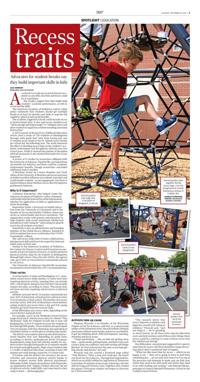
Second graders play together during recess Sept. 2 on the playground at Lincoln Elementary School in
Second graders play Gaga ball, a variation of dodgeball, in the pit.
Second graders climb on the playground.
Second graders line up at the conclusion of recess.
SPOTLIGHT | EDUCATION
As schools try to eke out as much time for academics as possible, free time and recess could be at a premium.
But studies suggest free time might help social and life skills.
The American Academy of Pediatrics said in a May policy statement that students should get multiple breaks of at least 20 minutes each daily to reap the full cognitive, physical and social benefits.
The academy suggested schools could include recess as instructional time. It also said recess should occur "often enough and long enough" to "mitigate stress and allow students to regain focus before resuming classroom instruction."
A 2019 Journal of Research in Childhood Education article cited a study of 728 students in kindergarten through sixth grade that went from having just one 15-minute recess break to two 15-minute recess breaks per school day the following year. The study measured the effect of doubling recess time on the students' academic achievement and disciplinary referrals over two school years. While it showed the number of discipline referrals increased, it also showed that math test scores improved.
A review of 13 studies by researchers affiliated with the University of Arkansas-Fayetteville concluded there are benefits for behavior and there could be academic achievement benefits, though researchers concluded additional study is needed.
A literature review by Connor Brandon and Trent Atkins of the University of Montana said recess may have an indirect positive influence on academic outcomes and could benefit students' social engagement, but there is mixed evidence about whether recess directly improves problematic behavior.
Why is it important?
Catherine Ramstetter, who helped create the American Academy of Pediatrics' policy statement, said breaks help the brain better retain information, whether for application of skills or application of future knowledge.
Ramstetter holds a doctorate in health education from the University of Cincinnati and is the founder of Successful Healthy Children, where she serves as school health and recess consultant. The organization works with parents and educators to help students with social-emotional, intellectual and physical well-being by "advocating for playful recess for all students everyday."
Ramstetter is also an administrator and founding member of the Global Recess Alliance, founded in 2020 to explore how recess could reduce the COVID19 pandemic's effects.
She said recess helps kids to learn collaboration, interpersonal skills and how to be respectful, kind and follow rules on their own.
Similar to the American Academy of Pediatrics, the Centers for Disease Control and Prevention recommends at least 20 minutes of recess, or similar period of physical activity, daily for all students in kindergarten through high school. Since the mid-2000s, the agency said, up to 40% of school districts nationwide reduced or cut recess.
The University of Arkansas-Fayetteville researchers recommend schools follow the CDC's recommendation.
Time varies
As of December, 12 states and Washington, D.C., mandated school recess while another 12 states have laws requiring physical activity, meaning they can include after-school sports and gym class but don't necessarily require free play, according to Axios. Wisconsin does not have any laws requiring school recess or physical activity.
EdWeek surveyed 464 K-12 teachers nationwide last year; 36% of elementary school teachers said recess lasts 21 to 30 minutes at their school. The number of recesses each day varied, with 26% of elementary school teachers saying students got recess twice a day and 12% saying students got more than two recesses daily.
In the Milwaukee area, recess varies, depending on the school district and grade level.
For example, recess in the Waukesha School District ranges from one 15-minute recess and a 30-minute "Play Workshop" daily for students in half-day 4-year-old kindergarten, to two 15-minute recesses for students in first through fifth grades. Those students also participate 30 to 60 minutes with Play Workshop, the equivalent of scheduled station or center play in small groups inside.
The district also requires physical education instructional minutes that vary depending on grade level, according to district spokesperson Kevin O'Connor. Requirements range from 100 minutes weekly for students in first through third grades to 125 minutes weekly for seventh and eighth grades. High school students take 1.5 credits of physical education, receiving at least 180 minutes per week during a semester, O'Connor said.
O'Connor said the district has resources for recess activities and classroom physical activity breaks to ensure students receive daily physical enrichment. Milwaukee Public Schools also partners with Playworks, an organization that "help(s) students discover the joy of physical activity, build skills, and come back to class ready to learn — all through play."
Activists take up cause
Shannon Wysocki, a co-founder of the Wisconsin chapter of Say Yes to Recess, said that, as a school social worker at the elementary level, she noticed kids sitting in classrooms without many breaks, and recess was limited. It got her thinking about child development, learning, attention and focus issues.
"I kept questioning ... why are kids not getting more time ... spent outside, getting breaks, and there's just such a heavy push on academics and state testing and things like that. So I just noticed over the years recess kept getting shorter and shorter," she said.
Wysocki said she created a Facebook page called "Play Matters." Then, a year and a half ago, she found out about Say Yes to Recess. Through that organization, which successfully lobbied for legislation in Tennessee to mandate 40 minutes of recess per school day, she met Allison Grigg and Victoria Carey. Together, they created the group's Wisconsin chapter and began to advocate for a Wisconsin bill.
"The research shows that recess improves academics and improves overall well-being of children," Wysocki said, "and our thing is ... we're spending so much money on all these extra special education costs and interventions and all these extra things when recess could be a solution to some of those issues that the children are having."
One Milwaukee-area principal suggested he's open to more time for recess, but there should be a larger discussion about what's needed for that to happen.
"When we take more time for recess — which we are happy to do — then we're going to have to pull from something else … we are only here from 8 to 3 on top of the pressures and demands to make sure our kids (are) where they need to be with math and where they need to be with reading and writing," said Michael Moore, principal of General Mitchell Elementary School in the Cudahy School District.