
Master of escape
100 years after death, Harry Houdini still a revered magician

Teller

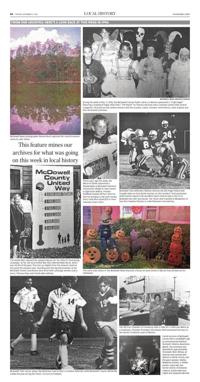
A 1905 portrait of Harry Houdini, the "Handcuff King"

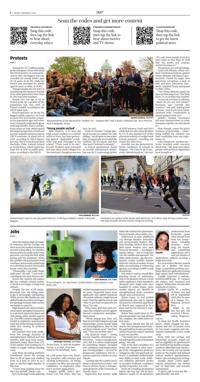
A crate containing Harry Houdini is lowered from a ship into New York Harbor during a 1914 public performance.

Houdini, wearing chains and handcuffs, prepares to jump from Harvard bridge into the Charles river on April 30, 1908, in Boston.

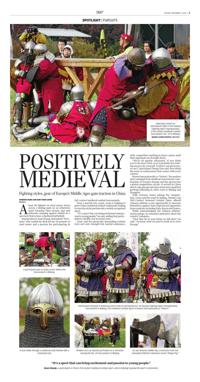
A crowd gathers in January 1922 in front of the Treasury building in Washington to watch one of Houdini's public straitjacket escapes.

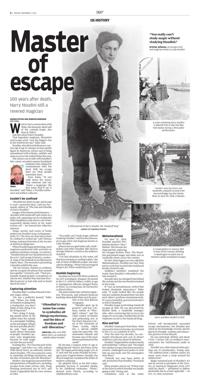
Harry and Bess Houdini in 1922
US HISTORY
Want to start a conversation with Teller, the famously silent half of the comedy-magic duo Penn & Teller?
Ask him about Harry Houdini.
That legendary magician, illusionist and escape artist "was the biggest star in the world in his day," Teller said.
Houdini, who died on Halloween a century ago at age 52, remains an inescapable figure in American culture and is being remembered with tributes, exhibits and séances across the United States this year.
The séances are at odds with Houdini's late-career crusade to expose fraudulent mediums who claimed to communicate with the dead. Still, his escape feats are what people remember most.
Even today, "if you walk down the street, stop someone and say, 'Name a magician,' the first name they'll say is Houdini," said Teller, a Houdini enthusiast and artifact collector.
Couldn't be confined
"Houdini was about escape, and escape is such a powerful idea," said Joe Posnanski, author of "The Life and Afterlife of Harry Houdini."
Images of his famous performances — shackled with handcuffs and chains in a police cell, squirming out of a straitjacket while dangling by rope above a city street, suspended upside-down in his water torture cell — are burned into collective memory.
Songs, movies and scores of books underscore Houdini's long-lasting popularity. It's "the story of a man who cannot be confined or locked up," said Thomas Ewing, national historian of the Society of American Magicians.
When Houdini began performing, most magicians performed with assistants or audience members onstage. In contrast, "Houdini himself was the prime focus of his acts," said George Schwartz, curator-at-large at the Peabody Essex Museum in Salem, Mass. The museum is presenting a Houdini exhibit this year.
"He was bound, chained or confined, and he escaped situations that seemed inescapable," Schwartz said. "That profoundly shaped people's conceptions of who he was, whether they had seen Houdini in person or had only read or heard about his feats."
Capturing attention
Houdini didn't confine himself to theater stages, either.
"He was a publicity hound," Teller said. "When you think of Houdini escaping from a straitjacket, you don't think of him doing it in his living room."
"He's doing it hanging upside down by his ankles from the outside of a newspaper building, so the newspaper will get the best possible photo," he said. "And underneath, there's thousands of people. Houdini captures your imagination because he took magic out into the real world."
In doing this, "he's become part of the language," said John Cox, who authors Wild About Harry, an authority website about Houdini. "His very name has come to symbolize all things mysterious, and the idea of freedom and self-liberation."
Modern-day magicians presented their interpretations of Houdini acts, including escapes from water torture cells. Doug Henning performed one in 1975, and David Copperfield did his own version in 1984.
"You really can't study magic without studying Houdini," said Kristen Johnson, an escape artist and magician known as Lady Houdini.
Johnson has escaped water cells, straitjackets and other Houdini-like devices onstage without a curtain as the audience watched.
"I've had situations in the water cell that have not gone according to plan," she said. In times of difficult escapes, she stays calm by thinking, "What's the most logical thing to do? What would Harry do?"
Humble beginning
Houdini was born Erik Weisz on March 24, 1871, in Budapest, Hungary. He moved to the U.S. with his father, a rabbi, at age 4. Immigration officials changed Weisz to Weiss. As a young man, he was known as Ehrich Weiss.
The entire family later settled in Appleton, Wisconsin, and endured financial hardship when Rabbi Weiss lost his position at the Zion Reform synagogue.
"Houdini grew up in poverty," said Eric Colleary, author of "Houdini's Library" and the Cline curator of theater and performing arts at the Harry Ransom Center at the University of Texas, Austin, which has a special exhibit under the same title. "He reinvented himself and became one of the most famous performers in the world."
He became a trapeze artist at age 9, calling himself "Ehrich, the Prince of the Air." He began performing magic acts at 17 and took the name Houdini in homage to Jean-Eugène Robert-Houdin, the French magician considered the father of modern conjuring.
He adopted Harry as his first name, probably because it sounded similar to his childhood nickname, "Ehrie," derived from Ehrich, according to wildaboutharry.com.
Metamorphosis
On June 22, 1894, Houdini married Wilhelmina Beatrice "Bess" Rahner. She became his stage partner, replacing his younger brother Theo. The Houdinis performed magic and other acts in vaudeville shows across the country.
By 1895, their biggest act was called the Metamorphosis. Houdini was tied, then put in a sack that was tied shut and placed inside a locked trunk.
Audience members examined the trunk, then Houdini's wife pulled a curtain around it.
Seconds later, he emerged from behind the curtain and she was found restrained in the trunk.
It "was an instantaneous switch that looked absolutely miraculous," Teller said. "It really looked like two people had just suddenly dreamed their way into each other's positions instantaneously. It's such a beautiful, practical trick that's so full of meaning."
Houdini began performing handcuff escapes in 1895. He was discovered by Martin Beck, a vaudeville manager, who, after convincing him to focus his stage acts on escapes, booked him on the Orpheum circuit as the Handcuff King.
Rise and fall
Houdini's fame grew from there. After successful shows in Europe, he returned to the U.S. as a celebrity in 1905.
Over the next two decades, he constantly introduced new acts to attract audiences and stay ahead of imitators.
Houdini "helped define modern media and marketing," Colleary said. "He staged free outdoor escapes that drew enormous crowds, challenged local police to lock him up and made sure the newspapers were there."
"Nobody has ever been better at self-promotion than Houdini," Posnanski said.
Many people came to see "if they were at the show in which Houdini was finally going to fail," Ewing said.
Containers such as the water torture cell incorporated concealed escape mechanisms, but Houdini also relied on his knowledge of locks and his physical strength, stamina and exhaustive practice to free himself.
He was extremely athletic and about 5 feet, 5 inches tall, according to measurements the Smithsonian made in 1926.
Houdini was often injured when getting out of straitjackets, Ewing said. "He suffered from a kidney injury for many years from a strap around his midsection."
Magic remained part of Houdini's act and he served as president of the Society of American Magicians from 1917 until his death — attributed to diffuse peritonitis due to a burst appendix — on Oct. 31, 1926, in Detroit.
"(Houdini's) very name has come to symbolize all things mysterious, and the idea of freedom and self-liberation."
John Cox, who runs Wild about Harry, an authority website about Houdini
"You really can't study magic without studying Houdini."
Kristen Johnson, an escape artist and magician known as Lady Houdini