
PREYING ON THE FAITHFUL
Priest impersonators proliferate, offering fraudulent services
SPOTLIGHT| MEXICO
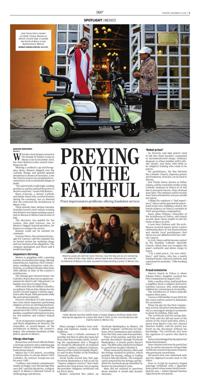
When Rev. Jesús Romero arrived at the funeral of Dahina Loaiza in Mexico City in December 2024, her sister Roberta Loaiza sensed something was off.
Wearing a cardinal's cap and Ferragamo shoes, Romero skipped over the Catholic liturgy and granted general absolution to dozens of mourners, a rite the Church reserves for exceptional circumstances such as imminent danger of death.
"He said he held a really high-ranking position as a priest and had the power to absolve everyone," Loaiza told Reuters.
Elena D'Acosta, a devout Catholic and family friend who assisted Romero during the ceremony, was so alarmed that she contacted the Archdiocese of Mexico City.
Three months later, Bishop Salvador González issued a news release warning that Romero was impersonating a priest and no diocese in Mexico had records of him.
The discovery was painful for the Loaizas, who paid Gayosso, one of Mexico's biggest funeral providers, for Romero to conduct the service.
Romero could not be reached for comment.
Gustavo Torres, the commercial manager for Gayosso, said the company has no formal system for verifying clergy and was unaware of the allegations. The company apologized, and Torres said it would investigate.
Impostors thriving
Mexico is grappling with a growing number of unauthorized clergy, offering funeral Masses, baptisms, First Communions, weddings and patron-saint celebrations, according to Reuters interviews with officials in nine of the country's archdioceses.
The damage goes beyond money: the Catholic Church does not recognize sacraments by what it calls "fake priests," so families may have to repeat them.
With more than 120 million Catholics, according to Vatican data, Mexico has the world's second-largest Catholic population after Brazil. Faith permeates daily life and national identity.
Dioceses elsewhere in Latin America also warn about impostors performing religious services or soliciting donations.
Seven Mexican dioceses said the frauds spread since the COVID-19 pandemic as families scrambled to find priests to pray for sick relatives and conduct funeral rites.
"A lot of impostors started to appear," said María Magdalena de Ibarrola, the chancellor, or record-keeper, of the Archdiocese of Mexico, the country's largest. She estimates hundreds of fake priests operate in Mexico.
Clergy shortage
Researchers and church officials blame a shortage of priests and a widening gap between cultural Catholicism and the institutional church.
Mexico has 17,331 priests, according to Vatican data, or one per almost 7,000 Catholics. By contrast, Europe has one for every 1,882.
"Celibacy and related commitments simply no longer carry the prestige they once did," said Elio Masferrer, a religion expert at Mexico's National School of Anthropology and History.
Many younger Catholics treat weddings and baptisms mainly as family traditions.
"They want a Catholic ceremony if possible, but they're often disconnected from what that actually entails, including the requirement that a liturgical act should be officiated by an ordained minister," said Rev. Guillermo Gutiérrez, director of the Center for Family, Bioethics and Society Studies at the Pontifical University of Mexico. Social media moved into that gap. Facebook Marketplace is full of ads for "express religious services" that rarely mention the Church does not recognize the providers. Religious certificates sell for $30 to $100.
Reuters contacted five sellers on Facebook Marketplace in Mexico. All offered "original" certificates for baptisms, First Communions and Confirmations that they said came from parishes.
Three of the parishes said they don't provide documents through Facebook Marketplace. A fourth parish doesn't exist. The fifth seller claimed to be linked to a parish but wouldn't identify it.
When contacted by Reuters, Meta said the listings violated its policies, which prohibit the buying, selling or trading of real or fake documents. The company said it removed the five listings and disabled the Facebook group identified by Reuters for breaching its rules.
Meta did not respond to questions about whether it would take broader measures.
'Rebel priest'
De Ibarrola said fake priests tend to fall into three buckets: suspended or excommunicated clergy; seminary dropouts or others familiar with Catholic rituals; and those with little or no religious training who claim to be priests.
For parishioners, the line between the Catholic Church, impostor priests and breakaway churches can be hard to discern.
José Tomás Sierra, known as Father Chema, said he started his studies at the Catholic seminary in Toluca at 14, left due to personal reasons, then returned years later. The seminary said its records show Sierra attended for one year and did not return.
Calling the seminary a "bad experience," Sierra said he pursued the priesthood on his own, building a church, the Parish of Mercy, on Toluca's outskirts in 2009 and growing a congregation.
Jonás Jaime Pedraza, chancellor of the Archdiocese of Toluca, said church records show Sierra sought to join the Order of Mercy in 2010.
A year later, Pedraza said, the archdiocese received reports about a priest celebrating Mass in San Buenaventura and alerted local parishioners that Sierra was not affiliated with the Catholic Church.
In 2019, Sierra said he became a priest in the Brazilian Catholic Apostolic Church, which does not recognize the pope's authority and allows clergy to marry.
"I'm a rebel priest, I'm very rebellious," said Sierra, who has a neatly trimmed beard, tattooed eyebrows and a penchant for profanity. "I like breaking rules."
Fraud extensive
Sierra's church in Toluca is where Paloma Peña's daughter received her First Communion in August 2025.
Peña, a mother of two, had heard from a neighbor about a religious instructor, Gabriela Carrasco, who could prepare children for communion in six months.
The Archdiocese of Toluca typically requires three years.
Carrasco told families to pay $200 for the course and for a priest to administer the sacraments.
When the day for the First Communion arrived, the priest introduced himself as a monsignor and gave sacraments to about 40 children, Peña said.
The certificate had the wrong date, but Peña said she did not learn of the extent of the fraud until May when a priest from Mexico City, Rev. Manuel Sánchez Padilla, said his parish was listed on the document without his knowledge. The certificate also bore the signature of a priest who died in 2020.
Sierra acknowledged the deception but denied involvement.
Since Sánchez took over his parish last year, he said he uncovered a string of fake certificates issued in the name of priests who previously served there.
His parish now uses embossed seals and has digitized records back to the 1980s.
Even so, in July he received a forged marriage certificate with a signature from a priest whose name closely resembled his own — Father Manuel Sánchez Tapia from his own parish.