

IRAN'S NEW LEADER VOWS TO KEEP UP ATTACKS
Country aims to pressure US, Israel to halt bombardment
Khamenei

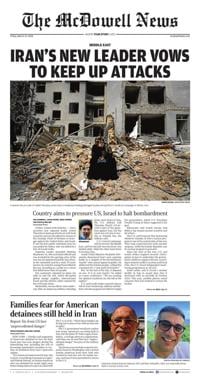
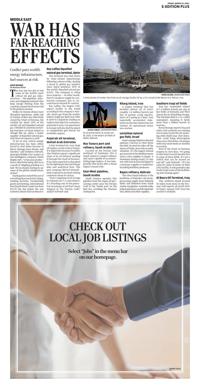
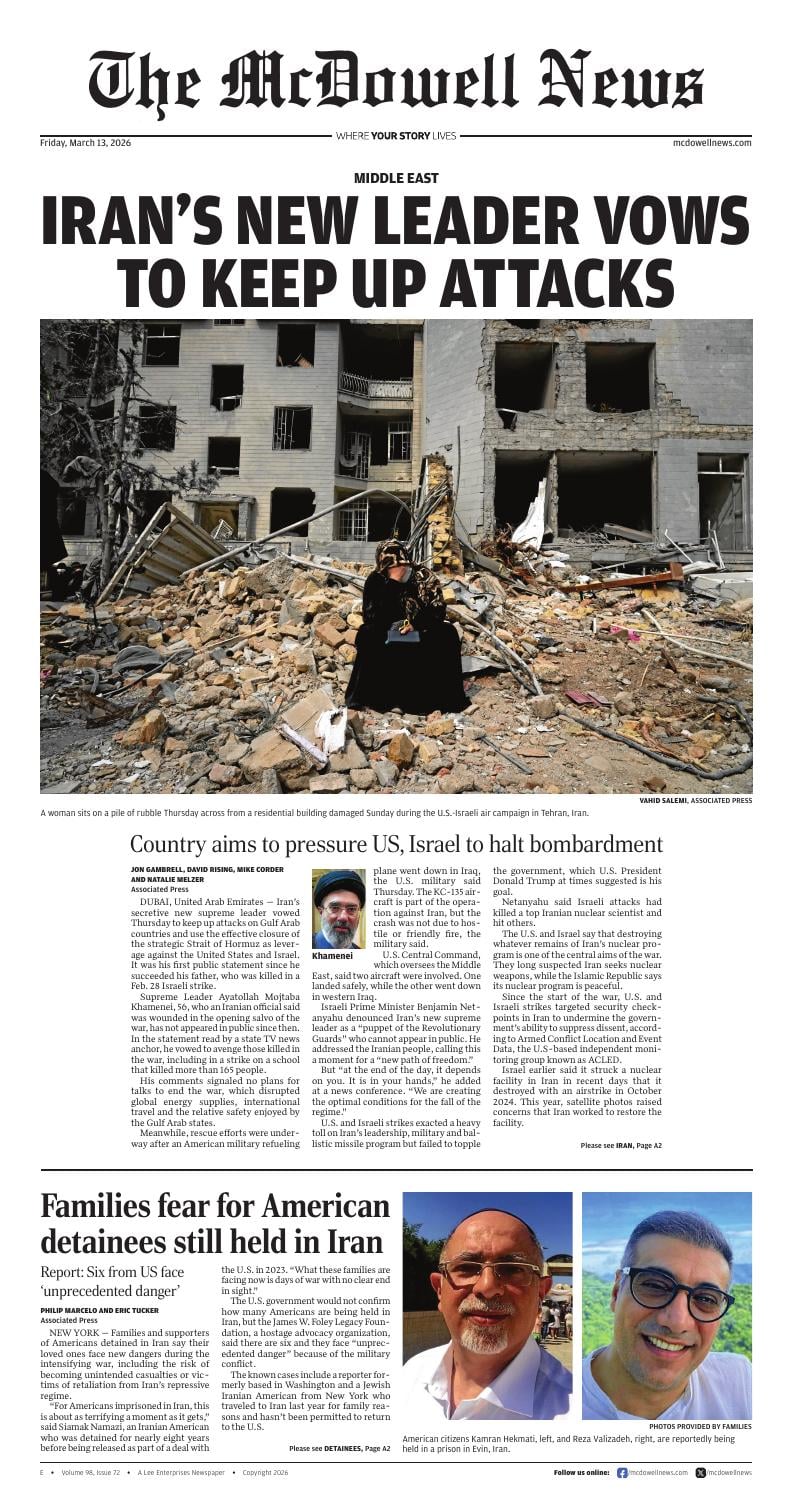
A woman sits on a pile of rubble Thursday across from a residential building damaged Sunday during the U.S.-Israeli air campaign in Tehran, Iran.
MIDDLE EAST
DUBAI, United Arab Emirates — Iran's secretive new supreme leader vowed Thursday to keep up attacks on Gulf Arab countries and use the effective closure of the strategic Strait of Hormuz as leverage against the United States and Israel. It was his first public statement since he succeeded his father, who was killed in a Feb. 28 Israeli strike.
Supreme Leader Ayatollah Mojtaba Khamenei, 56, who an Iranian official said was wounded in the opening salvo of the war, has not appeared in public since then. In the statement read by a state TV news anchor, he vowed to avenge those killed in the war, including in a strike on a school that killed more than 165 people.
His comments signaled no plans for talks to end the war, which disrupted global energy supplies, international travel and the relative safety enjoyed by the Gulf Arab states.
Meanwhile, rescue efforts were underway after an American military refueling plane went down in Iraq, the U.S. military said Thursday. The KC-135 aircraft is part of the operation against Iran, but the crash was not due to hostile or friendly fire, the military said.
U.S. Central Command, which oversees the Middle East, said two aircraft were involved. One landed safely, while the other went down in western Iraq.
Israeli Prime Minister Benjamin Netanyahu denounced Iran's new supreme leader as a "puppet of the Revolutionary Guards" who cannot appear in public. He addressed the Iranian people, calling this a moment for a "new path of freedom."
But "at the end of the day, it depends on you. It is in your hands," he added at a news conference. "We are creating the optimal conditions for the fall of the regime."
U.S. and Israeli strikes exacted a heavy toll on Iran's leadership, military and ballistic missile program but failed to topple the government, which U.S. President Donald Trump at times suggested is his goal.
Netanyahu said Israeli attacks had killed a top Iranian nuclear scientist and hit others.
The U.S. and Israel say that destroying whatever remains of Iran's nuclear program is one of the central aims of the war. They long suspected Iran seeks nuclear weapons, while the Islamic Republic says its nuclear program is peaceful.
Since the start of the war, U.S. and Israeli strikes targeted security checkpoints in Iran to undermine the government's ability to suppress dissent, according to Armed Conflict Location and Event Data, the U.S-based independent monitoring group known as ACLED.
Israel earlier said it struck a nuclear facility in Iran in recent days that it destroyed with an airstrike in October 2024. This year, satellite photos raised concerns that Iran worked to restore the facility.
As Netanyahu spoke, the Israeli military said it detected a new barrage of missiles launched from Iran toward Israel.
Iran is trying to inflict enough global economic pain to pressure the U.S. and Israel to halt their bombardment, which began Feb. 28.
Trump promised to "finish the job," though he claimed Iran is "virtually destroyed." He said in a social media post Thursday that ensuring Iran does not develop a nuclear weapon was a higher priority than soaring oil prices.
The U.S. military said Thursday that American forces now struck more than 6,000 targets since the operation against Iran began including more than 30 minelaying vessels.
Meanwhile, Iran-backed Hezbollah militants launched about 200 rockets from Lebanon at northern Israel while sirens rang out and loud booms from the interception of Iranian missiles could be heard in other areas. Israel launched another wave of attacks on Tehran and in Lebanon.
The U.N. refugee agency said up to 3.2 million people in Iran were displaced by the ongoing war. It said most fled from Tehran and other major cities toward the north of the country or rural areas. About 800,000 people were internally displaced in Lebanon, prompting fears of a humanitarian crisis.
Khamenei called on Gulf Arabs to "shut down" U.S. bases in the region, saying protection promised by Washington was "nothing more than a lie."
He also said Iran studied "opening other fronts in which the enemy has little experience and would be highly vulnerable" if the war continues. He did not elaborate, but Iran was linked to previous attacks on U.S., Israeli and Jewish targets around the world.
Khamenei is close to Iran's paramilitary Revolutionary Guard and is widely seen as even less compromising than his father, Ayatollah Ali Khamenei. His location is unknown, and he is likely a prime target for the U.S. and Israel.
In addition to attacking energy infrastructure across the region, Iran effectively closed the Strait of Hormuz, the waterway leading from the Persian Gulf toward the Indian Ocean through which a fifth of the world's traded oil flows.
At a news conference Thursday, Iran's ambassador to Tunisia, Mir Masoud Hosseinian, said Iranian naval forces "established full control" over the strait and "carried out precise strikes in response to attacks on our oil infrastructure."
"Global energy security is contingent on respect for Iran's sovereignty," he said.
He said the new supreme leader was wounded in the attack on his family's home that killed his wife and father, but "it is not serious."
Israeli warplanes pummeled Lebanon in response to missiles from Iran-backed Hezbollah fighters launched into Israel. One strike hit in a neighborhood close to Lebanon's parliament, U.N. offices and international embassies.
Israeli military spokesperson Avichay Adraee said they targeted a "facility affiliated with Hezbollah."
An Israeli strike also hit near Lebanon's only public university, killing a professor and the director of the science faculty at the campus in Hadath, on the outskirts of Beirut's southern suburbs. There was no immediate comment from Israel.
Israeli Defense Minister Israel Katz warned Lebanon that if its government does not prevent Hezbollah from attacking, Israel "will take the territory and do it ourselves."
British officials said several U.S. personnel were injured Wednesday night in drone strikes in northern Iraq. Drone strikes also were reported in Bahrain, Kuwait, Dubai and Saudi Arabia.