

Pentagon, tech industry at odds
Both sides wary of the other's trustworthiness

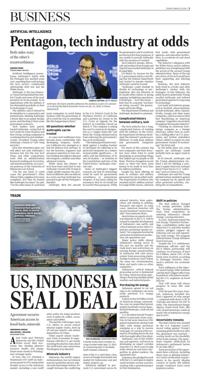
Anthropic CEO Dario Amodei addresses the audience as part of a session on AI during the World economic Forum on Jan. 23, 2025, in Davos, Switzerland.
ARTIFICIAL INTELLIGENCE
Artificial intelligence powerhouse Anthropic's battle with the Pentagon has sparked some soul-searching that could reshape the tech sector's complicated relationship with war and the White House.
Anthropic is the San Francisco-based startup behind the chatbot Claude and some of the most powerful AI on the market. In its negotiations with the military, it has demanded guardrails on how its technology is used.
The military said it refused to be beholden to a corporation and pushed back, labeling Anthropic a threat akin to an enemy foreign power and blocking it from some government contracts.
Tech leaders have quietly backed Anthropic, saying that AI isn't ready for some weapons and that strong-arming companies is counterproductive and antidemocratic. President Trump called Anthropic a bunch of "left-wing nut jobs."
How this showdown plays out will affect not only Anthropic's business but also the way tech titans and other corporations work with an administration known for lashing out at resisters, said Alan Rozenshtein, an associate professor at the University of Minnesota Law School.
"On the one hand, it could cause the government's other Silicon Valley suppliers to be more compliant, lest they be treated like Anthropic has been," he said. "On the other hand, it could lead more companies to avoid doing business with the government at all to avoid the risk of something like this happening to them."
US questions whether Anthrophic can be trusted
As some tech trailblazers have become more comfortable with developing weapons, Southern California has emerged as a hub for defense tech startups. It has the factories, engineers and aerospace expertise to turn venture funding and military demand into weapons, satellites and other advanced systems.
While many key players in tech have been reluctant to join Anthropic's brawl with Trump in a high-profile manner, the positions on different sides are laid out in a court case that Anthropic has pursued to get off the Pentagon's blacklist.
Anthropic filed the lawsuit in the U.S. District Court in the Northern District of California and a petition for review in the U.S. Court of Appeals for the District of Columbia Circuit on March 9. The company is asking the court to overturn its designation as a "supply chain risk" and block the Trump administration from enforcing the government's ban on its technology.
"The federal government retaliated against a leading frontier AI developer for adhering to its protected viewpoint on a subject of great public significance — AI safety and the limitations of its own AI models — in violation of the Constitution and laws of the United States," Anthropic's lawsuit said.
Some of Anthropic's biggest concerns are that its technology could be used for government surveillance or autonomous weapons. It has been asking for assurances that its AI would not be used for these purposes. While the government said it would not use the tech for those purposes, it was unable to provide Anthropic with the assurance it wanted.
Tech industry groups, Microsoft and workers from Google and OpenAI have backed Anthropic in its legal fight.
On March 16, lawyers for the U.S. government said in a court filing that the Defense Department had started to wonder whether Anthropic could be trusted.
"Anthropic could attempt to disable its technology or preemptively alter the behavior of its model either before or during ongoing warfighting operations, if Anthropic — in its discretion — feels that its corporate 'red lines' are being crossed," the government said in the filing.
The Department of Defense and Anthropic declined to comment.
Complicated history between military, tech
The tech industry has a long, complicated history of working with the military. In the 1960s, the Department of Defense developed the internet's predecessor, ARPAnet, to help keep military and government computers secure.
For much of this century, big tech companies and their investors have often tried to avoid developing or promoting things that helped spy on people or kill them. That has changed in recent years as there has been more money to be made in tech fixes for military problems.
Google has been offering AI tools to civilians and military personnel for unclassified work. The Department of Defense also awarded a $200-million contract to Google Public Sector, a division that works with government agencies and education institutions, to accelerate AI and cloud capabilities.
The industry's allegiance with the White House and its military ambitions was strengthened with the arrival of the second Trump administration. Many of the top executives of the tech world have been supporting and advising Trump.
However, the tech industry finds itself in a tricky spot after Anthropic's clashes with the Pentagon. In late February, the public feud escalated after Trump assailed Anthropic and ordered government agencies to stop using its technology.
Last week, tech industry groups such as TechNet, whose members include Anthropic, Meta, OpenAI, Nvidia, Google and other major companies, said in an amicus brief that blacklisting an American company "engenders uncertainty throughout the broader industry."
"Treating an American technology company as a foreign adversary, rather than an asset, has a chilling effect on U.S. innovation and further emboldens China's efforts to export its own government-backed AI technology," the brief said.
As the battle plays out, some experts say Anthropic would probably have an upper hand in court.
In its lawsuit, Anthropic said the Trump administration violated a law for labeling a company a supply chain risk, noting it doesn't have ties to a U.S. "adversary," such as China or Iran.
Anthropic also said the Trump administration retaliated against the company for its speech and other protected activities, violating the 1st Amendment.