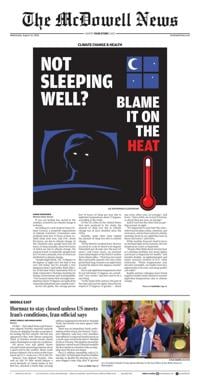

Not sleeping well? Blame it on the heat, scientists say
If you are feeling less rested in the summer, scientists say climate change is to blame.
According to a new analysis from Climate Central, a nonprofit organization of climate scientists, Greensboro area residents have lost 37 hours of heat-related sleep each year, and 13%, about five hours, are due to climate change. In the Charlotte area, people have lost 40 hours of sleep annually, about five hours of which are due to climate change, the analysis found. In Asheville, people have lost 30 hours annually, four of which are attributed to climate change.
“People might think, ‘Oh, 75 degrees or 80 degrees at night isn’t too bad; it was over 100 today,’ but it’s actually a very dangerous time,” said Ashley Ward, director of the Heat Policy Innovation Hub at Duke University’s Nicholas Institute for Energy, Environment and Sustainability. “Our research shows that overnight temperatures above 75 degrees can really drive vulnerable individuals into a health crisis.”
Across the globe, the average person lost 56 hours of sleep per year due to nighttime temperatures above 77 degrees, according to the study.
Of the 253 cities in the United States that were analyzed in the study, the amount of sleep loss due to climate change has at least doubled since the 1970s.
Globally, some cities have tripled the amount of sleep loss due to climate change.
“At the (North Carolina) level, that has occurred at a rate of about 0.06 degrees Fahrenheit per decade over the past 60 years,” said Corey Davis, an assistant state climatologist at the North Carolina State climate office. “That may not sound like a noticeable amount, but over a time period that long, it means our nights have warmed by almost four degrees overall,” he said.
Davis said nighttime temperatures that do not fall below 75 degrees are considered “very warm,” and that used to be a rare thing.
“In the entire 20th century, this part of the state only had 49 nights when the low stayed at 75 degrees or greater — about one every other year, on average,” said Davis. “Since 2000, we’ve had 75 in total, or about three per year, on average.”
And it's just not the cities that are getting warmer at night.
“It’s important to note that this statewide trend includes urban, suburban, and rural areas, and we have noticed a similar warming trend in our nighttime lows in these rural areas,” said Davis.
While weather forecasts tend to focus on daytime highs in the summer, the low temperature is just as important.
“People often think about extreme heat as a daytime problem, but warm nights can be just as important for health,” said Jennifer Runkle, an epidemiologist and senior research scientist at N.C. State University. “When temperatures stay elevated overnight, our bodies have less opportunity to recover, and sleep quality can suffer."
Runkle and her colleagues have found negative health trends related to warmer nighttime temperatures due to climate change.
“A growing body of research suggests that chronic sleep disruption due to warmer nights can have downstream effects on mental health, including increased stress, anxiety, depression and suicide risk,” said Runkle.
Air conditioning can help protect people from hot nights, but access to cooling is often tied to income, and some groups are more susceptible, the study noted. The effect of warmer nighttime temperatures can more than double for someone over the age of 65, for women, and people already living in hotter climates.
“If you’re a person who works in a high-heat exposure job and come home counting on being able to cool yourself at night, you need that recovery from daytime exposure,” said Ward. “If you don’t have adequate air conditioning or can’t afford to run it, you can’t rely on opening windows or enjoying a cool breeze to lower your body temperature or cool your home.”
“I like to say that plants, people, and pets all rely on a period of cooler weather at night so they can rest and recover,” said Davis.
Ginger Bumgarner covers climate change and the environment in the Triad and Northwest North Carolina. Her work is funded by a grant from the Z. Smith Reynolds Foundation and Journalism Funding Partners.