
STEIN VETOES HOMELESS BAN BILL
NC House bill would restrict public encampments, expand drug penalties
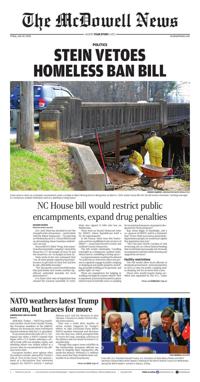
Crews work to clean up a homeless encampment under a bridge on West Fleming Drive in Morganton on March 1, 2023. Under House Bill 437, the bill would criminalize "residing overnight in a temporary outdoor habitation used as a dwelling or living space."
POLITICS
Gov. Josh Stein has decided to test the strength of his veto powers — particularly with his fellow Democrats — by rejecting on Wednesday an N.C. House bill focused on determining where homeless individuals can stay.
House Bill 437, titled "Drug-free zones/ Unauthorized public camping," cleared the House by a 73-40 margin on June 30 and the Senate by a 26-16 margin on June 24.
Stein wrote in his veto statement that "we all want people experiencing homelessness to get back on their feet and live in safe, affordable housing."
"Yet, this poorly constructed bill makes that goal harder and creates another significant unfunded mandate for local governments."
It is Stein's first veto of legislation that cleared the General Assembly in 2026. Stein also signed 12 bills into law on Wednesday.
There were no Senate Democrat votes for HB437, where Republicans hold a 30-20 supermajority.
In the House, there were five Democrats and two unaffiliated votes in favor of HB437 — none from Forsyth County and Guilford County Democrats.
The bill would criminalize "residing overnight in a temporary outdoor habitation used as a dwelling or living space."
Local governments would not be allowed "to authorize or otherwise allow any person to regularly engage in public camping or sleeping on any public property, including any public building or its grounds, and public right-of-way."
There are exemptions for lodging or residing overnight in a motor vehicle "that is registered, insured and located in a place where it may be lawfully used, or camping for recreational purposes on property designated for those purposes."
Rep. Brian Biggs, R-Randolph, and a co-sponsor of HB437, said in a statement that "if Gov. Stein was serious about helping homeless people, he would have signed this legislation into law."
"His veto puts North Carolina at risk of missing out on critical federal funding that would help move people out of unsafe encampments and into stable housing and supportive services."
Facility restrictions
The bill would allow local officials to designate government-owned properties to serve as sites for public camping and/ or sleeping, but for no more than a year.
Those sites would require being certified and regulated by the N.C. Labor Department. The department would be required to have set the requirements by June 30, 2027.
However, HB437 provides no dedicated state funding to support these new obligations.
Those local government entities would be responsible for:
• Ensuring the safety and security of the designated property and the persons lodging or residing there;
• Maintaining sanitation, including providing access to clean and operable restrooms and running water;
• Coordinating with the appropriate department, agency or entity to provide access to behavioral health services, which must include substance abuse and mental health treatment resources; and
• Prohibiting illegal substance use and alcohol use on the designated property.
Government entities would be required to provide documentation to the department that: there are not sufficient open beds in local homeless shelters; the property is not located in areas zoned for residential use; the property would not "adversely and materially affect the property value or safety and security of other existing residential or commercial property; and not negatively affect the safety of children."
The bill would allow any local resident or business owner to bring a civil action against a local government for potential violations of the law.
If a complaint is received by the local government, it would have 15 business days to "cure the alleged violation."
Exemptions to filing a complaint would include a state of emergency declared by the governor or local government.
Drugs and homelessness
The bill adds felony charges to anyone who commits an offense involving illegal drugs inside public sites that would be established as drug-free homeless service zones.
That includes an operator of a facility-based service "who intentionally allows a person to commit an offense" in a drug-free homeless service zone.
Those charges would go into effect on Dec. 1.
There has been concern expressed by advocates opposed to HB437 that churches, nonprofits and agencies could be subject to criminal penalties for drug offenses committed by individuals, or sued for affecting property values.
Stein wrote that HB437 "fundamentally misunderstands how people suffering from addiction get healthy."
"If government threatens criminal liability against those who seek treatment, and against the people, organizations and churches trying to help them, government stands in the way of services that promote health and safety, and people's problems are actually made worse," Stein wrote.
"I have long called for funding to crack down on drug trafficking, invest in behavioral health, and expand affordable housing options — because homelessness and substance misuse are real problems that deserve real solutions, not this bill."
Will the veto stand?
With the 2025-27 state budget bill signed into law Tuesday by Stein, the next time the legislature is scheduled to meet is July 27 for a special session with no end date indicated.
Most special sessions include, among permitted legislative actions, a potential veto override vote.
Of Stein's 15 vetoes during the 2025 sessions, all but three have been overridden, including one on June 3, 2026, and four on June 24, 2026.
The 2026 veto override votes had the support of at least one House Democrat and/or former House Democrat now unaffiliated.
"The governor waited a day after signing the state budget, suggesting that he didn't want to detract from the positive bipartisan message of that action," said Mitch Kokai, a senior policy analyst with conservative think tank John Locke Foundation.
"Then he buried his House Bill 437 veto message in a news release that offered positive comments about seven other bills he signed at the same time.
"This suggests to me that the governor and his advisers were going out of their way to de-emphasize his opposition to House Bill 437."
Kokai said that, considering that at least one House Democrat and both unaffiliated House members voted for HB437, "they are not likely to be persuaded by the governor's veto to change course."
"It's likely that the House will vote to override the veto the next time enough members gather in Raleigh to meet the three-fifths threshold. It will be one more item of business to address as they try to wrap up their work for the year."
Homeless coalitions' response
A coalition of homeless services providers, elected leaders, municipalities, ministers of faith, advocates, business owners and other stakeholders praised Stein's veto on Wednesday.
"Communities need practical solutions that address homelessness through housing, treatment and support services, not mandates that shift costs and liabilities onto local taxpayers and organizations," said Stephanie Watkins-Cruz, director of Housing Policy for N.C. Housing Coalition.
Liz Carbone, who leads advocacy efforts for N.C. Coalition to End Homelessness, said HB437 "creates additional barriers to employment, safety and housing while placing further strain on already understaffed law enforcement agencies, emergency responders, service providers, and taxpayers. "
"This legislation harms North Carolinians while delivering no real or substantive funding or policy solutions that have proven successful anywhere in the United States."
The coalition said their concern is that the impact from HB437 could be "particularly acute in rural North Carolina, where many communities lack the infrastructure and resources necessary to comply with the bill's requirements."
"Twenty-six of the 79 counties served by the North Carolina Balance of State Continuum of Care do not currently have a qualifying emergency shelter.
"For many local governments, the requirements contemplated in HB437 would necessitate entirely new facilities, staffing structures, and service systems."
The coalition said service providers, faith communities and local agencies to homeless individuals "should be encouraged to engage individuals experiencing homelessness, not exposed to additional legal risks for circumstances beyond their control."
"Likewise, criminal penalties associated with sleeping or camping when no viable alternatives exist risk increasing interactions with the criminal legal system without addressing the underlying causes of homelessness."
rcraver@wsjournal.com 336-727-7376 @rcraverWSJ