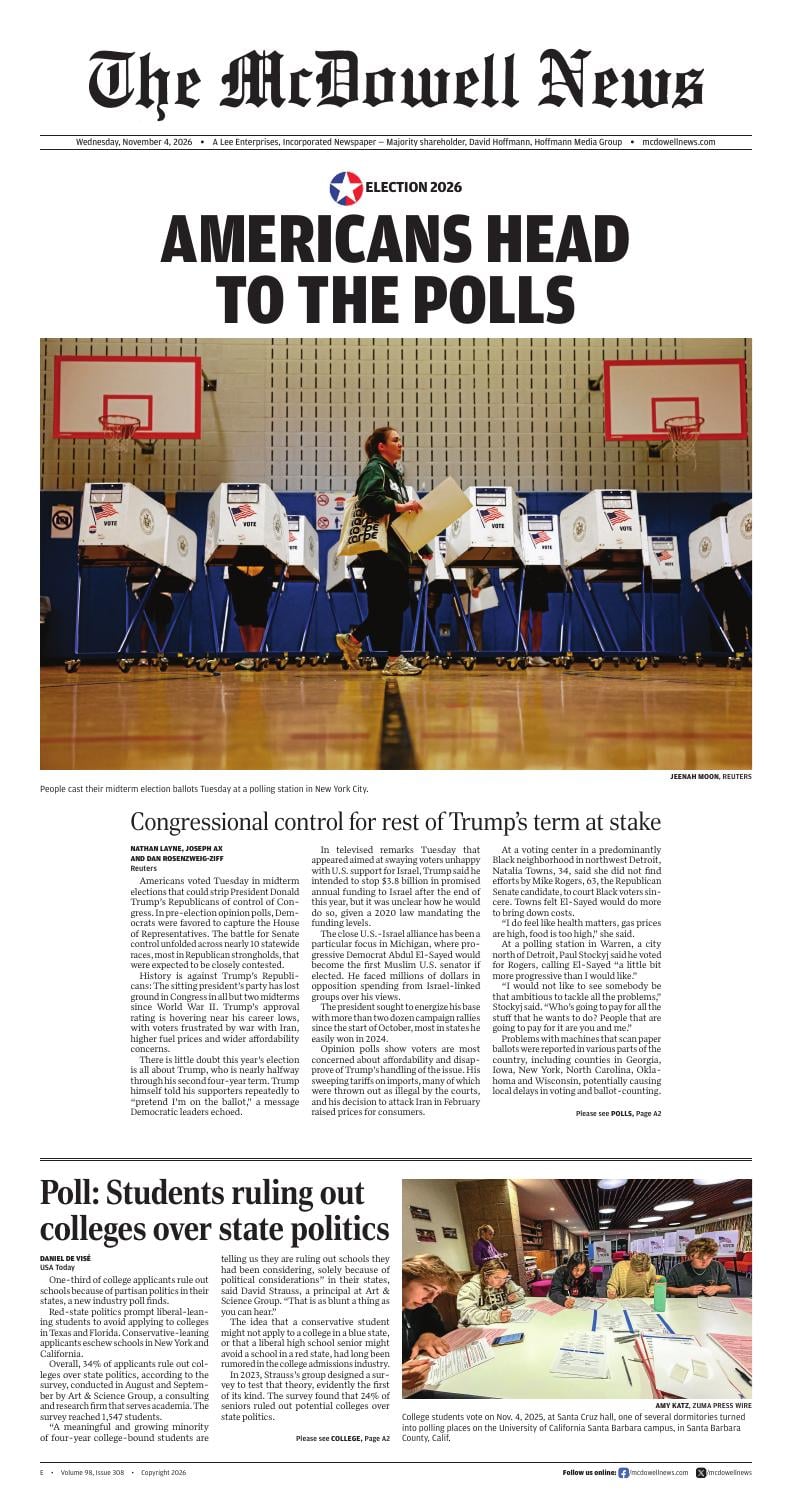


AMERICANS HEAD TO THE POLLS
Congressional control for rest of Trump's term at stake
ELECTION 2026
Americans voted Tuesday in midterm elections that could strip President Donald Trump's Republicans of control of Congress. In pre-election opinion polls, Democrats were favored to capture the House of Representatives. The battle for Senate control unfolded across nearly 10 statewide races, most in Republican strongholds, that were expected to be closely contested.
History is against Trump's Republicans: The sitting president's party has lost ground in Congress in all but two midterms since World War II. Trump's approval rating is hovering near his career lows, with voters frustrated by war with Iran, higher fuel prices and wider affordability concerns.
There is little doubt this year's election is all about Trump, who is nearly halfway through his second four-year term. Trump himself told his supporters repeatedly to "pretend I'm on the ballot," a message Democratic leaders echoed.
In televised remarks Tuesday that appeared aimed at swaying voters unhappy with U.S. support for Israel, Trump said he intended to stop $3.8 billion in promised annual funding to Israel after the end of this year, but it was unclear how he would do so, given a 2020 law mandating the funding levels.
The close U.S.-Israel alliance has been a particular focus in Michigan, where progressive Democrat Abdul El-Sayed would become the first Muslim U.S. senator if elected. He faced millions of dollars in opposition spending from Israel-linked groups over his views.
The president sought to energize his base with more than two dozen campaign rallies since the start of October, most in states he easily won in 2024.
Opinion polls show voters are most concerned about affordability and disapprove of Trump's handling of the issue. His sweeping tariffs on imports, many of which were thrown out as illegal by the courts, and his decision to attack Iran in February raised prices for consumers.
At a voting center in a predominantly Black neighborhood in northwest Detroit, Natalia Towns, 34, said she did not find efforts by Mike Rogers, 63, the Republican Senate candidate, to court Black voters sincere. Towns felt El-Sayed would do more to bring down costs.
"I do feel like health matters, gas prices are high, food is too high," she said.
At a polling station in Warren, a city north of Detroit, Paul Stockyj said he voted for Rogers, calling El-Sayed "a little bit more progressive than I would like."
"I would not like to see somebody be that ambitious to tackle all the problems," Stockyj said. "Who's going to pay for all the stuff that he wants to do? People that are going to pay for it are you and me."
Problems with machines that scan paper ballots were reported in various parts of the country, including counties in Georgia, Iowa, New York, North Carolina, Oklahoma and Wisconsin, potentially causing local delays in voting and ballot-counting.
Isolated voting machine malfunctions are not unusual for U.S. elections, but election experts say that backup systems, including old-fashioned counting by hand, and other safeguards mean these rarely affect results.
The U.S. Department of Justice said Tuesday it was deploying 1,000 election monitors and observers to all 50 states in what it called the largest Election Day monitoring effort in history.
Democrats have criticized the plan as potential voter intimidation. In roughly two-thirds of the jurisdictions DOJ targeted, voters supported Democrat Kamala Harris over Trump in the 2024 presidential election, a Reuters analysis found.
All 435 seats in the House of Representatives are up for election, along with 35 of the Senate's 100 seats, though most contests are not considered competitive. Democrats must flip at least three House seats and four Senate seats to win a majority in each chamber.
Democrats have little margin for error in the Senate. The party must defend all of its current seats while winning at least two states that voted for Trump by a double-digit margin two years ago: Alaska, Iowa, Kansas, Nebraska, Ohio, South Carolina and Texas. Opinion polls showed Democrats either narrowly leading or within striking distance in all of those states.
The Alaska Senate race was recently thrown into turmoil after the New York Times reported that the campaign of Democratic candidate Mary Peltola, 53, helped recruit a third candidate to run as an independent who shares the first and last name of her Republican opponent, Dan Sullivan, 61.
Peltola denied involvement. Trump's DOJ launched a criminal probe into the allegations and filed a lawsuit to block certification of the election results, though a judge dismissed the latter effort. The Justice Department is notifying more than 20 people they are subjects of the criminal probe, according to a person familiar with the investigation who spoke on the condition of anonymity to talk about the investigation.
Since the Times story, Trump has repeatedly complained that many Americans do not know what "incumbent" means. But supporters of the incumbent Sullivan told Reuters they were familiar with the word, and they were not confused by the two Dan Sullivans on their ballot.
"They make it pretty obvious; it says 'incumbent' after his name," said Jake Wesley, 27, who grew up in Anchorage and is now stationed there in the U.S. Air Force.
In Texas, Democratic Senate candidate James Talarico, 37, has his party once again dreaming of winning the biggest Republican-favoring state after decades of heartbreak. His scan dal-plagued opponent, Republi can Attorney General Ken Paxton, 63, has benefited from hundreds of millions donated on his behalf by Elon Musk. There are 47 House races widely seen as competitive, according to a Reuters analysis of the leading election forecasters. If the other contests all proceed as predicted, Democrats would need to win 13 of those races to secure a majority.