

'REJOICING INSIDE'
Woolworth's busboy remembers witnessing Greensboro sit-ins
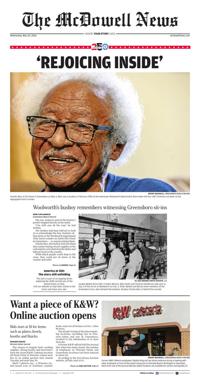
Charles Bess at his home in Greensboro on May 6. Bess was a busboy in February 1960 at the downtown Woolworth Department Store when the four A&T freshmen sat down at the segregated lunch counter.
Joseph McNeil (from left), Franklin McCain, Billy Smith and Clarence Henderson take part in Day 2 of the sit-ins at Woolworth on Feb. 2, 1960. McNeil and McCain were members of the Greensboro Four, who initiated the protests. Busboy Charles Bess is behind the counter.
Charles Bess has a wall of awards and recognitions at his home in Greensboro.
Charles Bess at his home in Greensboro.
The one-sentence note in the busboy's pocket weighed heavily on his mind.
"I'm with you all the way," he had written.
The workers had been told not to look at or acknowledge the four students sitting down at the Woolworth Department Store lunch counter on South Elm Street in Greensboro — or anyone joining them.
Charles Bess, the busboy, had seen them days earlier buying school supplies at the cash register as he picked up the dishes and leftover food on the counter.
While Black people could shop in the store, they could not sit down at the counter and order.
America at 250: The story still unfolding
This story is part of an ongoing series exploring the 250th anniversary of the United States in 2026.
Visit our website to read other stories in the series and share your own.
But on Feb. 1, 1960, Bess saw them actually take a seat, and he heard the white waitress tell them they didn't serve "colored people."
Other Black people had sat down before at that very same counter, but they left when told they wouldn't be served.
This time, the four students stayed until closing.
Bess had intended to slip his note of encouragement to the men, but he never got a chance. His boss later saw the note and confronted him about it.
Now 89, Bess is believed to be the last surviving Woolworth's worker from that time. He remembers what it was like to observe history in the making.
The Greensboro Four
The four men returned to Wool-worth's the next day.
And the crowd with them grew.
So much has been made of the four N.C. A&T freshmen — the late Joseph McNeil, the late Franklin McCain, the late David Richmond and Jibreel Khazan (formerly Ezell Blair Jr.). They altered history in not only Greensboro but the South by shoving Jim Crow law into the public consciousness.
McNeil was the Socratesand Langston Hughes-quoting quiet guy from Wilmington.
Richmond was the Dudley High School long-jumper and math whiz.
Khazan, a Dudley classmate and Boy Scout, had a flair for the dramatic.
McCain was the lanky one who'd arrived from Washington seemingly with nerves of steel.
At McCain's funeral in 2014, the late Rev. Jessie Jackson said that most people adjusted to their place on the back of the bus or at the back door of the restaurant. But in 1960 at the Woolworth's, the four freshmen decided they should be treated like everybody else.
So, in a room in A&T's Scott Hall the night before the sit-in, they laid out their plan. They had seen the police dogs and billy clubs on TV, and they knew that anything could happen.
The Rev. Martin Luther King would later say the young men's bold move reinvigorated the Civil Rights Movement.
Within two weeks of the start of the Greensboro protests, Black high school and college students in most of the state's major cities — Winston-Salem, Durham, Charlotte, Raleigh and High Point — began staging sit-ins of their own.
Today, the story of the Greensboro Four lives on, whether in the Hollywood portrayal of a character in "The Butler" who travels to Greensboro to join the lunch counter protest, or the Smithsonian's National Museum of American History, which houses a portion of the Woolworth's lunch counter and stools.
The International Civil Rights Center and Museum made its home in the old dime-store building, opening to the public on Feb. 1, 2010, the 50th anniversary of the sit-in.
Former President Barack Obama — at the request of the News & Record at the museum's opening in 2010 — wrote of what happened at the counter as part of a movement that would "forever change America."
'Keep on talking, brother'
Charles Bess moved to Greensboro from King's Mountain in 1957 and was staying with his sister and her husband. When the sit-in happened, he'd been on the job at Woolworth's for about a year.
The iconic photo of four of the students at the lunch counter was snapped on Day 2 of the sit-ins, with Billy Smith and Clarence Henderson rotating into Richmond and Khazan's seats.
There's Bess in the background, wearing his white uniform.
"A young man making history and didn't even know it," quipped Bess, who was 23 at the time.
Black people at Woolworth's served as cooks and busboys. They went to work every day, Bess said, believing that having a segregated lunch counter was wrong.
"I was glad to see them sitting there," Bess said of the A&T students. "I was rejoicing inside."
Instead of taking the bus home that day, he took a cab.
"I don't know why," Bess said. "I said to the driver, 'Don't you know four guys sat down at the counter today?' He said, 'What?' He said, 'Keep on talking, brother. I like how you're talking.'"
Bess remembers telling everyone he crossed paths with, including his sister and brother-in-law. "I wanted to spread the news," he said.
He wrote the note and tucked it into his work clothes: "I'm with you all the way."
He worried that if he tried to slip it to one of the four students, someone might see. Someone was always watching them.
So, he buried the note deep in his pocket. He forgot about it when the day was over, and he tossed his uniform in the bin to be picked up by a laundry service. When the employee with the service went through the pockets to make sure they were empty, he found the note and handed it to Bess's boss, Rachel Holt.
Bess says the work at Woolworth's was hard, and he was paid about $1 an hour and took home about $30 a week. While many other workers would quit after a short time, he was reliable and did his job without complaint.
He suspects that was on his boss's mind when she confronted him about the note.
"She said, 'I see the note that you've written," he said.
He was too nervous to say anything.
And then she walked away, never to speak of it again.
Some people will say he should have handed the note to the Greensboro Four. Given them a nod, maybe. Shown his support in some way.
Bess said he's at peace about how he handled it.
Many Black people back then had the same question: How involved do I get? Speaking out could mean losing their jobs or suddenly finding they could no longer borrow money.
That's the reason so many Black preachers stood at the front of the movement. Preachers were insulated because they were financially supported by the Black community.
For the workers, it was easy to become numb to segregation. At Woolworth's, the Black employees ate in a tiny upstairs break room while the White employees dined at the counter.
"We had gotten so accustomed to it," Bess said.
'Start serving the colored folks'
The sit-ins forced Bess and the other Black workers to confront the painful issue that followed them to the back of the bus and shadowed them every time they drank from a "colored only" water fountain.
Now they were putting their fate in the hands of the four A&T freshmen.
As the days wore on, the lunch counter was so packed with students that the Elm Street Woolworth's, a leader for the company in sales, suddenly wasn't making much money. Bess saw it for himself.
That July, he and the other Black workers were told to bring their Sunday best clothes to work the next day.
"Ms. Holt said, 'We are going to start serving the colored folks,'" Bess said.
The company had decided to give in to the demands of the students.
And the store manager decided that if the store was going to serve Black people, then their Black employees should be first.
So, Bess, Geneva Tisdale, Susie Morrison and Anetha Jones slipped into their Sunday clothes at lunchtime and sat down at the counter. The waitress took their order and they ate. Those around them watched, but the store wasn't busy. After they ate, they went back to work.
Bess said that he later crossed paths with Richmond, the only one of them to stay behind in Greensboro, where it was tough for him to find work after being labeled a troublemaker.
Bess stayed on at Woolworth's another year. Then he worked in a packing plant and later a foundry. He married his sweetheart and raised a family in the city.
By the time he left Woolworth's, Black women were working there as waitresses.
In 2010, the International Civil Rights Museum gave Bess a "Participants Award" at its grand opening. Every year, he attends the wreath-laying at A&T in honor of the four former students.
"Even after the sit-ins, I had no idea it would go this far," Bess said.
"I had no idea I'd still be talking about it."
Nancy.McLaughlin@greensboro.com 336-373-7049 @nmclaughlinnR