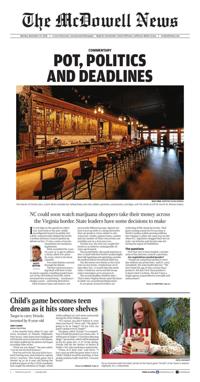

POT, POLITICS AND DEADLINES
NC could soon watch marijuana shoppers take their money across the Virginia border. State leaders have some decisions to make

The interior of Chronic Guru, a farm-direct cannabis bar selling flower, pre-olls, edibles, gummies, concentrates, cartridges, and THC drinks at 279 W. Fourth St, Winston-Salem.

SCOTT SEXTON
COMMENTARY
It's not high on the agenda for either Gov. Josh Stein or the next, wildly reconfigured General Assembly, but a little-noticed entity dubbed the North Carolina Advisory Council sparked up debate on Nov. 17 over a series of recommendations for marijuana legalization.
Stein assembled the council a year or so ago to address a sticky, albeit low-priority, issue: what to do about cannabis.
Two main themes coursed through the debate.
The first (and most pressing) dealt with how to rein in and/or regulate a budding market born out of the 2018 federal Farm Bill, which loosened laws around hemp – marijuana's benign cousin – and hemp derivatives.
Slick business types and stoners, not necessarily different groups, figured out how to jazz up Delta 9, a hemp derivative that can produce a buzz similar to old-school pot. Drinks, gummy bears, cookies and any number of other concoctions are available now in a store near you.
Trouble was, the state was caught flatfooted as an industry unimaginable 20 years ago boomed.
The second theme, discussed seriously on Nov. 17, dealt with how North Carolina might deal with legalizing and regulating cannabis for medical and/or recreational adult use.
The discussion was timely as the clock ticks on two fronts. A federal law set to take effect Dec. 11 would wipe the entire Delta-9 industry out in one fell swoop unless lawmakers act to preserve it.
The second deadline would be July 1. That's when Virginia throws open the doors to adult-use, recreational dispensaries.
As we speak, licensed retailers are stationing ATMs along the border. That giant sucking sound you'll soon hear is North Carolina wallets pouring millions into Virginia's coffers the same way we did when N.C. legislators dragged their feet on state-run lotteries and alcohol sales following the repeal of Prohibition.
The questions
Now that you've been briefed, consider some of the advisory council's questions.
Are regulations needed pronto?
"People are using these products every day without any protection," said Dr. Larry Greenblatt, the state health director. "We don't limit the age of who can buy these products. We don't test these products to know what's in them. We don't have a single agency responsible for oversight and enforcement."
More tellingly, consider this from Robeson County District Attorney Matt Scott, who said that if it were up to him, every intoxicating Delta-9 product would be banned.
That is not feasible, and he knows it. He's also aware of the economics and polling that consistently show good-sized majorities of North Carolinians back legalization.
"But the level of work to shut down all these doors, it's kind of like putting toothpaste back into the tube," Scott said.
What rules do we need for traditional cannabis and intoxicating derivatives?
No sales to anyone under 21, treat anyone caught driving under the influence of THC the same as a drunk driver and find reliable field sobriety tests to check.
And more importantly, regulate the intoxicating molecule of THC. A lab that tests and certifies products offered for sale makes the whole thing safer.
"If you just create a list of what's banned, creative people will come up with novel compounds that would potentially be legal," Greenblatt explained.
For context, consider the landscape of video poker parlors and machines. Once they were allowed, every time a game was banned, tweaks to the computer programs that run them were implemented.
An assistant city attorney in Winston-Salem, widely considered an expert in the field, once likened after-the-fact video-poker regulation to "playing Whac-A-Mole."
Does the state need a board to set guidelines for marijuana sales, much like ABC does for alcohol?
If the state legalizes adult-use cannabis, N.C. may need an organization similar to the Alcoholic Beverage Control system.
The ABC system, in case you haven't been in one lately, allows the state to tightly regulate use and tax all retail sales. It also operates under a Byzantine system that creates all sorts of unnecessary hurdles, regulations and expenses.
To wit, a small local distillery – Old Nick Williams in Lewisville, say – cannot sell its whiskey in an ABC store five miles away unless it's moved first through a centralized warehouse hours away.
If weed becomes legal, does N.C. limit the number of licenses and dispensaries?
"It wouldn't be as many as people wanted," Greenblatt said.
Duh. No one wants dispensaries on every street corner.
A smarter way would be to give locals a say in whether they want a dispensary. Other states do it that way, which means that tourist areas and cities in states such as Colorado tend to have the shops, while rural, more conservative counties do not.
Should the state regulate growing the devil's lettuce at home?
Other states, including Virginia, do, and that's proved to be difficult and expensive.
Law enforcement types on the council basically said, "Forget about it."
And Forrest Parker, CEO of Qualla Enterprises and Great Smoky Cannabis Company, said regulating home growers would be a nightmare.
"It's just not a good move," said Parker.
Of course he'd say that. Tons of legal marijuana is grown on the Cherokee reservation, and the dispensary the tribe operates is a cash cow.
The bottom line here is the bottom line.
What we're doing now – turning a blind eye – isn't working. Cops know it, elected officials know it, business people know it, and voters know it.
Talking through the permutations matters. Especially with clocks ticking.
Scott Sexton has been a bemused observer of daily life — and occasional thorn in the side of elected officials — in Winston-Salem since 2005. ssexton@wsjournal.com
336-727-7481 @scottsextonwsj